

Centralization: Power, Order, and the State
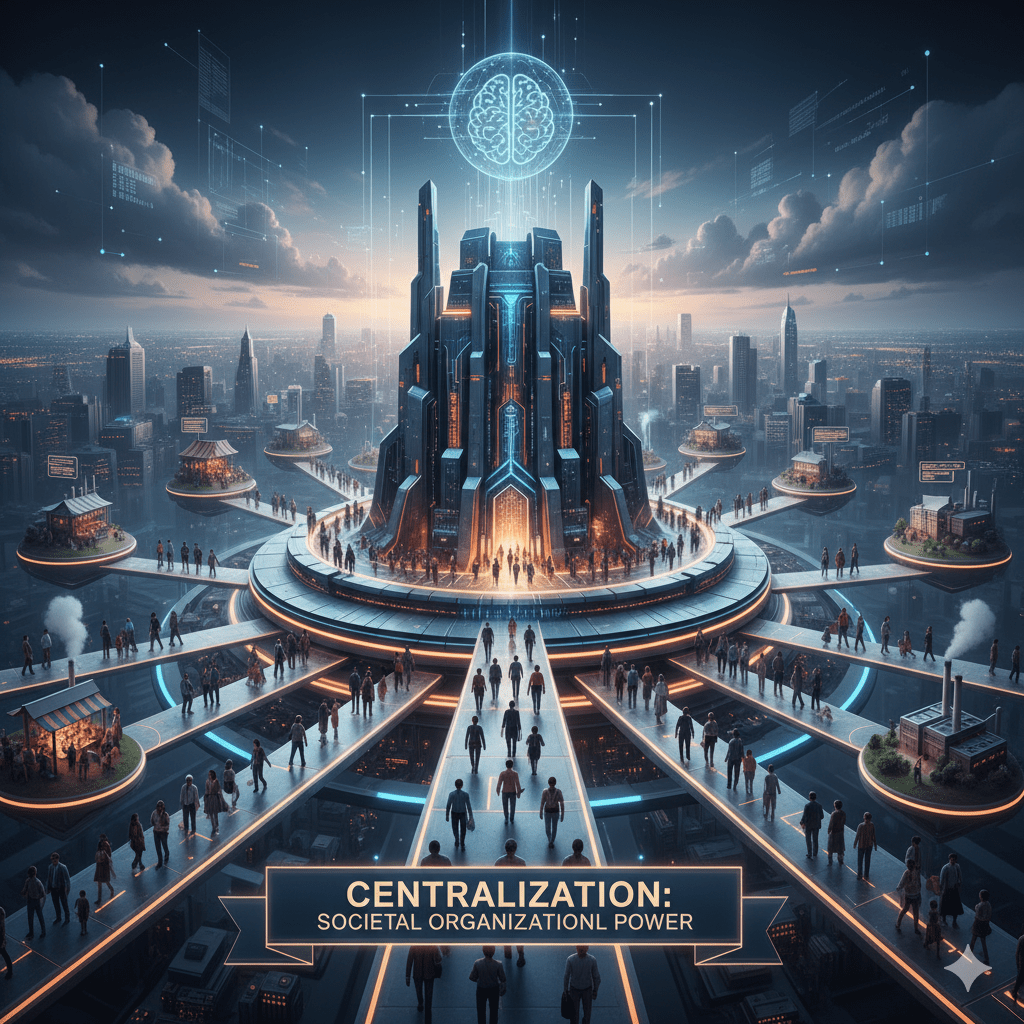
1. Definition: The Concentration of Authority
In the lexicon of political sociology and administrative theory, Centralization refers to the systematic process wherein decision-making authority and supervisory control are concentrated within a single focal point, specific group, or hierarchical peak. Traditionally associated with the Weberian analysis of Bureaucracy, centralization signifies a structure where top-tier officials retain the prerogative to define goals, allocate resources, and issue commands that trickle down through a rigid chain of command. This process ensures that the "head" of the organization or state maintains absolute oversight over its various "limbs," effectively minimizing local deviations and ensuring a uniform application of rules.
Max Weber viewed centralization as a fundamental characteristic of modern Legal-Rational Authority. For Weber, as societies move away from traditional and charismatic forms of power, they increasingly adopt centralized structures to achieve higher levels of efficiency and predictability. The definition extends beyond simple geography; it involves the monopolization of legitimate power. In a centralized system, lower-level units are viewed as administrative conduits rather than autonomous decision-makers, creating a social architecture defined by vertical integration and hierarchical accountability.
2. Concept & Intellectual Background
The conceptual roots of Centralization are deeply embedded in the historical rise of the Nation-State. During the transition from the fragmented feudal order of the Middle Ages to the early modern period, monarchs sought to break the power of local lords by consolidating tax collection, military command, and judicial oversight. This "Consolidation of Sovereignty" laid the groundwork for the modern administrative state. The background of centralization is, therefore, a story of modernity—the quest for a singular, coherent authority capable of managing large-scale territories and diverse populations through standardized laws.
In the 20th century, the concept migrated from politics to Corporate Governance. As industries expanded into global giants, the need for coordination across vast geographic areas favored centralized models. However, this intellectual history is also marked by a persistent tension between the benefits of macro-level stability and the costs of local disempowerment. While centralization facilitates rapid mobilization—essential in times of war or economic crisis—it often leads to atrophy of local participation. Understanding centralization requires viewing it as a dynamic social force that oscillates between the necessity of order and the democratic demand for subsidiarity.
3. Detailed Sociological Perspectives
A. Weberian Bureaucracy: Rationality and Its Discontents
For Max Weber, centralization was the engine of Bureaucratic Rationalization. He emphasized that a centralized hierarchy ensures that decisions are made based on objective rules rather than personal whims, fostering a "Calculable" environment. This structure ensures that information flows upward while orders flow downward with minimal friction. However, Weber was deeply ambivalent about this process. He warned that extreme centralization leads to the "Iron Cage" of rationality—a state where the individual becomes a "small cog" in a massive, unfeeling machine. The focus on procedural rigidity can stifle creativity, resulting in Alienation and a "trained incapacity" to respond to unique human needs.
B. Conflict Theory: Centralization as Ruling Class Control
From the perspective of Karl Marx and later Conflict Theorists, centralization is rarely about neutral efficiency. Instead, it is a tool utilized by the ruling class to maintain hegemony over resources and labor. Marx argued that the centralization of capital is an inherent tendency of capitalism, where power is consolidated in the hands of the few to facilitate the extraction of surplus value. In the political realm, a centralized state serves as the "executive committee" of the bourgeoisie, enabling them to suppress local resistances and standardize exploitation. Centralization, in this view, is a mechanism of social stratification that widens the gap between the decision-making elite and the dispossessed masses.
C. Decentralization Theories: The Ostrom Alternative
Challenging the "necessity" of centralization, Elinor Ostrom proposed a framework of Polycentricity and local governance. Ostrom argued that for managing Common-Pool Resources (like water bodies or forests), a centralized "top-down" approach often fails because it lacks the local knowledge and community trust required for sustainability. Her sociological perspective suggests that decentralized, community-led systems can be more responsive, equitable, and efficient in the long run. By empowering local stakeholders, societies can avoid the informational bottlenecks and regressive policy-making that often plague highly centralized administrative systems.
4. Indian Contextualization (Paper II Integration)
The Indian experience with Centralization is a complex narrative of a "Unitary Spirit in a Federal Body." Historically, the British Raj established a highly centralized administrative structure (the "Steel Frame") to maintain colonial order. Post-independence, the Indian Constitution maintained a strong center to ensure National Integration and prevent secessionist tendencies. This resulted in the "Strong Center" model where the Union holds significant power over taxation and emergency provisions, reflecting the sociological need for stability in a deeply diverse and fragmented society.
However, the 73rd and 74th Constitutional Amendments represented a paradigm shift toward Decentralization through the Panchayati Raj Institutions (PRIs). This move was rooted in Mahatma Gandhi’s vision of "Gram Swaraj"—the belief that true democracy must begin at the village level. Despite these reforms, the struggle between centralized planning (historically through the Planning Commission) and the Democratic Decentralization of local bodies remains a central theme in Indian political sociology. The emergence of the NITI Aayog and the debate over Cooperative Federalism highlight the ongoing negotiation between the need for a unified national policy and the reality of regional aspirations.
5. Real-Life Global Examples
- US Federal Government: The expansion of federal power in the United States, particularly through the Commerce Clause and centralized social safety nets like Social Security, illustrates how centralization is used to create a cohesive national standard in a country originally built on state-level autonomy.
- Corporate Centralization (Amazon): In the corporate sector, Amazon exemplifies extreme centralization in data processing and logistics. By consolidating decision-making at the Seattle headquarters, the firm achieves streamlined efficiency and global dominance. However, this has led to critiques regarding the stifling of local competition and the monopolistic control over the digital marketplace.
6. Case Study: The French Prefecture System
The French Prefecture System, established by Napoleon Bonaparte, stands as the historical archetype of administrative centralization. Napoleon divided France into departments, each overseen by a Prefect appointed directly by the central government in Paris. These prefects functioned as the "tentacles" of the state, ensuring that national laws were strictly enforced even in the remotest villages. This system achieved an unprecedented level of national uniformity and administrative coherence, effectively turning France into a singular, integrated political entity.
Sociologically, the Prefecture System demonstrates how territorial centralization can be used to forge a National Identity by erasing regional dialects and customs in favor of a state-defined culture. While France underwent a "Defferre Decentralization" process in the 1980s, the legacy of the prefects remains a powerful example of how centralization can create an enduring administrative order that persists through multiple changes in regime, providing a blueprint for state-building across the globe.
Mains Mastery Dashboard
Centralization represents a fundamental structural process in modern society where decision-making authority is consolidated at a singular hierarchical peak. From a Weberian perspective, centralization is the byproduct of Legal-Rational Authority, designed to ensure predictability and administrative efficiency. By standardizing procedures and commands, a centralized state can mobilize resources rapidly and ensure the uniform application of law across diverse territories, as evidenced by the French Prefecture System.
However, the sociological implications of this concentration of power often manifest as a disconnect between the state and local communities. Weber himself warned of the "Iron Cage," where extreme centralization leads to bureaucratic rigidity and the alienation of local subjects, who are reduced to mere "cogs" in an administrative machine. Conflict Theorists argue that this structure serves to maintain ruling class hegemony, enabling the elite to suppress local variances that might challenge their control over labor and resources.
In contrast, Decentralization Theories, particularly those of Elinor Ostrom, argue that centralized authority often lacks the local knowledge and social capital necessary for effective governance. Ostrom’s polycentric model suggests that community-led systems are more equitable and responsive than "top-down" mandates. In CONCLUSION, while centralization provides the macro-stability required for modern statehood, its persistence often creates a legitimacy crisis at the local level. Modern governance, therefore, increasingly seeks a "Cooperative Federalism" model that reconciles the need for centralized oversight with the democratic imperative for local agency and participation, ensuring that power remains grounded in the lived reality of the people.
Revision Strategy: Keywords
- Legal-Rational Authority: Power based on codified rules rather than tradition.
- Iron Cage: Weber’s term for the loss of human agency in rigid bureaucracies.
- Subsidiarity: The principle that decisions should be made at the lowest effective level.
- Vertical Integration: A structure where oversight is managed through a direct chain of command.
- Polycentricity: Ostrom’s concept of multiple centers of decision-making authority.
- Steel Frame: The centralized, colonial administrative legacy in Indian governance.
