

Social Solidarity: The Glue of the Social Organism
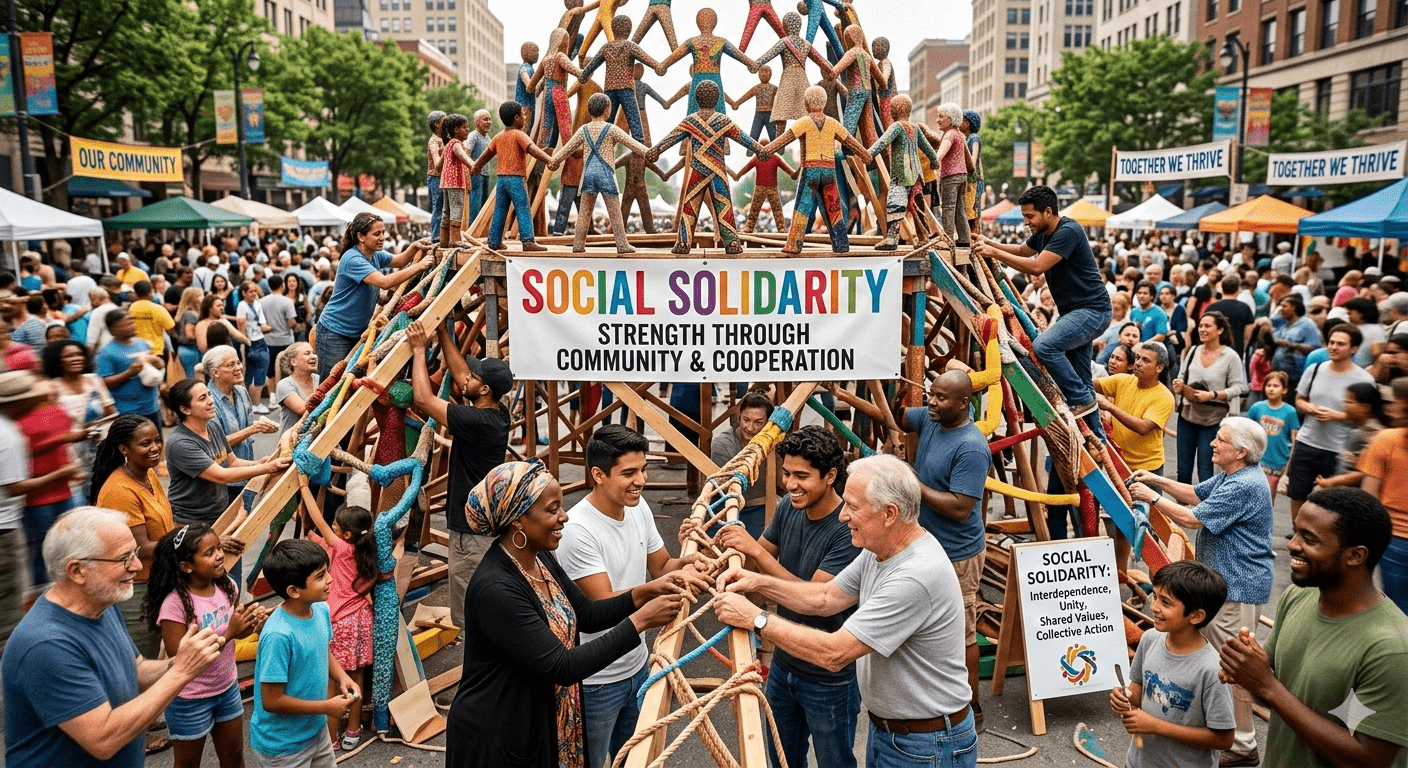
1. Definition: The Architecture of Social Cohesion
In the developmental history of classical sociology, Social Solidarity is defined as the set of bonds, shared values, and interdependencies that unite the members of a society, creating a sense of mutual responsibility and belonging. It is the "invisible glue" that prevents a human aggregate from devolving into a "war of all against all." Émile Durkheim, in his 1893 work The Division of Labour in Society, fundamentally anchored this concept as the primary object of sociological inquiry. He argued that solidarity is a Social Fact that varies in form according to the complexity of the society. This definition implies that social order is not a product of a forced "Social Contract" but arises from the Structural Requirements of collective life.
For a sociologist, the definition of social solidarity signifies the study of the Collective Conscience. It involves the belief that the individual is a social product, deriving identity and purpose from group enmeshment. By defining solidarity as the Functional integration of parts, the discipline investigate how Moral Regulation and shared symbols (rituals) ensure the Authoritative Allocation of roles and duties. This successfully transitioned the study of humanity from "abstract ethics" to a Rationalized Science of social mechanics, established through a rigorous internal moral code of Inquiry Integrity, providing the analytical tools to understand how a National Identity is sustained across historical epochs.
2. Durkheim’s Duality: Mechanical and Organic
Durkheim traced the evolution of the Social Fabric by identifying two "Ideal Types" of solidarity that correspond to different stages of development:
A. Mechanical Solidarity (Traditional)
This form of solidarity is found in "simple" or traditional societies characterized by Homogeneity. Individuals perform similar tasks, share identical beliefs, and possess a pervasive Collective Conscience. In this background, the "Part" is a miniature version of the "Whole."
- Repressive Law: Because the collective conscience is so strong, any violation of a norm is seen as an attack on the entire community, resulting in severe, ritualized punishment designed to reaffirm Moral Order.
- Segmentary Structure: Society consists of self-sufficient units (clans or villages) that resemble one another.
B. Organic Solidarity (Modern)
With the increase in Dynamic Density (population size and interaction frequency), societies develop a complex Division of Labor. Modern societies are characterized by Heterogeneity, where individuals perform specialized tasks. Solidarity here arises from Interdependence—much like the organs in a biological body.
- Restitutive Law: The legal-rational framework focuses on "returning things to their original state" (contracts, civil law) rather than mere punishment, reflecting a Secular and cooperative logic.
- Functional Integration: The stability of the Social Organism depends on the specialized parts fulfilling their roles for the survival of the aggregate.
3. The Collective Conscience and Social Control
The conceptual background of Social Solidarity is rooted in the Collective Conscience—the totality of beliefs and sentiments common to the average members of a society. Durkheim argued that as we move toward Organic Solidarity, the collective conscience becomes more abstract and individualized. This background represents a fundamental shift in the Theory of Action: from "forced conformity" to "mutual necessity."
Intellectual history shows that this background moved the focus of social science toward the study of Secularization. In modern societies, the Cult of the Individual becomes the new shared religion. Understanding this concept requires recognizing that Social Order depends on the Value Consensus required to manage the friction of competition. This perspective established the foundation for Functionalism, proving that the stability of the Social Fabric depends on the Authoritative Allocation of Meaning to individual achievement, providing the Nomothetic Authority required to establish the universal laws of integration.
4. The Crisis of Transition: Anomie and Pathologies
Durkheim warned that the transition from mechanical to organic solidarity is often accompanied by Pathological forms of the division of labor. The most famous is Anomie—a state of "normlessness" where rapid Social Change outpaces the creation of new moral regulations.
From this perspective, high rates of suicide, crime, and industrial conflict are symptoms of a Social Pathology where solidarity has failed. Anomie represents the "Dark Side" of Modernity: the Alienation of the individual who is no longer integrated into a cohesive Collective Conscience. This study reveals that Economic Progress without Moral Regulation leads to the disintegration of the Social organism, reconciling Knowledge, Power, and the Body within a fragmented systemic aggregate.
5. Sociological Perspectives: Consensus vs. Conflict
The concept of solidarity is a primary site of Theoretical Contestation:
- Functionalist Perspective (Parsons): Views solidarity as the "Functional Requirement" for stability. Through the AGIL Schema (Integration), specialized institutions ensure that the different "parts" of society work in Consensus. Solidarity is seen as the prerequisite for Social Integration.
- Conflict Theory (Marx/Mills): Argues that "Solidarity" is often a Hegemonic Mask used by the elite to suppress dissent. They argue that in-group solidarity (e.g., Nationalism) is frequently utilized for Social Closure (Weber) to exclude the Subaltern. For Marxists, true solidarity can only be achieved through Class Consciousness and the overthrow of exploitative Relations of Production.
6. Indian Contextualization (Paper II Integration)
In Indian Society, the concepts of solidarity are characterized by the Synthesis of Tradition and Modernity. Traditionally, the Indian village exhibited a unique form of Mechanical Solidarity through the Jajmani System—a ritualized system of Reciprocity and Structural Inequality that bound different castes into a holistic, interdependent unit. Sociologists like M.N. Srinivas analyzed this as a "Segmentary Solidarity" where groups shared a ritual Collective Conscience despite hierarchical distances.
Post-independence India illustrates a move toward Organic Solidarity through Democratic Mobilization and Urbanization. However, the Caste System has adapted; it now provides "Communitarian Solidarity" for political ends (Vote Bank Politics). B.R. Ambedkar utilized the concept of Fraternity (solidarity) as the soul of the Indian Republic, arguing that political democracy is meaningless without Social Democracy. This proves that in the Indian Context, solidarity is a Synthetic process, resulting in Multiple Modernities where the "Sacred" ties of kinship are repurposed to achieve Substantive Equality in a modern state.
7. Case Study: Labor Unions and Collective Action
Labor Unions serve as the definitive case study for Applied Social Solidarity in industrial societies. Unions represent a shift from the individual "Calculus of Choice" to Collective Mobilization. By uniting workers under a shared Identity and a common goal, unions manufacture a Mechanical solidarity within the Organic structure of capitalism.
Sociologically, this case study reveals the Transformative Agency of solidarity. It proves that Power Dynamics can be re-negotiated when the Subaltern achieve Class Consciousness. It highlights how shared grievances and mutual aid (solidarity) can challenge the Structural Violence of the market. For sociologists, the history of the labor movement remains the blueprint for identifying how Collective Conscience is used for Social Change, reconciling Knowledge, Power, and the Body in a quest for justice.
Mains Mastery Dashboard
Social Solidarity represents the epistemological and structural core of modern social inquiry, acting as the primary mechanism that prevents the Social Fabric from disintegrating into Anomie. As articulated by Émile Durkheim, the evolution of society is marked by a shift in the nature of these bonds. In traditional societies, Mechanical Solidarity prevails, where Homogeneity and a pervasive Collective Conscience are enforced through Repressive Law. This "Social Gravity" ensures that the individual remains a total product of the group. However, the modern Division of Labor forces a transition to Organic Solidarity, where stability is a diachronic outcome of Interdependence. In this view, Restitutive Law (contracts) replaces punishment, providing the Legal-Rational framework required for Functional Integration in a complex social organism.
In the Indian context, this transition is uniquely manifested through the "Multiple Modernities" framework. India’s traditional morphology utilized the Jajmani System to create a localized Mechanical Solidarity that integrated diverse castes into a hierarchical but cohesive unit. Unlike the Western experience where traditional ties "withered away," Indian social institutions like Caste have not disintegrated; instead, they have "Modernized" (Yogendra Singh) into interest-based solidarity groups. This persistence of "Segmentary Solidarity" within a modern democratic framework facilitates Vote Bank Politics and Democratic Mobilization. This proves that solidarity in India is a Synthetic process, where the "Sacred" ties of the past are repurposed to negotiate for Substantive Progress and the Authoritative Allocation of secular resources.
In CONCLUSION, social solidarity is a Total Social Fact that remains the prerequisite for a Reflexive and equitable social existence. The sustainability of the Indian Republic depends on achieving a Dynamic Balance—ensuring that the Organic Solidarity of the nation-state is anchored in the Constitutional Morality of Fraternity (Ambedkar). Reconciling Knowledge, Power, and Agency in the 21st century requires moving beyond "Mechanical Conformity" toward a Humanistic Solidarity that honors diversity. Sociology ensures that the study of collective life serves the ends of Human Liberation, proving that the progress of a nation is measured by the strength of the bonds that allow its citizens to coexist in Human Dignity in a globalized world.
Revision Strategy: Keywords
- Collective Conscience: The shared moral and spiritual bond of a group (Durkheim).
- Repressive Law: Traditional legal system focused on punishment and moral reaffirmation.
- Restitutive Law: Modern legal system focused on compensation and restoration.
- Anomie: A state of normlessness arising from rapid transition (Durkheim).
- Dynamic Density: The combination of population size and interaction intensity.
- Fraternity: The social and emotional component of solidarity (Ambedkar/Rousseau).