

Socialization: The Internalization of Society
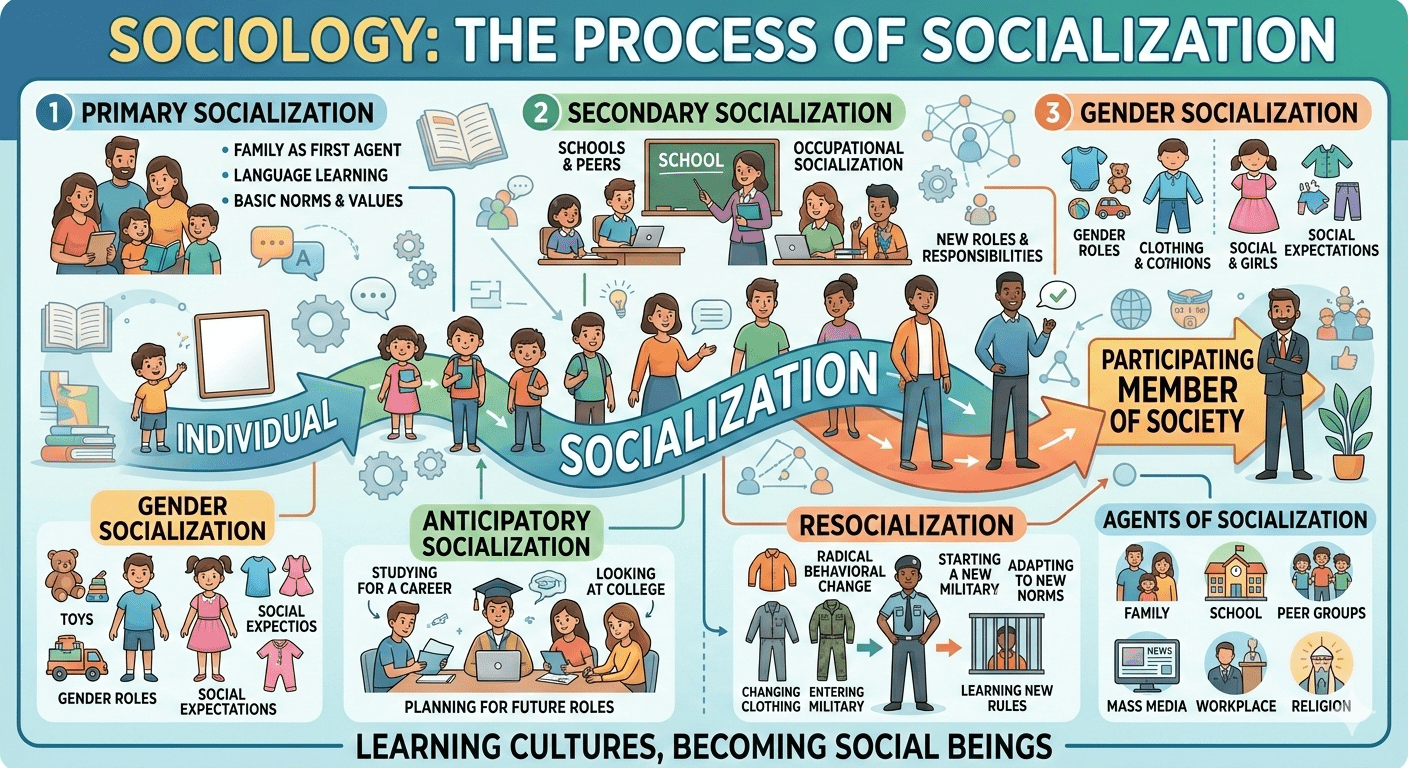
1. Definition: The Bridge between Individual and Society
In the developmental architecture of sociology, Socialization is defined as the lifelong process through which individuals learn and internalize the values, norms, beliefs, and behaviors appropriate to their social group. It is the fundamental mechanism that transforms a "biological organism" into a "social person," ensuring the continuity of the Social Fabric across generations. While biology provides the raw material, socialization provides the Symbolic Logic required for meaningful participation in collective life. As articulated by George Herbert Mead, the mind and the self are social achievements, emerging only through interaction with others. This definition implies a Duality of Agency: while society acts upon the individual to ensure Conformity, the individual also utilizes these learned scripts to exercise their own creative Agency.
For a sociologist, the definition of socialization signifies the study of the Authoritative Allocation of Identity. It involves the belief that the "Self" is clinical and can be mapped through the internalization of external social facts. By defining socialization as a process of Value Transmission, the discipline investigate how Social Control is transformed into self-discipline. This successfully transitioned the study of humanity from "instinct-based" theories to a Rationalized Science of cultural programming, providing the Analytical Authority required to distinguish between innate traits and the socially constructed National Identity, established through a rigorous internal moral code of Inquiry Integrity.
2. Typologies: The Life Cycle of Learning
The conceptual background of Socialization identifies that the process occurs in distinct phases, each mediated by different Agents of Socialization:
- Primary Socialization: Occurs in infancy and childhood, primarily through the Family. It involves the initial construction of reality and the development of language and basic moral codes.
- Secondary Socialization: Occurs later in life through School, Peers, and Media. It teaches individuals how to act in specialized settings and adopts specific Social Roles required by the Division of Labor.
- Anticipatory Socialization: The process of practicing for future roles (e.g., medical students acting like doctors). It facilitates Social Mobility by helping individuals learn the "Cultural Capital" of the group they wish to join.
- Resocialization: The radical process of discarding old behavior patterns and accepting new ones, often occurring in Total Institutions like prisons or military camps (Goffman).
This background represents a fundamental shift in the Theory of Progress: the realization that the Social organism is not static but is continuously reproduced through the learning of every new member, established through a rigorous internal moral code of Reciprocity.
3. Symbolic Interactionism: Constructing the Self
George Herbert Mead and Charles Horton Cooley provided the definitive sociological grammar for socialization. Cooley’s Looking-Glass Self posits that our self-concept is a reflection of how we imagine others perceive us. It consists of three steps: (1) imagining our appearance, (2) imagining the judgment, and (3) a resulting self-feeling (pride or shame).
Mead radicalized this by identifying the stages of Self-Development:
- Preparatory Stage: Pure imitation without understanding symbols.
- Play Stage: Children take on the roles of Significant Others (e.g., "playing house").
- Game Stage: Children learn to take on multiple roles simultaneously and understand the Generalized Other—the internalized collective norms of the entire society.
From this perspective, socialization is a Meaningful Performance where the Individual negotiates the tension between the "I" (impulse) and the "Me" (socialized self), reconciling Knowledge, Power, and the Body through symbolic exchange.
4. Functionalism: Talcott Parsons and Pattern Maintenance
From the Functionalist perspective, as articulated by Talcott Parsons, socialization is the primary mechanism for System Integration. In his AGIL Schema, socialization falls under the Latency (L) function, also known as "Pattern Maintenance."
Parsons argued that for a society to maintain Equilibrium, individuals must want to do what the system needs them to do. Socialization ensures the Value Consensus by transmitting the Value-Orientation of the culture. Through the Socialization process, individuals internalize their status-roles, ensuring that the Collective Conscience remains resilient against the threat of Anomie. Functionalists prove that the stability of the Social organism depends on the effective "programming" of individuals to fulfill Functional Prerequisites, established through a rigorous internal moral code of Order.
5. Conflict Theory: Louis Althusser and Reproduction
In contrast to the consensus model, Conflict Theorists view socialization as a tool for Social Control and the maintenance of inequality. Louis Althusser introduced the concept of Ideological State Apparatuses (ISAs)—including schools, religion, and the family—which socialize individuals into the dominant Ruling Class ideology.
From this viewpoint, socialization is the Hegemonic Mask that manufactures "Spontaneous Consent" to exploitation. Schools, for instance, teach a "Hidden Curriculum" of obedience and hierarchy, preparing the Proletariat for their roles in the capitalist Mode of Production. Pierre Bourdieu supplemented this by showing how socialization transmits Cultural Capital, ensuring that elite status is reproduced as a "natural" trait rather than a structural advantage. This critique reveals that the struggle for Social Justice requires a radical "Un-learning" or Counter-socialization to reclaim Subaltern Agency.
6. Indian Contextualization: Sudhir Kakar and Caste
In Indian Society, socialization is analyzed through the unique tension between the Joint Family and modern individualistic institutions. Sudhir Kakar, in The Inner World, argued that the Indian child develops a "Relational Self" due to prolonged physical proximity and maternal indulgence. This creates a high Need for Belonging and a predisposition toward Communitarian Solidarity rather than Western autonomy.
Furthermore, the Caste System serves as a primary cognitive map in early socialization. Children learn the boundaries of Purity and Pollution through household rituals and language, which internalizes Structural Violence and Stigma before the child reaches the Game Stage. Contemporary India illustrates a Conflict of Socializations: the "Sanskari" values of the home vs. the "Globalist-Secular" values of the English-medium school. This proves that in the Indian Context, socialization is a Synthetic process, resulting in Multiple Modernities where the National Identity is anchored in a reflexive negotiation between Tradition and the Constitution.
7. Gender Socialization: The Quantified Inequality
Gender socialization is the most pervasive form of Structural Differentiation. Data reveals how social learning translates into massive socioeconomic disparities:
- Indian Labor Market (PLFS 2022-23): The Female Labor Force Participation Rate (FLFPR) in India stands at 37.0%, compared to 78.5% for males. This 41.5% gap is a diachronic outcome of socialization that labels the domestic sphere as "feminine" and the public-economic sphere as "masculine."
- The "Son Meta-Preference": Socialization into the "Patrilineal" logic results in skewed demographics. Despite a better natural survival rate for females, the Economic Survey of India 2018 identified 63 million "missing women" due to gender-biased socialization and sex-selective practices.
- Education (NFHS-5): While the Gender Parity Index in primary education is now 1.02 (favoring girls), the literacy rate for females (71.5%) remains lower than for males (84.4%). Socialization dictates that girls' education is often viewed as a Terminal path leading to marriage, rather than a Career-oriented path.
8. Case Study: Resocialization in "Total Institutions"
Erving Goffman’s study of Total Institutions (prisons, mental hospitals, monasteries) serves as the definitive case study for Resocialization. In these settings, individuals undergo a "Mortification of the Self"—the systematic stripping of their previous identity.
Sociologically, this reveals the Transformative Power of the environment. Through "degradation ceremonies" (shaving hair, assigning numbers), the institution breaks down the individual’s Agency and rebuilds them in the image of the institution. This study confirms that Identity is a fragile construction maintained by social support. For sociologists, the total institution remains the blueprint for identifying how Bureaucratic Rationalization can lead to total Social Control, reconciling Knowledge, Power, and the Body within a closed systemic aggregate.
Mains Mastery Dashboard
Socialization represents the epistemological and structural core of social inquiry, acting as the primary mechanism for the Internalization of Society. As articulated by George Herbert Mead, the development of the "Self" is a process of learning to take on the role of the Generalized Other. By internalizing the collective norms and Value Consensus of the group, individuals achieve a state of Social Integration, moving the study of humanity from "biological determinism" to a profound inquiry into the Social Fabric. This "Pattern Maintenance" (Parsons) ensure that the Collective Conscience remains resilient, making socialization the indispensable engine of social continuity and predictability in a complex National Identity.
However, this process is also characterized by Structural Violence. From a Conflict Perspective, as theorized by Louis Althusser, socialization is mediated through Ideological State Apparatuses (ISAs) such as the family and education system. These institutions do not just transmit "values"; they transmit Ruling Class Ideology, socialising the Proletariat into their roles within the capitalist Mode of Production. In the Indian context, the socialization into the Caste System and patriarchal norms serves as a quintessential example of how Structural Inequality is "naturalized" at the cognitive level. The "Stigma" of the Subaltern is internalized before the child can exercise Reflexive Agency, ensuring the Hegemony of the elite. Thus, socialization is not a neutral process but a site of Democratic Mobilization where the struggle for Social Justice requires the "de-coding" of these internalized hierarchies.
In CONCLUSION, socialization is a Total Social Fact that is inherently reflexive. Its sustainability depends on achieving a Dynamic Balance—ensuring that Instrumental Learning does not lead to the total Alienation of the spirit. Reconciling Knowledge, Power, and Agency in the 21st century requires moving beyond "Mechanical Conformity" toward an Emancipatory Socialization. Sociology ensures that the study of human learning serves the ends of Substantive Progress, proving that the "Rebirth of the Individual" is possible through the collective reclamation of the Social Logic of inclusion and Human Dignity in a globalized world.
Revision Strategy: Keywords
- Looking-Glass Self: The idea that the self-concept is a reflection of others' perceptions (Cooley).
- Generalized Other: The internalized collective norms of society (Mead).
- Pattern Maintenance: The functional need to transmit values to maintain stability (Parsons).
- Relational Self: Identity formed through enmeshment in social networks (Kakar).
- ISAs: Institutions that manufacture consent through ideology (Althusser).
- Cultural Capital: Social assets (education, speech) that facilitate social mobility (Bourdieu).