

Sociological Imagination: The Interplay of History and Biography
1. Definition: The Quality of Mind
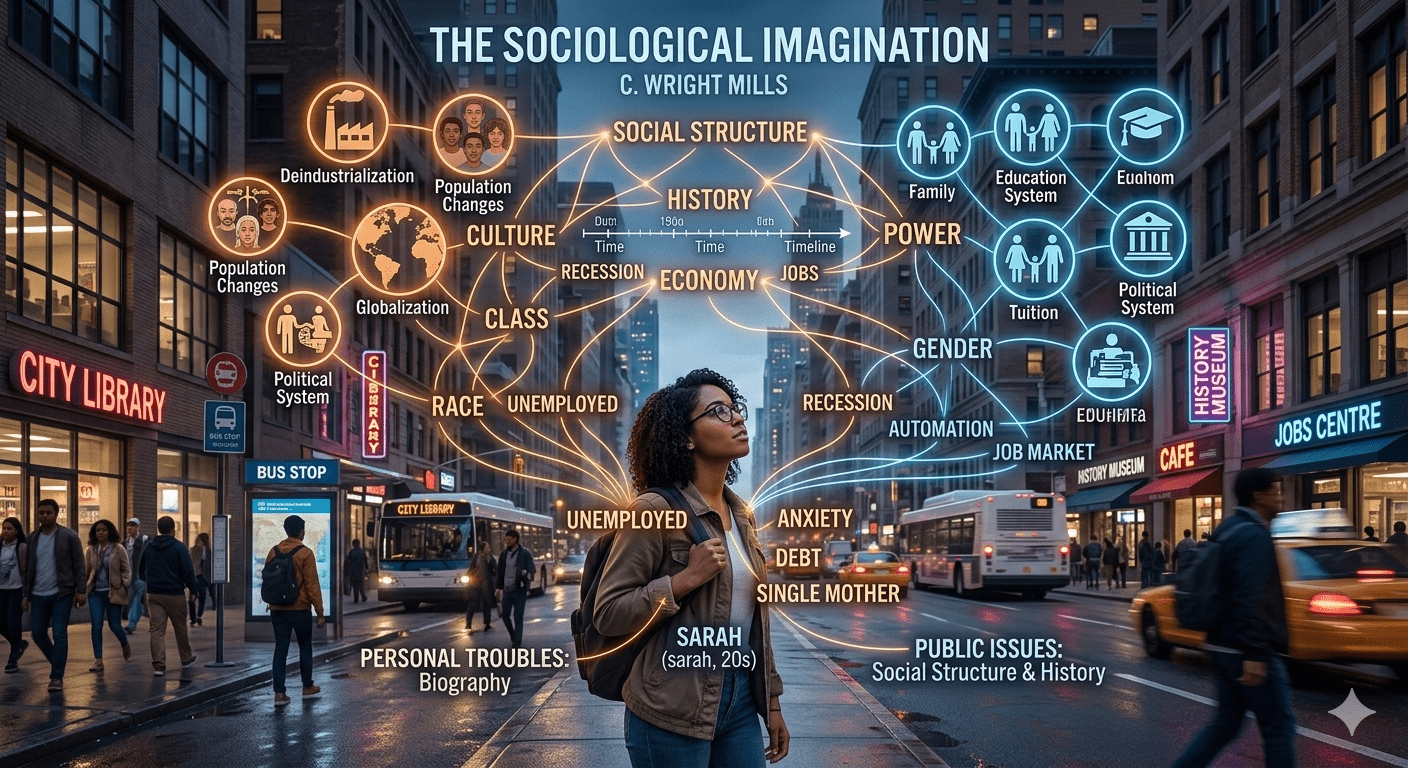
In the rigorous theoretical landscape of modern social inquiry, the Sociological Imagination is defined by C. Wright Mills (1959) as a vivid awareness of the relationship between personal experience and the wider society. It is the "quality of mind" that allows individuals to grasp the intricate interplay between their own biographies (the life story of the person) and social history (the developmental trajectory of the world). Mills argued that neither the life of an individual nor the history of a society can be understood without understanding both. This definition implies a radical Epistemological Rupture, transitioning the focus from isolated "private orbits" of existence to a profound inquiry into how macro-structural forces determine micro-level realities.
For a sociologist, the definition of the sociological imagination signifies the study of the Authoritative Allocation of Meaning to individual suffering. It involves the belief that what appears as a personal failure is often a symptom of a structural malfunction. By defining the imagination as a tool for Human Liberation, Mills investigate how individuals can use reason to understand the Social organism they inhabit. This successfully transitioned the study of humanity from "abstract psychology" to a Rationalized Science of structural connections, providing the Analytical Authority required to distinguish between transitory personal grievances and long-term public crises, established through a rigorous internal moral code of intellectual craftsmanship.
2. Concept & Background: The 1959 Epochal Text
The conceptual background of the Sociological Imagination is rooted in the mid-20th-century crisis of American sociology. Mills wrote his seminal text during the Cold War, a period characterized by the rise of Bureaucratic Rationalization and the "Mass Society." The background represents a fundamental shift in the Theory of Knowledge: a fierce critique of what Mills called "Grand Theory" (exemplified by Talcott Parsons' abstract schemas) and "Abstracted Empiricism" (statistical research divorced from historical context).
Intellectual history shows that the sociological imagination was designed to rescue sociology from academic Alienation and return it to a role of Political Agency. This background moved the focus of social science toward the study of Power Dynamics and the National Identity. Understanding this concept requires recognizing that Mills assumed a Mechanical system of influence: as society modernizes, the Authoritative Allocation of Power becomes more centralized (The Power Elite), making the sociological imagination the primary prerequisite for Democratic Mobilization and the reclamation of Individual Agency.
3. The Core Binary: Personal Troubles vs. Public Issues
A central pillar of Mills' framework is the distinction between "Troubles" and "Issues," which facilitates the mapping of the Social Fabric:
- Personal Troubles: These occur within the character of the individual and within the range of their immediate relations with others. They have to do with the "self" and those limited areas of social life of which the person is directly aware (e.g., one person being unemployed in a city of millions).
- Public Issues: These have to do with matters that transcend these local environments of the individual and the range of their inner life. They have to do with the organization of many such environments into the institutions of an historical society as a whole (e.g., fifteen million people being unemployed in a nation).
From this perspective, the sociological imagination proves that Subjective Reality is a product of social arrangement. This perspective highlights the Duality of Reality: to explain the "trouble" of divorce, one must analyze the "issue" of changing family structures, economic modes of production, and Legal-Rational frameworks of the state. Mills’ analysis proves that the "Certainty" of individual choice is often a Regulatory Fiction, reconciling Knowledge, Power, and the Body through the lens of structural causality.
4. The Three Sorts of Questions
To exercise the sociological imagination, Mills posited that one must consistently ask three fundamental Nomothetic Questions about the Social organism:
- What is the structure of this particular society as a whole? How are its essential components related? How does it differ from other varieties of social order?
- Where does this society stand in human history? What are the mechanics by which it is changing? How does any particular feature we are examining affect, and how is it affected by, the historical period in which it moves?
- What varieties of men and women now prevail in this society? What varieties are coming to prevail? In what ways are they selected and formed, kept and repressed, made free and made Alienated?
These questions provide the Analytical Authority required to bridge the gap between Knowledge, Power, and the Body. They successfully move the focus of the discipline toward the study of Social Statics and Dynamics, proving that the progress of the Social Fabric is a diachronic outcome of these structural and historical intersections.
5. Critique: Conflict Theory and the 'Power Elite'
From the Conflict Perspective, the sociological imagination is a tool to unmask Structural Violence. Mills utilized his own framework to analyze the Power Elite—an interlocking directorate of military, corporate, and political leaders who make decisions affecting millions.
From this viewpoint, the sociological imagination reveals that the Authoritative Allocation of Labels (like "freedom" or "democracy") is often a Hegemonic Mask for elite domination. Critical theorists argue that without the sociological imagination, individuals remain trapped in False Consciousness, viewing their hardships as personal defects rather than results of Systemic Exploitation. This critique reveals that the struggle for Social Justice is essentially the struggle to broaden the Cognitive Justice of the masses, established through a rigorous internal moral code of Intellectual Courage.
6. Indian Contextualization: Farmer Suicides & Debt (Paper II)
In Indian Society, the sociological imagination is essential for deconstructing the Agrarian Crisis. While a suicide is often reported as a "Personal Trouble" involving depression or individual debt, a sociological lens reveals it as a Public Issue.
Sociologists apply the three questions to the Indian Context:
- Structure: The breakdown of the Jajmani System and the rise of Capitalized Agriculture without adequate state support.
- History: The impact of the 1991 LPG reforms and global trade fluctuations on local crop pricing.
- Human Variety: The specific Subaltern Agency of the small-holder farmer caught in a Graded Inequality of credit access.
This transition proves that the National Identity of the farmer is anchored in a Structural Violence where the Collective Conscience is fragmented by neoliberal policies. Thus, achieving Substantive Progress in India depends on the state’s ability to recognize these "private" tragedies as Total Social Facts that require structural reform based on Constitutional Morality.
7. Global Statistics: The Quantified Imagination
Applying the sociological imagination to contemporary global data reveals how structural shifts create personal Life Chances:
- Unemployment and Automation (WEF 2023): The World Economic Forum estimates that 83 million jobs will be lost globally by 2027 due to AI and automation. For the individual worker, losing a job is a "Personal Trouble," but the sociological imagination identifies it as a Public Issue of the Fourth Industrial Revolution.
- Youth Unemployment in India (PLFS 2022-23): While the overall unemployment rate is 3.2%, the rate for youth (15-29 years) with higher education is significantly higher (approx. 13.4%). This proves that the "failure" to find a job is not a lack of effort but a Structural Gap between the Education system and the Economic mode of production.
- Global Debt: According to the IMF (2024), global debt stands at 235% of GDP. For a family, debt is a "Character defect"; for the sociologist, it is a Pathological Social Construct arising from the Financialization of the global economy.
Mains Mastery Dashboard
The Sociological Imagination, a concept pioneered by C. Wright Mills, represents the epistemological core of modern social inquiry, acting as the primary mechanism for understanding how Macroscopic Social Facts dictate Micro-level biographies. Mills argued that individuals often perceive their hardships as "Personal Troubles"—isolated failures of character or effort. However, the "imagination" allows one to see these as "Public Issues" rooted in the Structural Contradictions of society. By analyzing the Social Fabric through the lens of history, the discipline successfully transitioned the study of humanity from "individual psychology" to a Rationalized Science of structural connections, providing the Analytical Authority required for Human Liberation.
In the Indian context, the Agrarian Crisis serves as the definitive application of this framework. While the suicide of a farmer is often reduced to a "trouble" of debt or depression, the sociological imagination reveals a profound "issue" of Structural Violence. By asking Mills' Three Sorts of Questions, we uncover that the crisis is a product of De-territorialized global markets, the breakdown of traditional Jajmani Reciprocity, and the Authoritative Allocation of resources away from the Subaltern. In this view, the farmer is not a failing individual but a casualty of the National Identity struggling with the "Iron Cage" of neoliberal modernization. Thus, the imagination serves as a tool for Democratic Mobilization, shifting the "Authoritative Word" from individual blame to systemic reform.
In CONCLUSION, the sociological imagination is a Total Social Fact that remains the prerequisite for a Reflexive and equitable social existence. Its sustainability depends on achieving a Dynamic Balance—ensuring that the "Power Elite" do not monopolize the Authoritative Allocation of meaning. Reconciling Knowledge, Power, and Agency in the 21st century requires moving beyond "Mechanical Objectivity" toward an Emancipatory Humanism. Sociology ensures that the study of personal life serves the ends of Substantive Progress, proving that the "Rebirth of the Individual" is possible only through a collective understanding of the Social organism in a globalized, fragmented world.
Revision Strategy: Keywords
- Biography vs. History: The intersection of individual life and societal timeline.
- Personal Troubles: Issues resolved within the individual’s immediate range of relations.
- Public Issues: Matters that transcend local environments and involve institutions.
- Quality of Mind: The mental capacity to shift between perspectives (political to psychological).
- The Power Elite: Interlocking leadership of major institutions (Military, Corp, State).
- False Consciousness: Being unaware of the structural forces that shape one's life.
