

Sociology: The Systematic Study of the Social Organism
1. Definition: Beyond Common Sense
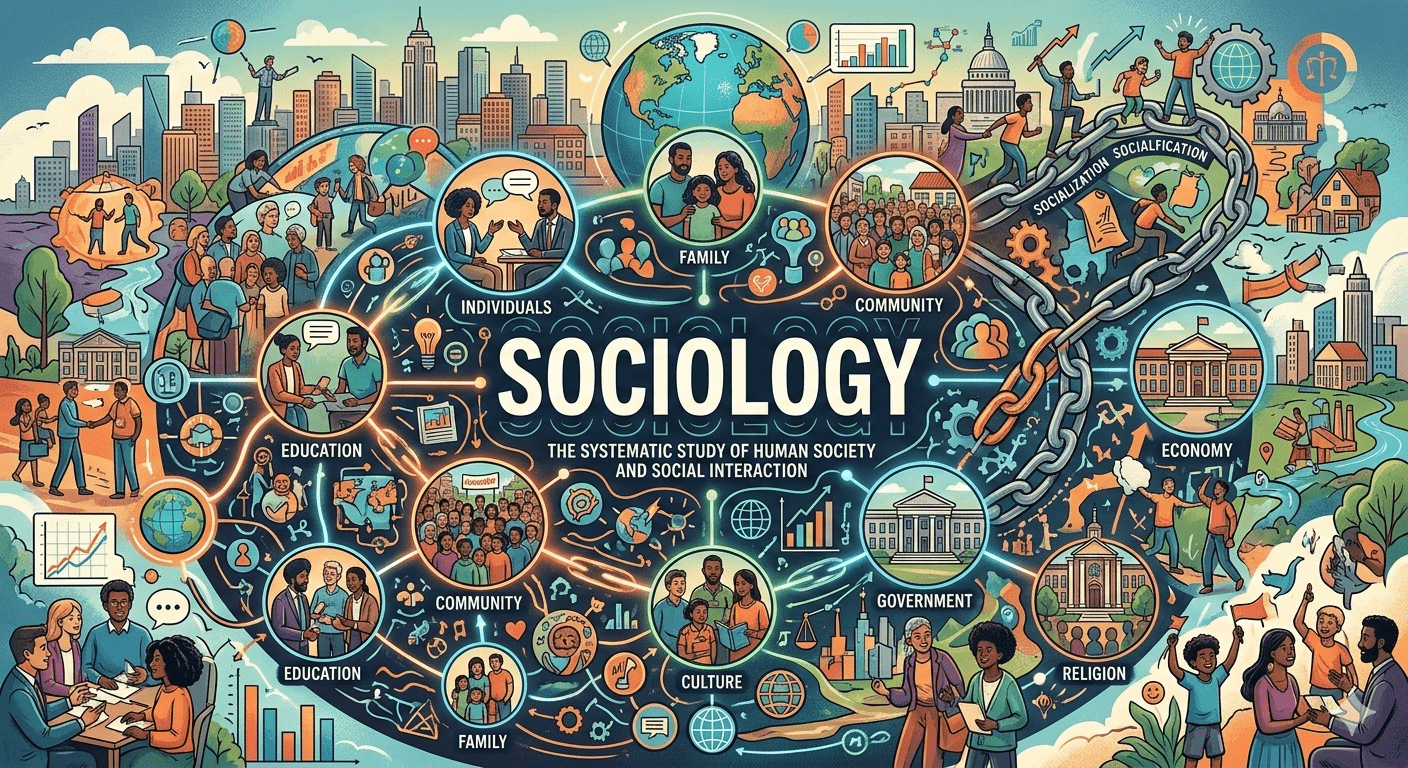
In the rigorous foundational architecture of the behavioral sciences, Sociology is defined as the scientific study of human society, social relationships, and the recurring patterns of collective behavior. Etymologically derived from the Latin socius (companion) and the Greek logos (study), the term was coined in 1838 by Auguste Comte, who envisioned the discipline as the "Queen of Sciences." Sociology represents a fundamental Epistemological Rupture, transitioning the understanding of human existence from theological speculation or "common sense" to a Rationalized Science. This definition implies a commitment to Nomothetic and Ideographic inquiry, where the goal is to discover the universal laws governing the Social Fabric while respecting the unique Subjective Meanings assigned by individual actors.
For a sociologist, the definition of the discipline involves the study of the Authoritative Allocation of Power and Meaning. It is the study of the Collective Conscience (Durkheim), the Mode of Production (Marx), and the Rationalization of the world (Weber). By defining society as an autonomous sui generis reality, sociology investigate how social institutions—the family, religion, the state—constrain individual agency. This successfully transitioned the study of humanity from "moral philosophy" to a Causally Adequate Science, providing the Analytical Authority required to unmask Structural Violence and facilitate Substantive Progress through a rigorous internal moral code of Objectivity.
2. Concept & Background: The Triple Revolution
The conceptual emergence of Sociology was not an accident but a Structural Requirement of 19th-century Europe. The background of the discipline is rooted in the "Triple Revolution" that dismantled the Sacred Canopy of the Middle Ages:
- The Enlightenment (Intellectual Revolution): Prioritized human reason over divine revelation, Establishing the Sovereignty of the individual and the scientific method.
- The French Revolution (Political Revolution): Destroyed the "Divine Right" of kings and introduced the Social Contract, making the study of Social Order and stability urgent.
- The Industrial Revolution (Economic Revolution): Triggered massive Urbanization, the breakdown of the Joint Family, and the rise of the Proletariat, creating a "Laboratory of Change" for early sociologists.
Intellectual history shows that sociology acted as the Theoretical engine for the Modernization process. It established the Rational-Legal authority of secular governance. Understanding this concept requires recognizing that sociology was born as a "conservative response" (Nisbet) to the chaos of modernity, seeking to re-establish Social Solidarity in a world increasingly characterized by Alienation and Anomie.
3. Functionalist Perspective: Émile Durkheim and Social Facts
Émile Durkheim, the architect of functionalism, viewed sociology as the study of Social Facts. These are ways of acting, thinking, and feeling that are external to the individual and exert a coercive power over them. Durkheim utilized Methodological Monism—applying the methods of natural science to the Social Fabric.
From this perspective, society is a Social Organism where every institution has a Function (e.g., crime clarifies moral boundaries). His work on Social Solidarity (Mechanical vs. Organic) proves that the stability of the system depends on the Value Consensus. Durkheim successfully moved the focus of the discipline toward Integration, providing the Nomothetic Authority required to discover the laws of social cohesion, established through a rigorous internal moral code of Scientific Rigor.
4. Conflict Theory: Karl Marx and the Motor of History
In contrast to functional stability, Karl Marx viewed sociology as a tool for Human Emancipation. He argued that the motor of history is Class Conflict. For Marx, society is a site of Structural Violence where the Bourgeoisie exploits the Proletariat by extracting Surplus Value.
Marx tracing the Relations of Production showed that social institutions like religion ("Opium of the masses") and law act as a Hegemonic Mask for ruling-class interests. From this viewpoint, the goal of sociology is Praxis—the synthesis of theory and action to achieve Social Revolution. His analysis proves that the current Social Logic is a product of Materialist contradictions, reconciling Knowledge and Power in a quest for a classless National Identity.
5. Interpretive Sociology: Max Weber and Verstehen
Max Weber radicalized sociology by introducing Methodological Dualism. He argued that because humans assign Subjective Meanings to their actions, sociology cannot rely on external laws alone. It requires Verstehen—interpretive, empathetic understanding.
Weber’s analysis of Rationalization and the "Iron Cage" of bureaucracy remains the blueprint for identifying the Pathologies of Modernity. He traced how the Symbolic Logic of religion (Protestantism) could inadvertently create the Economic Mode of Production (Capitalism). This perspective highlights the Duality of Agency, proving that ideas are as powerful as material forces in shaping the Social Fabric, established through a rigorous internal moral code of Value-Neutrality.
6. Interactionism: George Herbert Mead and Symbols
At the micro-level, Symbolic Interactionism (Mead, Cooley) posits that society is an Ongoing Performance. Mead argued that the "Self" is a social achievement, developed through the internalization of the Generalized Other (collective norms).
From this viewpoint, sociology is the study of Meaningful Interaction mediated through Symbols. The Authoritative Allocation of Labels (e.g., "deviant" or "citizen") dictates the individual’s Life Chances. This successfully transitioned the study of humanity from "instinct-based" theories to a profound inquiry into Socialization, proving that the progress of the Social organism is a diachronic outcome of microscopic negotiations of meaning.
7. Indian Contextualization: Emergence and G.S. Ghurye (Paper II)
In Indian Society, sociology emerged as a response to the Colonial Encounter. While the British used Social Anthropology to "other" Indian tribes, Indian pioneers like G.S. Ghurye (The Father of Indian Sociology) utilized the discipline to build a National Identity.
Ghurye established the Bombay School in 1919 and founded the Sociological Bulletin. He utilized an Indological and Comparative approach to study the Caste System and tribes, challenging the colonial Hegemony. Furthermore, B.R. Ambedkar utilized sociological inquiry as a Political Tool for Democratic Mobilization, arguing for the "Annihilation of Caste" through Constitutional Morality. This proves that in the Indian Context, sociology is a Synthetic process, resulting in Multiple Modernities where the "Sacred" tradition and "Secular" science coexist in a quest for Substantive Equality.
8. Case Study: Weber’s Study on the Protestant Ethic
Max Weber’s 1904 study, The Protestant Ethic and the Spirit of Capitalism, serves as the definitive case study for the Sociological Imagination. Weber analyzed how the Calvinist doctrine of Predestination led to "worldly asceticism" and the pursuit of wealth as a sign of grace.
Sociologically, this case study reveals the Transformative Agency of culture. It proved that Causal Adequacy must include the actor’s Subjective Meanings. Weber showed that the "Spirit" of modern capitalism was a diachronic outcome of a religious Shift in Knowledge. For sociologists, this remains the blueprint for identifying how Structural Shifts lead to a total reconfiguration of the Social Contract, reconciling Knowledge, Power, and the Body within a rationalized systemic aggregate.
Mains Mastery Dashboard
Sociology represents the most profound epistemological transformation in modern history, acting as the primary mechanism for moving beyond the "Common Sense" perceptions of everyday life. While common sense is localized, non-reflexive, and often serves to rationalize the status quo, sociology is a disciplined inquiry that utilizes Research Methodologies to unmask the Structural Contradictions of society. As articulated by Émile Durkheim, sociology achieves its scientific status by treating Social Facts as "things," utilizing Quantitative Inquiry to discover the Nomothetic Laws that govern the Social Fabric. This shift transitioned the study of humanity from "anecdotal observation" to a Rationalized Science, providing the Analytical Authority required to distinguish between transitory opinions and long-term Structural Transformations.
However, the relationship between the two is characterized by a structural dialectic. Max Weber argued that sociology must account for the Subjective Meanings that actors assign to their behavior—meanings that are often rooted in the "common sense" of their specific Lifeworld. Through Verstehen, sociology interprets these meanings to achieve Causal Adequacy. In the Indian context, the shift from the "Book-View" (scriptural common sense) to the "Field-View" (empirical sociological study) of M.N. Srinivas illustrates this point. Srinivas proved that statistics on Caste could not capture the dynamic "common sense" of Sanskritization and mobility. Thus, sociology does not just "reject" common sense; it subjects it to Organized Skepticism to achieve Substantive Progress and Human Emancipation from traditional dogmas.
In CONCLUSION, sociology is a Total Social Fact that remains the prerequisite for a Reflexive and equitable social existence. Its sustainability depends on achieving a Dynamic Equilibrium—ensuring that the Scientific Authority of the state does not lead to the total Alienation of human meaning. Reconciling Knowledge, Power, and the Individual in the 21st century requires a move toward a Scientific Humanism. By unmasking the Hegemonic distortions of common sense, sociology ensures that the Social Contract remains an evidence-based achievement, proving that the progress of a nation is measured by its capacity to apply reason to the complexities of the Human Condition.
Revision Strategy: Keywords
- Sui Generis: Durkheim’s idea that society is a unique reality in itself, not just a collection of individuals.
- Nomothetic: The search for universal, general laws (Scientific approach).
- Ideographic: The search for unique, specific meanings (Interpretive approach).
- Verstehen: Weber’s term for empathetic, interpretive understanding.
- Epistemological Rupture: A fundamental break with previous ways of knowing (Bachelard/Mills).
- Praxis: The synthesis of theory and action aimed at transforming society (Marx).