

Spatial Analysis: Geography, Power, and the Social Fabric
1. Definition: The Authoritative Allocation of Space
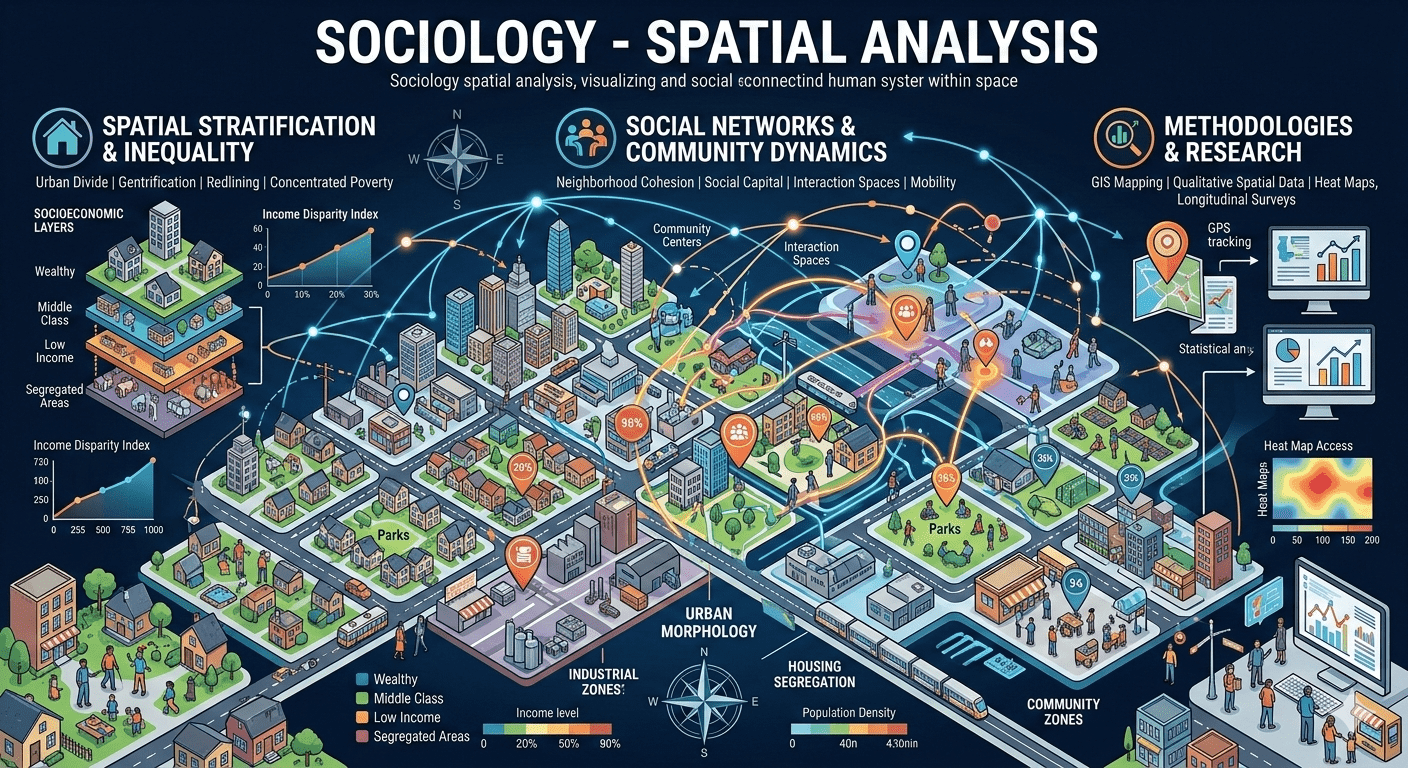
In the rigorous theoretical architecture of modern social inquiry, Spatial Analysis is defined as the systematic study of how geographical space, physical environments, and territorial arrangements influence and are influenced by social phenomena. Unlike simple cartography, sociological spatial analysis treats space not as a neutral container but as a Social Fact (Durkheim) and a product of Human Agency. It involves the study of population distribution, migration patterns, and the Spatio-Temporal constraints on human interaction. As articulated by Henri Lefebvre, space is "produced" through social relations, making spatial analysis the definitive inquiry into the Authoritative Allocation of meaning and power across a territory.
For a sociologist, the definition of spatial analysis signifies the transition from "abstract society" to "material society." It involves the belief that social structures are mirrored in the physical layout of cities and villages. By defining geography as a site for Structural Violence or Emancipation, the discipline investigate how Knowledge, Power, and the Body are managed through distance and proximity. This successfully transitioned the study of humanity from "Social Philosophy" to a Rationalized Science of demographics and GIS-based inquiry, providing the Analytical Authority required to understand how National Identity is anchored in the control of space.
2. Concept & Background: The 'Spatial Turn'
The conceptual background of Spatial Analysis is rooted in the "Spatial Turn" of the late 20th century, which critiqued sociology for being "space-blind." Historically, the field emerged through the realization that social change (dynamics) is always a Spatially uneven process. The background represents a fundamental shift in the Theory of Knowledge: the realization that "where" an event happens is as important as "why" it happens.
Intellectual history shows that early spatial analysis was dominated by Environmental Determinism, but modern frameworks emphasize Social Construction. Understanding this concept requires recognizing that the Modernization of the state involves the Bureaucratic Rationalization of territory—using mapping and GIS technology to manage the Social organism. This perspective establishes the foundation for Urban Sociology, proving that the stability of the Social Fabric depends on the Authoritative Allocation of Labels to "prime" vs. "peripheral" locations, providing the Nomothetic Authority required for modern city planning and Rationalized Social Control.
3. Urban Ecology: The Chicago School (Park & Burgess)
The Chicago School, led by Robert Park and Ernest Burgess, provided the definitive foundation for spatial analysis. They utilized biological models to study the city as an Ecological System. Burgess’s Concentric Zone Model (1925) mapped Chicago into five zones, illustrating how Economic Competition determines spatial distribution.
- The Loop (CBD): The center of Knowledge-Power and commerce.
- Zone of Transition: The area of Anomie, high mobility, and immigrant settlement.
- Commuter Zone: The site of elite Social Closure.
From this perspective, spatial analysis involves the study of "Invasion, Succession, and Dominance." Park’s analysis proves that Urbanization is a morphological process that dictates Social Solidarity. For sociologists, this work remains the blueprint for identifying how Structural Shifts in Space lead to individual pathologies, reconciling Knowledge, Power, and the individual within a mechanical systemic aggregate of the industrial city.
4. Marxist Geography: David Harvey and the 'Spatial Fix'
In contrast to the "natural" ecological view, David Harvey provided a radical Conflict perspective on space. Harvey argued that capitalism produces specific spatial arrangements to survive its internal contradictions. He introduced the concept of the "Spatial Fix"—the process by which capital expands geographically to resolve crises of over-accumulation.
From this viewpoint, Urban Planning and land use are tools for the extraction of Surplus Value. Harvey’s analysis proves that the "Social Fabric" is carved up to serve the Bourgeoisie. The Authoritative Allocation of Infrastructure (like highways vs. public transit) is a diachronic outcome of Class Conflict. This critique reveals that spatial analysis is a tool for De-masking Hegemony, proving that the struggle for Social Justice is essentially the struggle for the "Right to the City" (Lefebvre), established through a rigorous internal moral code of Democratic Agency.
5. Human Ecology and Resource Allocation
Human Ecology focuses on the Functional integration between populations and their physical environments. It examines how Structural Differentiation allows societies to adapt to diverse climates and resource constraints.
From this perspective, spatial analysis involves mapping the Authoritative Allocation of Resources (water, food, energy). It highlights the Duality of Reality: humans transform the environment through Technology, but the environment imposes limits on the Social organism. For sociologists, this analysis is vital for identifying how Climate Change and resource depletion trigger Migration and Conflict, reconciling Knowledge, Power, and the Body within a developmental systemic aggregate that spans across Spatio-Temporal boundaries.
6. Indian Contextualization: Caste and the Smart City (Paper II)
In Indian Society, spatial analysis is the only way to understand the Materiality of Caste. Traditionally, the morphology of the Indian Village was a physical map of Graded Inequality. Upper castes occupied the center (the "Sacred" space), while the Subaltern groups (Dalits) were spatially excluded to the periphery or downwind. This represents a Pathological Social Construct enforced through spatial Structural Violence.
Contemporary India illustrates a shift through Global Urbanization. Sociologists like Gautam Bhan have analyzed "Evictions" and the rise of Slums as spatial failures of Constitutional Morality. Furthermore, the rise of Gated Communities in "Digital India" represents a modern Social Closure, where the middle class utilizes Spatial Technology to isolate themselves from the National Identity of the poor. The Smart Cities Mission is analyzed as an Authoritative Allocation of "Rationalized" space that often ignores the Substantive Progress of the marginalized. This proves that in the Indian Context, spatial analysis is a Political site, where the quest for Social Justice depends on the Democratic Mobilization of the landless.
7. Case Study: Robert Park’s Urban Neighborhoods
Robert Park’s study of Chicago’s neighborhoods serves as the definitive case study for Applied Spatial Analysis. Park observed that "natural areas" (like Little Italy or Chinatown) emerged without central planning, based on the Social Logic of ethnic Solidarity.
Sociologically, this case study reveals the Transformative Agency of culture in space. It proved that Causal Adequacy in urban studies must include Subjective Meanings. However, it also illustrates the Paradox of the Ghetto: what provides "belonging" for the group can also lead to Social Exclusion from the wider Social Fabric. For sociologists, Park’s work remains the blueprint for identifying how Morphological opening and spatial proximity dictate the Life Chances of individuals, reconciling Knowledge, Power, and the Body within a volatile city aggregate.
Mains Mastery Dashboard
The sociological understanding of Spatial Analysis represents a profound epistemological transition from treating geography as a background to recognizing it as an active driver of Social Order. As articulated by David Harvey, space is the primary mechanism for the "Spatial Fix" of capitalism. Harvey posited that the built environment—cities, ports, and highways—is not a neutral achievement but a structural requirement for capital to resolve its internal crises. The Authoritative Allocation of spatial resources is thus a diachronic outcome of Class Struggle, where the "Sovereignty of the Market" dictates the morphology of human life, leading to the Alienation of the worker from the National Identity of the city.
In the Indian context, this reproduction of inequality is most visible in the spatial segregation of Caste. Traditionally, the Indian village morphology functioned as a physical system of Graded Inequality (Ambedkar). By excluding Subaltern groups to the periphery, the Structural Violence of "Purity and Pollution" was inscribed onto the land itself. This transition successfully moved the study of Caste from "ritual philosophy" to a Rationalized inquiry into spatial deprivation. In modern urban India, this logic has "modernized" into the "Gated Community" and the slum-demolition drive, proving that the Social Logic of exclusion remains a persistent Social Fact that challenges the Constitutional Morality of the republic.
In CONCLUSION, spatial analysis is a Total Social Fact that remains the prerequisite for a Reflexive and equitable social existence. Its sustainability as a democratic project depends on achieving a Dynamic Balance—ensuring that Urbanization leads to Emancipation rather than the creation of new "Digital Ghettoes." Reconciling Knowledge, Power, and Agency in the 21st century requires moving beyond "Mechanical Spacing" toward a Humanistic Urbanism. Sociology ensures that the study of territory serves the ends of Human Liberation, proving that the progress of a nation is measured by its capacity to achieve Substantive Equality across its entire Social Fabric in a globalized world.
Revision Strategy: Keywords
- Spatial Fix: The use of geographical expansion to solve capitalist economic crises (Harvey).
- Production of Space: The idea that space is a social construction, not just a physical fact (Lefebvre).
- Invasion & Succession: Ecological terms for the movement of social groups through urban zones.
- De-territorialization: The process where social relations transcend local borders (Appadurai).
- Materiality of Caste: The physical manifestation of hierarchy in village and city layouts.
- Right to the City: The demand for marginalized groups to have a say in urban production.