

Structural Functionalism: The Logic of Social Integration
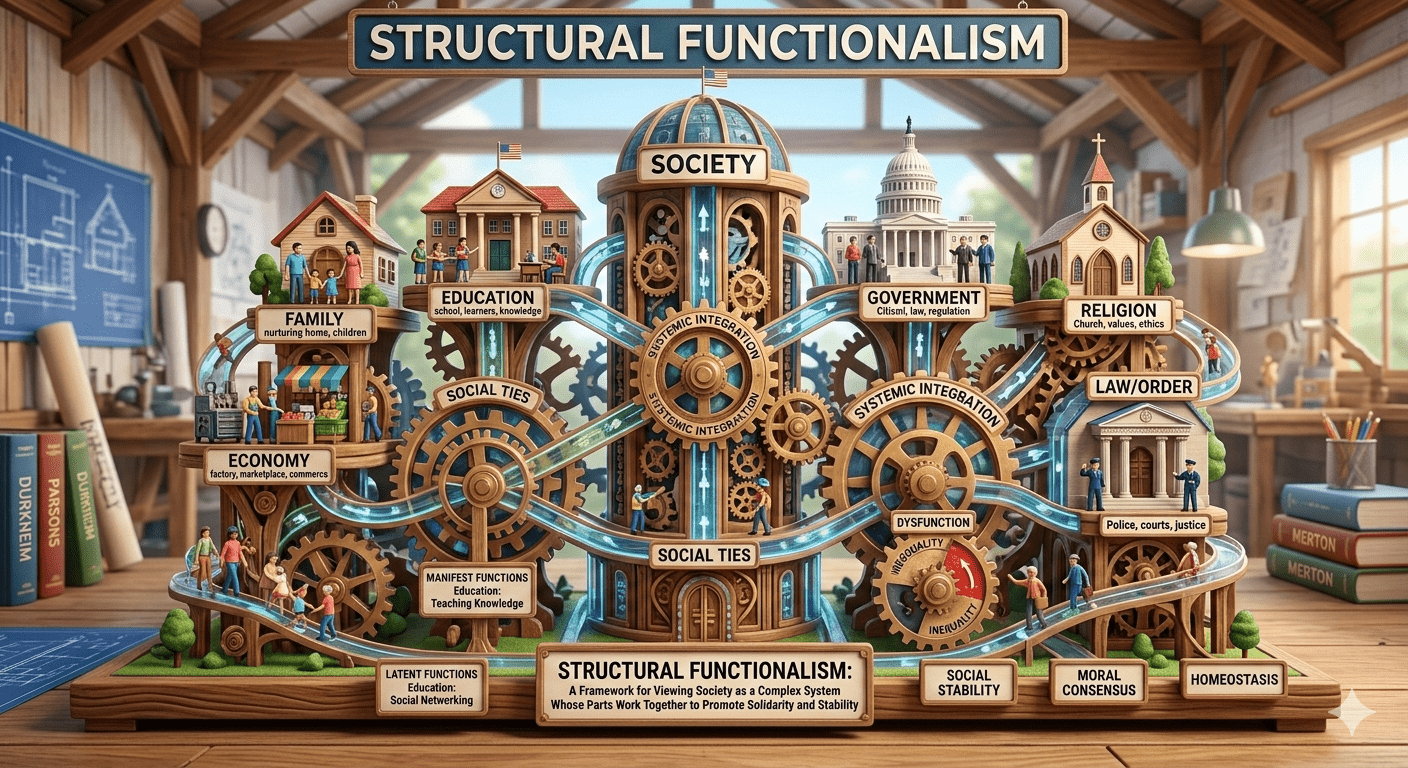
1. Definition: The Authoritative Allocation of Order
In the rigorous theoretical landscape of classical sociology, Structural Functionalism is defined as a macro-sociological perspective that conceptualizes society as a complex, self-regulating system whose constituent parts work in Consensus to promote stability, survival, and Social Order. Borrowing terminology from biology (the organic analogy), functionalism posits that social institutions—such as the family, religion, and the state—function like the organs of a living body. Each part performs a specific Functional Prerequisite that contributes to the overall Equilibrium of the system. This definition implies a commitment to Intersubjective Stability, where the primary object of inquiry is how the Social Fabric remains cohesive despite the friction of individual interests.
For a sociologist, the definition of structural functionalism signifies the study of the Integration of the Action System. It involves the belief that social reality is a Mechanical system of interdependent parts. By defining society as a sui generis reality, functionalism investigate how Value Consensus and shared norms facilitate Social Solidarity. This successfully transitioned the study of humanity from "moral philosophy" to a Rationalized Science of social mechanics, providing the Analytical Authority required to understand the National Identity as a diachronic outcome of institutional cooperation, established through a rigorous internal moral code of Inquiry Integrity.
2. Concept & Background: The Victorian Roots of Equilibrium
The conceptual background of Structural Functionalism is rooted in the 19th-century organic analogy pioneered by Herbert Spencer and the Functionalism of Émile Durkheim. Historically, the perspective emerged as a response to the chaos of the Industrial Revolution, seeking to discover the laws that maintain Social Cohesion. The background represents a fundamental shift in the Theory of Social Order: the realization that the "Social Fact" of stability is maintained through the Authoritative Allocation of meaning to specialized roles.
Intellectual history shows that functionalism provided the "Cultural Capital" required for Rational Social Planning in the mid-20th century. This background move the focus of social science toward the study of Homeostasis—the state where the system returns to balance after an external shock. Understanding this concept requires recognizing that functionalism assumes a Structural Differentiation: as societies modernize, institutions become more specialized (e.g., the separation of the economy from the family). This perspective established the foundation for Institutionalism, proving that the stability of the Social organism depends on the Value Consensus mediated through these specialized pillars, established through a rigorous internal moral code of Reciprocity.
3. Émile Durkheim: Social Facts and Moral Density
Émile Durkheim remains the definitive foundational figure of the functionalist tradition. He argued that sociology should be the study of Social Facts—external, coercive forces (like laws or religious dogmas) that constrain individual behavior.
In his work The Division of Labor in Society, Durkheim analyzed the transition from Mechanical Solidarity (based on similarity) to Organic Solidarity (based on interdependence). He argued that the "Function" of the division of labor was to create a new form of Social Solidarity. From this perspective, even "deviant" acts like crime have a function: they clarify moral boundaries and reaffirm the Collective Conscience. Durkheim’s analysis proves that the "utility" of any social phenomenon is its contribution to Integration, reconciling Knowledge, Power, and the Body within a cohesive systemic aggregate.
4. Talcott Parsons: The AGIL Schema and Action System
In the mid-20th century, Talcott Parsons systematized functionalism into Structural-Functionalism. He posited that for any social system to survive, it must fulfill four Functional Prerequisites, known as the AGIL Schema:
- Adaptation (Economy): The system must adapt to its environment and secure resources.
- Goal Attainment (Polity): The system must define and achieve collective goals.
- Integration (Law/Religion): The system must coordinate its internal parts and ensure solidarity.
- Latency (Family/Education): The system must maintain and renew the Value-Orientation of individuals (Pattern Maintenance).
Parsons argued that the Social system is maintained through Value Consensus and the Internalization of norms during socialization. His analysis highlights the Mechanical nature of equilibrium, where the Authoritative Allocation of roles ensures that the Social organism avoids Anomie. This study reveals that the stability of the National Identity is a diachronic outcome of these four subsystems working in a Dynamic Equilibrium.
5. Robert K. Merton: Manifest, Latent, and Dysfunctional
Robert Merton provided a vital Reflexive refinement of functionalism by challenging the "Unity," "Universality," and "Indispensability" of institutions. He introduced more nuanced categories to the Structural analysis:
- Manifest Functions: The recognized and intended consequences of a social pattern (e.g., the manifest function of school is to provide literacy).
- Latent Functions: The unrecognized and unintended consequences (e.g., the latent function of school is to act as a daycare or provide a "marriage market").
- Dysfunctions: Consequences that disrupt the Social Order or decrease system stability.
Merton also introduced Functional Alternatives—the idea that the same function can be performed by different institutions. This perspective highlights the Duality of Reality: while institutions may appear functional for the elite, they may be dysfunctional for the Subaltern. Merton successfully moved the focus of the discipline toward the study of Empirical Complexity, proving that the progress of the Social organism depends on identifying both the hidden utilities and the systemic failures of the Social Fabric.
6. Conflict Critique: The Hegemonic Mask of Harmony
In contrast to the consensus model, Conflict Theorists (Marx, Dahrendorf) view structural functionalism as a Hegemonic Mask for elite domination. They argue that functionalism has a "Conservative Bias" because it justifies the Status Quo by claiming every part of society is "necessary."
From this viewpoint, what functionalists call "Consensus" is actually Coercion. The Authoritative Allocation of power is not for system survival but for the preservation of Ruling Class interests. Conflict theorists argue that Social Change is driven by Class Struggle and Structural Violence, not by gradual adaptation. This critique reveals that functionalism often ignores the Alienation of marginalized groups, proving that the sustainability of the Social system depends on the continuous suppression of Subaltern Agency.
7. Indian Contextualization: Jajmani and Joint Family (Paper II)
In Indian Society, structural functionalism was the dominant framework for Village Studies in the 1950s. The Jajmani System was analyzed by sociologists like William Wiser as a functional system of Ritual Reciprocity and economic security. In this view, the "Interdependence" of castes ensured the Equilibrium of the rural social order.
Furthermore, the Joint Family is viewed through a functionalist lens. While modern structures appear nuclear, sociologists like I.P. Desai argued for the "Functional Jointness" of the Indian family—where members may live apart but maintain the functions of mutual aid and ritual solidarity. However, B.R. Ambedkar challenged this functionalist serenity, arguing that Caste was a Pathological Social Construct based on Graded Inequality. He posited that the system was maintained through Structural Violence rather than consensus. This proves that in the Indian Context, functionalism is a Synthetic process, where the "Sacred" tradition of stability struggles against the "Secular" requirements of Substantive Equality and Democratic Mobilization.
Mains Mastery Dashboard
Structural Functionalism represents the epistemological and structural core of consensus-based social inquiry, acting as the primary mechanism for maintaining Social Order. As articulated by Talcott Parsons through the AGIL schema, society is a self-regulating organism that achieves Dynamic Equilibrium by fulfilling four essential Functional Prerequisites. In this view, institutions specialized in Adaptation (Economy) and Latency (Culture/Family) ensure that the National Identity remains resilient against the friction of Social Change. This "Action System" provides the Authoritative Allocation of meaning required for Social Integration, moving the study of humanity from "individual psychology" to a profound inquiry into the Social Fabric.
However, the "Blueprint for Order" is profoundly challenged by the Reflexive refinements of Robert K. Merton. Merton realized that what is functional for one group (the elite) might be Dysfunctional for another (the subaltern). By distinguishing between Manifest and Latent functions, Merton unmasked the Hegemonic nature of social patterns. In the Indian context, the Jajmani System illustrates this duality: while it provided functional Economic Security (Manifest), it also reproduced the Structural Violence of Caste-based Graded Inequality (Latent). Thus, while functionalism explains Structural Continuity, it often obscures the Alienation of marginalized groups. Achieving Social Justice requires moving beyond the "Mechanical Harmony" of Parsons toward a more Critical Functionalism that recognizes the Structural Contradictions of the system.
In CONCLUSION, structural functionalism is a Total Social Fact that remains the prerequisite for a Reflexive and equitable social existence. Its sustainability depends on achieving a Dynamic Equilibrium—ensuring that Instrumental Progress does not lead to the total Alienation of the spirit. Reconciling Knowledge, Power, and Agency in the 21st century requires moving beyond "Mechanical Stability" toward a Reflexive Humanism. Sociology ensures that the study of order serves the ends of Human Liberation, proving that the "Blueprint of Society" is a living achievement that must be re-negotiated to ensure Substantive Equality in a globalized, fragmented world.
Revision Strategy: Keywords
- Homeostasis: The tendency of a social system to re-establish equilibrium after change.
- Functional Prerequisites: The tasks that must be fulfilled for a society to survive (Parsons).
- Manifest Function: The intended and recognized consequence of a social pattern.
- Latent Function: The unintended and unrecognized consequence of a social pattern.
- Value Consensus: Shared agreement on values that acts as the "social glue."
- Anomie: A state of normlessness occurring when order fails (Durkheim).
