

Anchors of the Past: Ancient Maritime Links and the Tamil-Brahmi Discovery in Egypt
INTRODUCTION: Setting the Context
In February 2026, archaeological excavations at the ancient port of Berenike on the Red Sea coast of Egypt unearthed pottery shards inscribed with Tamil-Brahmi characters. These inscriptions, dating back to the 1st century CE, mention names like Kanan and Chathan, which are characteristic of the early Sangam period in South India.
ISSUES: Why is this Discovery Significant Now?
The emergence of this issue stems from the need to re-evaluate traditional Eurocentric narratives of global trade.
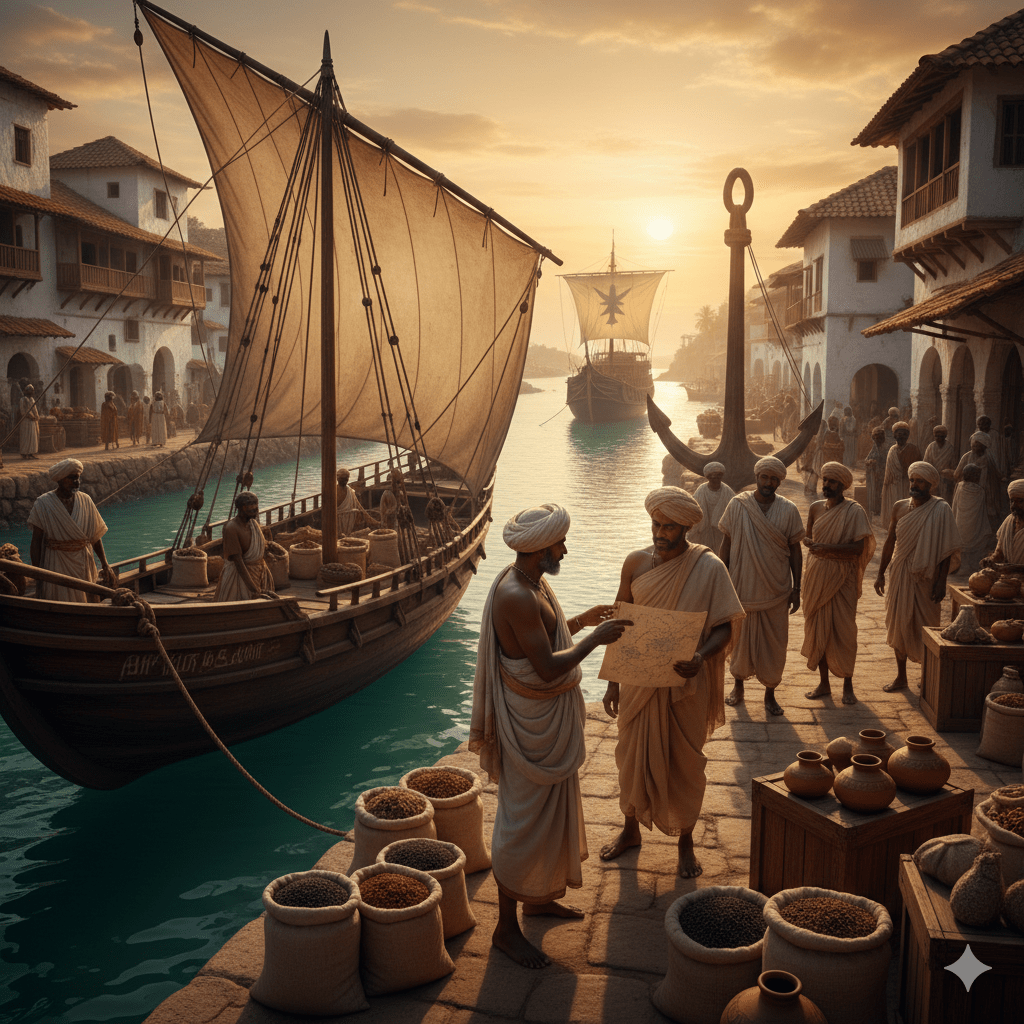
For decades, the "Silk Road" dominated historical discourse. However, new evidence from Berenike and Khor Rori (Oman) shifts the focus to the "Spice Route" or the Maritime Silk Road.
The discovery prompts a re-examination of how ancient mariners mastered the Hippalus (Monsoon) winds. Why did trade flourish specifically between the 1st century BCE and 2nd century CE? The answer lies in the unique seasonal reversal of winds in the Indian Ocean.
The presence of Tamil names in Egypt suggests that these were not just passing traders but a settled diaspora. This challenges the "Why" of ancient migration—was it purely commercial, or did it involve social integration?
The use of Tamil-Brahmi in a foreign land raises questions about the literacy levels of the common merchant class in ancient India, substantiating the depth of the Sangam Era civilization.
IMPLICATIONS: The Multi-dimensional Impact
Cultural Diplomacy: Substantiates India’s "Soft Power" by proving historical depth in international relations. As noted in PIB (Feb 2026), these links form the bedrock of India’s "Project Mausam". Economic History: Provides data for the "Drain of Wealth" in reverse—Pliny the Elder famously complained in the 1st century CE that India was "draining the Roman Empire of its gold" (nearly 50 million sesterces annually) for luxuries like pepper and muslin. Archaeological Tourism: Boosts the significance of sites like Arikamedu (Puducherry) and Muziris (Kerala), linking them to a global heritage circuit.
Preservation Issues: Many of these coastal sites are threatened by Climate Change and rising sea levels. Illicit Trade: Increased global interest in Indian antiquities often leads to the smuggling of artifacts, necessitating stricter Antiquities and Art Treasures Act (1972) enforcement.
INITIATIVES: Government and Global Efforts
To preserve and promote this heritage, several initiatives have been highlighted by the Ministry of Culture:
An ASI (Archaeological Survey of India) initiative to reconnect and re-establish communications between countries of the Indian Ocean world.
While primarily economic, it includes a "Heritage Wing" to preserve ancient ports.
A 2026 MoU between the Ministry of Culture and the Egyptian Ministry of Antiquities for joint underwater archaeological explorations in the Red Sea.
Efforts to list the "Ancient Maritime Trade Routes of India" as a UNESCO World Heritage Site.
INNOVATION: The Way Forward
How can India leverage these ancient links for modern strategic depth?
Creating a Global Digital Archive of Tamil-Brahmi and Sanskrit inscriptions found across SE Asia and the Middle East using AI to decipher eroded scripts.
Linking ancient maritime history with modern "Blue Economy" policies to foster a sense of shared identity among IORA (Indian Ocean Rim Association) nations.
Establishing a world-class National Institute of Underwater Archaeology in Gujarat or Tamil Nadu, modeled after the Southampton Oceanography Centre, to explore submerged heritage like Poompuhar.
Ensuring that "reclaiming history" does not lead to hyper-nationalism but stays grounded in substantiated archaeological facts.
5 KEY TAKEAWAYS
- Key Idea: Ancient India was a "Net Creditor" and a global trade hub, not an isolated subcontinent.
- Key Term: "Periplus of the Erythraean Sea" – An ancient Greek logbook that serves as a primary source for these trade routes.
- Key Issue: The vulnerability of coastal archaeological sites to Climate-induced Sea Level Rise.
- Key Example: The port of Berenike, where the 2026 discovery of Tamil-Brahmi shards confirms Indian residency in Egypt.
- Key Fact: India accounted for nearly 25-30% of global GDP during the 1st century CE, largely due to this maritime trade.
Probable Mains Questions
- GS Paper I (History/Culture): "Recent archaeological findings in the Red Sea region provide a new perspective on India’s maritime heritage. Discuss the significance of Tamil-Brahmi inscriptions in Egypt in reconstructing the trade history of the Sangam Age." (15 Marks, 250 Words)
- GS Paper I (Geography): "Explain the role of the Indian Ocean’s unique climatic features in shaping ancient maritime trade routes. How did the mastery of monsoon winds influence the socio-economic fabric of ancient India?" (10 Marks, 150 Words)
- GS Paper I (Society): "Globalisation is often viewed as a modern phenomenon. In light of ancient maritime links, evaluate the statement that India has historically been a cosmopolitan society." (15 Marks, 250 Words)
UPSC Syllabus Correlation
GS Paper I Indian Culture - Salient aspects of Art Forms, Literature, and Architecture from ancient to modern times; Ancient History - Trade and Commerce, Sangam Age; Physical Geography - Important Geophysical phenomena (Monsoons).