

Secularism
Secularism: The Architecture of Neutrality and Pluralism
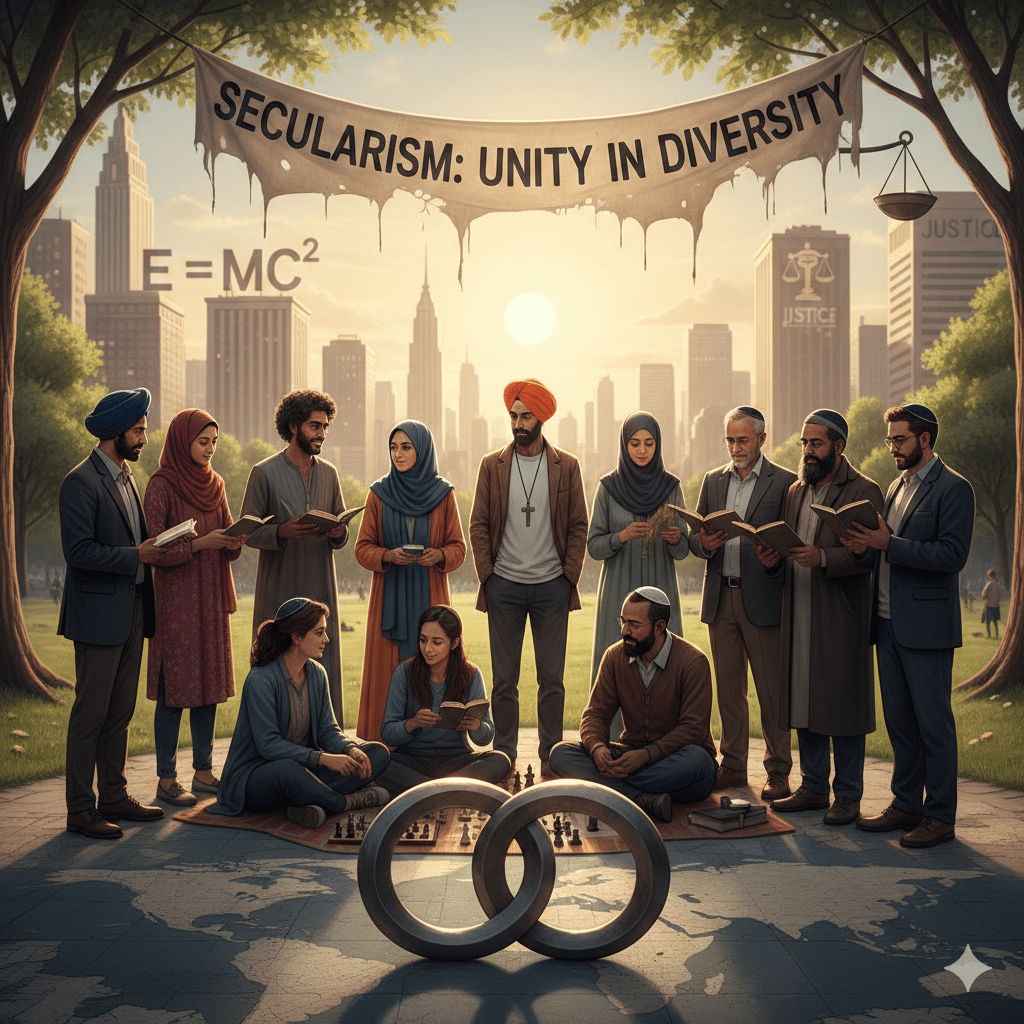
1. Definition: The Normative Separation of Spheres
In the developmental history of modern social and political theory, Secularism is defined as a normative political philosophy advocating for the systematic separation of religion from governmental and public affairs. Unlike "Secularization," which refers to the descriptive sociological process of religion losing influence, secularism is an ideology or principle that ensures religious beliefs do not dictate political decisions or legislative outcomes. Donald Eugene Smith, in his classic study India as a Secular State, defined the secular state as one which "guarantees individual and corporate freedom of religion, is not constitutionally connected to a particular religion, nor does it seek either to promote or interfere with religion." This definition implies a Legal-Rational framework where the state maintains a posture of Neutrality, treating all citizens as equal holders of rights regardless of their "Sacred" affiliations.
For a sociologist, the definition of secularism signifies the study of the Authoritative Allocation of secular space. It involves the belief that the public sphere should be governed by Rational-Critical debate rather than theological decree. By defining secularism as a Methodological Safeguard for pluralism, the discipline investigates how diverse communities coexist within a singular National Identity. This successfully transitioned the study of governance from "Divine Right" to a Social Contract, providing the analytical tools required to understand how a Social Fabric remains cohesive in a world that no longer shares a singular Collective Conscience.
2. Concept & Background: The Enlightenment Legacy
The conceptual background of Secularism is rooted in the 18th-century Enlightenment, which sought to liberate human reason from the "shackles of dogma." Historically, thinkers like John Locke and Thomas Jefferson argued for a "Wall of Separation" between Church and State to protect the Liberty of Conscience. This background represents a fundamental shift in the Theory of Legitimacy: the state derives its authority not from God, but from the Consent of the Governed. Secularism emerged as the prerequisite for Modernity, providing the ideological infrastructure for the rise of the neutral Nation-State.
Intellectual history shows that secularism was initially viewed as an Evolutionary milestone—the marker of a "mature" society that has outgrown its religious infancy. However, the background of this concept is also inextricably linked to Colonialism, as Western models of secularism were often exported to traditional societies as a benchmark for Civilization. Understanding this concept requires recognizing secularism as the Hegemonic Blueprint for modern governance, established through a rigorous internal moral code of secular ethics and scientific rationality, aimed at achieving Substantive Progress in a globalized world.
3. Emile Durkheim: The Secular Moral Order
Émile Durkheim provided a vital functionalist perspective on secularism. He argued that as traditional religion becomes less central due to the Division of Labor, society must develop a "Secular Moral Order." Durkheim famously noted that "if the gods are disappearing, it is because they are too far away." He sought to identify a secular basis for Social Solidarity that could fulfill the function previously held by religion.
From this perspective, secularism is the means to create a new Collective Conscience. Durkheim advocated for Moral Education in schools as a secular ritual to instill values of Duty and Discipline. His analysis proves that a republic cannot survive on laws alone; it requires a shared Secular Religion—the worship of the Human Person and the Common Good. This perspective highlights the Functional Requirement for secularism to act as the "Social Glue" of modernity, established through the Authoritative Allocation of Norms in a post-religious world.
4. Max Weber: The Disenchantment of the State
Max Weber viewed secularism through the lens of Rationalization and the "Disenchantment of the World." He argued that the rise of the modern, Bureaucratic state required the removal of magical and religious explanations from the machinery of government. Secularism, in the Weberian sense, is the hallmark of Legal-Rational Authority.
Weber tracing the Protestant Ethic showed that while religion gave birth to the "Spirit" of capitalism, the resulting social order became an "Iron Cage" that no longer needed its religious roots. From this viewpoint, secularism is a Mechanical System of procedural efficiency. However, Weber warned that this "Rationalized" state could lead to a Loss of Meaning. His analysis proves that secularism is the logical conclusion of Modernity, but it also creates the Disenchanted Citizen, who must find purpose in a world where the "Authoritative Word" of the priest has been replaced by the "Authoritative Data" of the scientist.
5. Critique: Marginalization and the Crisis of 'Alienation'
A profound critique of secularism comes from Religious Sociologists and Post-Colonial thinkers. They argue that the aggressive "Wall of Separation" (as seen in French Laïcité) can lead to the Social Marginalization of religious communities. Critics like Ashis Nandy and T.N. Madan have argued that secularism is an "alien" imposition in the Indian context, where religion is not just a belief but a Way of Life.
From this viewpoint, secularism can act as a Hegemonic Mask for the elite, effectively "Privatizing" the identities of the masses. Nandy argues that secularism is often "intolerant" of the Lived Religion of the Subaltern, leading to a state of Alienation and the rise of Communalism as a reactive mobilization. This critique suggests that "True" secularism must be Reflexive—accommodating the diversity of the Social Fabric rather than attempting to homogenize it through a cold, Instrumental Reason.
6. Indian Contextualization: Principled Distance (Paper II)
In Indian Society, secularism represents a unique Epistemological Synthesis. Unlike the Western model of "Separation," Indian secularism is characterized by "Sarva Dharma Sambhava" (Equal respect for all religions) or "Principled Distance" (Rajeev Bhargava). The Constitution of India (Preamble and Articles 25-30) ensures that while there is no state religion, the state can intervene in religious affairs to achieve Social Reform (e.g., the abolition of Untouchability or Triple Talaq).
B.R. Ambedkar utilized this "Principled Distance" to challenge the Structural Violence of the caste system. He argued for Constitutional Morality—where the secular rights of the Individual override the traditional laws of the community. Contemporary India illustrates a Conflict of Modernities: the "Nehruvian" secularism of the elite vs. the "Communitarian" religiosity of the ground. This proves that in the Indian Context, secularism is an ongoing Democratic Mobilization—a project of building a National Identity that reconciles Knowledge, Power, and Tradition in a quest for Substantive Equality.
7. Case Study: French Laïcité vs. The Indian Model
The contrast between French Laïcité and Indian Secularism serves as the definitive case study for Multiple Modernities. The French law of 1905 established a strict "Privatization" of religion, prohibiting religious symbols (like the Hijab or large crosses) in public schools.
Sociologically, this case study reveals the Paradox of Neutrality. While France aims for Formal Equality through the removal of symbols, it has triggered Reactive Mobilization among minority groups who feel their Cultural Identity is being erased. In contrast, the Indian model allows for State-Funded religious schools and personal laws, aiming for Substantive Justice through pluralistic accommodation. This study proves that what we call Social Solidarity depends on the Spatio-Temporal context of the Social Logic, reconciling Knowledge, Power, and the Body within a volatile national fabric.
Mains Mastery Dashboard
The concept of Secularism occupies a contentious epistemological space in contemporary sociology, representing a Total Social Fact that orchestrates the relationship between Power and the Sacred. In the Western context, secularism is typically associated with a "Wall of Separation" aimed at protecting Individual Agency from religious coercion. However, as articulated by Rajeev Bhargava, the Indian model is characterized by a "Principled Distance." This means the state is not "Indifferent" to religion, but maintains an Authoritative Allocation of intervention to promote Social Reform and Substantive Progress. B.R. Ambedkar utilized this framework to dismantle the Structural Violence of traditional hierarchies, asserting that Constitutional Morality must ensure that the Sovereignty of the Individual is protected from the Hegemony of the group.
This "Indian path" is profoundly challenged by sociologists like T.N. Madan and Ashis Nandy. Madan argues that secularism is an "alien" and "unfeasible" imposition on a society characterized by Communitarian Belonging. He posits that by forcing religion into the private sphere, the secular state effectively "disenchants" the Social Fabric, leading to a state of Anomie and reactive Communalism. Nandy supplements this by suggesting that secularism often acts as a Hegemonic Mask for the Westernized elite, which systematically marginalizes the Subaltern experience of faith. Thus, the struggle for secularism in India is a Democratic Mobilization aimed at achieving Cognitive Justice—recognizing that the "Secular" can only survive if it respects the "Traditional" without compromising on the Human Dignity of all citizens.
In CONCLUSION, secularization is not a linear movement toward the death of religion, but a Reflexive Reconfiguration of the public sphere. The sustainability of the Indian Republic depends on achieving a Dynamic Equilibrium between religious freedom and secular reform. Reconciling Knowledge, Power, and Agency requires moving beyond the binary of "Secularism vs. Communalism" toward a Reflexive Pluralism. By unmasking the limitations of both the Western "Wall" and the traditional "Dogma," sociology facilitates a more rational and equitable social existence, ensuring that the National Identity of modern states is a product of Substantive Inclusivity in a globalized world.
Revision Strategy: Keywords
- Laïcité: The French principle of strict secularism and privatization of religion.
- Principled Distance: The Indian model where the state intervenes for reform but respects all faiths.
- Sarva Dharma Sambhava: The ethos of equal respect and equal path for all religions.
- Constitutional Morality: Prioritizing democratic principles over traditional ritual laws (Ambedkar).
- Sacred Canopy: Berger’s term for the all-encompassing meaning provided by religion.
- Disenchantment: The loss of magical and spiritual meaning in a rationalized world (Weber).
