

Industrial Revolution: The Great Societal Rupture
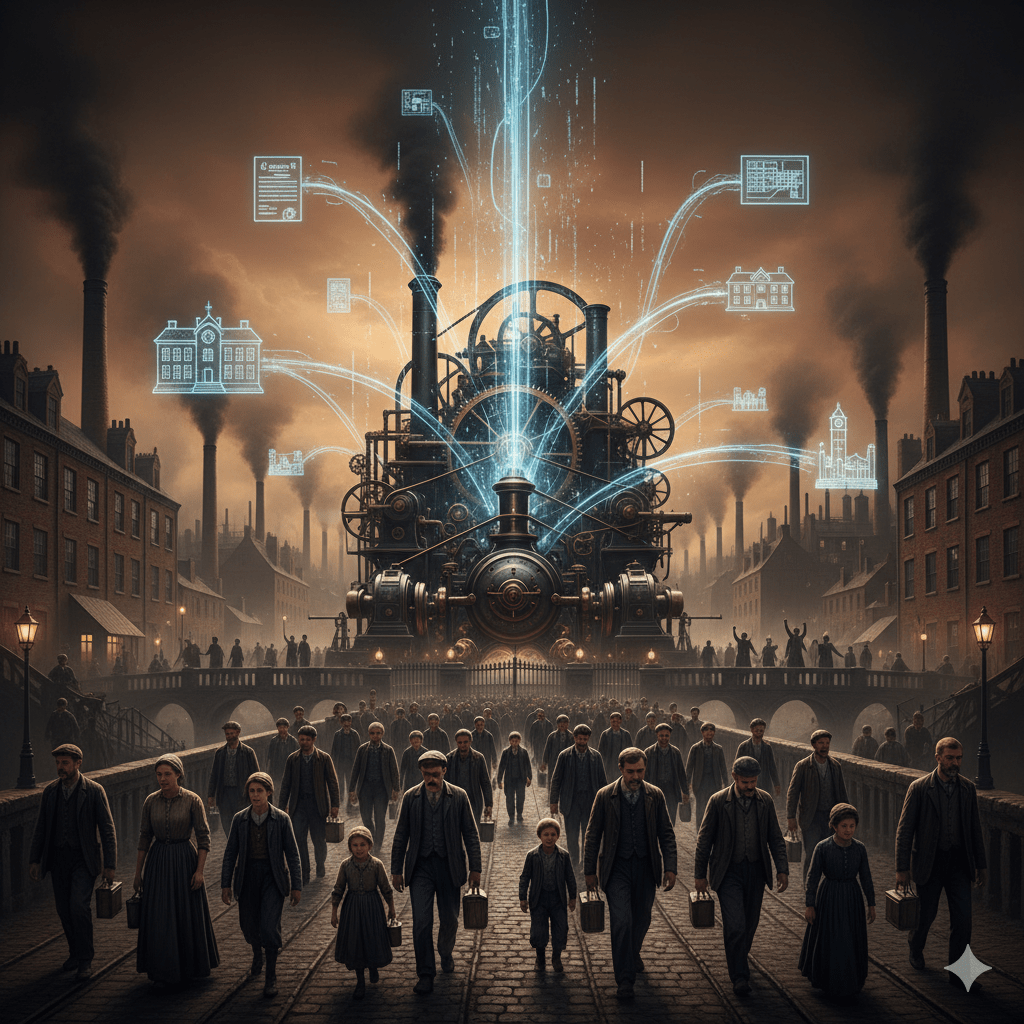
1. Definition: The Epoch of Mechanical Transformation
In the intellectual architecture of sociology, the Industrial Revolution is defined as a transformative historical epoch, beginning in the mid-18th century, characterized by the transition from agrarian and handicraft-based economies to ones dominated by machine manufacturing and the factory system. While historians focus on technological breakthroughs like the steam engine, sociologists define it as the "Great Rupture" that fundamentally reorganized human social existence. Karl Marx analyzed it as the material foundation of modern Capitalist Societies, marking the shift from feudal relations to a world defined by the Commodification of Labor and systemic class divisions.
For a sociologist, the definition of the Industrial Revolution signifies the birth of Industrial Modernity. It involves the authoritative allocation of social roles through the Division of Labor rather than tradition or kinship. By defining society as a site of Structural Differentiation, the revolution moved the center of social gravity from the village to the industrial metropolis. This successfully transitioned the study of society from "social philosophy" to a formal science, as thinkers like Auguste Comte sought to understand the resulting social instability and the new mechanisms required for Social Order in an era where the old sacred bonds had been irrevocably severed.
2. Concept & Background: The Logic of the Machine
The conceptual background of the Industrial Revolution is rooted in the Scientific Revolution and the Enlightenment, which prioritized Rationality and Efficiency over tradition. The background represents a fundamental shift in the Mode of Production; the "Domestic System" (where artisans worked at home) was replaced by the Concentrated Factory System. This change was not just technical but deeply social, as it required the Proletarianization of the peasantry—the process of stripping individuals of their land and tools, forcing them to sell their Labor Power for a wage.
Intellectual history shows that the revolution triggered massive Urbanization. In 1800, only 3% of the world's population lived in cities; by 1900, Britain had become the first truly urban nation. This background moved the focus of social science toward the Anomie (normlessness) of the city. Sociologists began to analyze how the factory environment reshaped Family Dynamics, transitioning the unit from a production-based extended family to a consumption-based nuclear family. Understanding this concept requires recognizing the Industrial Revolution as the prerequisite for Global Capitalism, providing the material infrastructure for the modern World-System.
3. Marxist Perspective: Polarization and Alienation
From the Marxist perspective, the Industrial Revolution is the story of polarization. Marx argued that the centralization of machinery in factories created two mutually exclusive classes: the Bourgeoisie (who own the Means of Production) and the Proletariat (who possess only their labor). The revolution solidified Exploitation because the surplus value produced by the worker was appropriated by the capitalist to fuel further industrial expansion.
A key feature of this perspective is Alienation. Marx posited that the specialized, repetitive nature of factory work during the revolution estranged the worker from the product, the process, their fellow humans, and ultimately their own "Species-Being." For Marxists, the Industrial Revolution was a necessary historical evil; while it created immense Material Wealth, it also generated the Class Consciousness and structural contradictions that would eventually pave the way for the socialist transformation of the social order.
4. Max Weber: Rationalization and the Iron Cage
Max Weber viewed the Industrial Revolution through the lens of Rationalization—the systematic application of logic and efficiency to every sphere of social life. He identified that the revolution was not just about coal and iron, but about a "Calculable Reality." The industrial era demanded Bureaucracy, precise timekeeping (the factory whistle), and technical competence.
Weber famously warned of the "Iron Cage" of modernity. He argued that the very efficiency that made the Industrial Revolution successful would eventually strip society of its Meaning and Mystery (the Disenchantment of the world). From this viewpoint, the industrial worker is a component of a Rationalized System that prioritizes the "bottom line" over humanistic values. Weber’s analysis proves that the revolution did not just change how we make things; it changed how we think, replacing the traditional authority of the past with a cold, Legal-Rational Authority structure.
5. Functionalism: Social Differentiation and Solidarity
In contrast to the conflict models, Emile Durkheim and the functionalist tradition viewed industrialization as a process of differentiation. Durkheim argued in The Division of Labour in Society that the Industrial Revolution facilitated the shift from Mechanical Solidarity (unity based on similarity) to Organic Solidarity (unity based on Interdependence). In the industrial system, individuals perform highly specialized tasks, making them functionally dependent on others for the survival of the whole.
Functionalists acknowledge that the rapid transition caused by the revolution led to Anomie—a temporary breakdown of moral regulation. However, they believe that through the development of Professional Ethics and state regulation, the industrial social organism achieves a higher state of Equilibrium. For Durkheim, the revolution was the primary driver of Social Evolution, creating a complex social fabric where the individual gains autonomy while remaining structurally bound to the Collective Conscience through mutual need.
6. Indian Contextualization: Colonialism and De-industrialization
In Indian Society, the Industrial Revolution was experienced not as an endogenous growth but as a Colonial Imposition. While Europe industrialized, India underwent De-industrialization. The British utilized the machine-made products of the revolution (like Lancashire cotton) to dismantle India's traditional artisanal textile sector. Dadabhai Naoroji famously conceptualized this as the "Drain Theory," where the wealth of India was siphoned off to fuel the Industrial Revolution in the West.
Furthermore, the colonial industrial encounter rigidified the Caste System in urban settings. As migrants flocked to the new industrial belts of Bombay and Calcutta, they often settled in Caste-based Chawls, proving that industrial modernity does not automatically dissolve traditional identities. Post-independence, Jawaharlal Nehru sought to replicate the industrial model through "Temples of Modern India" (heavy industries), aiming to achieve Social Progress through state-led planning. The contemporary era of LPG Reforms (1991) represents India’s "Second Industrial Revolution," characterized by the Knowledge Economy and the rise of a globalized middle class, highlighting the ongoing tension between Tradition and Market Rationality.
7. Case Study: The British Textile Industry
The British Textile Industry of the 19th century serves as the definitive case study for the Sociology of Labor. Concentrated in cities like Manchester (termed "Cottonopolis"), this industry showcased the most extreme effects of the Industrial Revolution. It relied on pauper children and women for their cheap labor and nimble fingers, working in "Satanic Mills" for 14-16 hours a day.
Sociologically, this case study reveals the Structural Violence of early capitalism. It led to the birth of the Trade Union Movement and the first Factory Acts, representing the beginning of the Welfare State. This study proves that social rights are not "granted" by the market but are reclaimed through struggle. For sociologists, the textile mills remain the archetypal site of the Conflict between Capital and Labor, illustrating how the Production of Wealth is inextricably linked to the Production of Inequality in the industrial age.
Mains Mastery Dashboard
The Industrial Revolution represents the most profound structural transformation in human history, orchestrating the transition from a society based on Ascribed Status to one governed by Rational-Legal Contract. Prior to the industrial rupture, the Social Order was characterized by Mechanical Solidarity, where kinship and traditional hierarchy dictated an individual's Life Chances. With the rise of the Factory System, these pre-modern bonds were replaced by impersonal, achievement-oriented relationships. As noted by Henry Maine, modern social progress is essentially the movement from the "circle of the family" (Status) to the "freedom of the individual" (Contract).
This shift fundamentally altered the Family Structure. In agrarian societies, the family was a Unit of Production, where the extended kin-group collaborated on common land. Industrialization necessitated Geographical Mobility, leading to the emergence of the Nuclear Family. As analyzed by Talcott Parsons, the nuclear family became functionally specialized to handle "Primary Socialization" and the "Stabilization of Adult Personalities," while leaving economic production to the Rationalized Market. Simultaneously, the Division of Labor became highly specialized. According to Emile Durkheim, this created a new form of Organic Solidarity based on Interdependence. In the Indian context, while industrialization promoted Secularization, traditional Caste-based labor divisions often persisted within the modern factory chawls, creating a Dual-Identity for the Indian worker.
In CONCLUSION, the Industrial Revolution acted as a Total Social Fact that dismantled the traditional sacred order to build the secular, bureaucratic Iron Cage of modernity. While it provided the Material Progress and individual rights necessary for a democratic society, it also generated new forms of Alienation and Systemic Inequality. Reconciling Knowledge, Power, and Agency in the post-industrial era requires understanding these historical roots, ensuring that the transition to Contract does not lead to the total erosion of Social Solidarity. Industrialization remains the primary lens through which sociology evaluates the ongoing Dialectic of Modernization and the quest for Substantive Equality.
Revision Strategy: Keywords
- Proletarianization: The process of turning independent producers into wage laborers.
- Alienation: The estrangement of individuals from their work and humanity (Marx).
- Organic Solidarity: Cohesion based on functional interdependence (Durkheim).
- Disenchantment: The loss of sacred meaning in a rationalized world (Weber).
- Drain Theory: Naoroji’s concept of the colonial extraction of Indian wealth.
- De-industrialization: The dismantling of a region’s industrial capacity by a colonial power.
