

Commercial Revolution: The Foundations of Global Capitalism
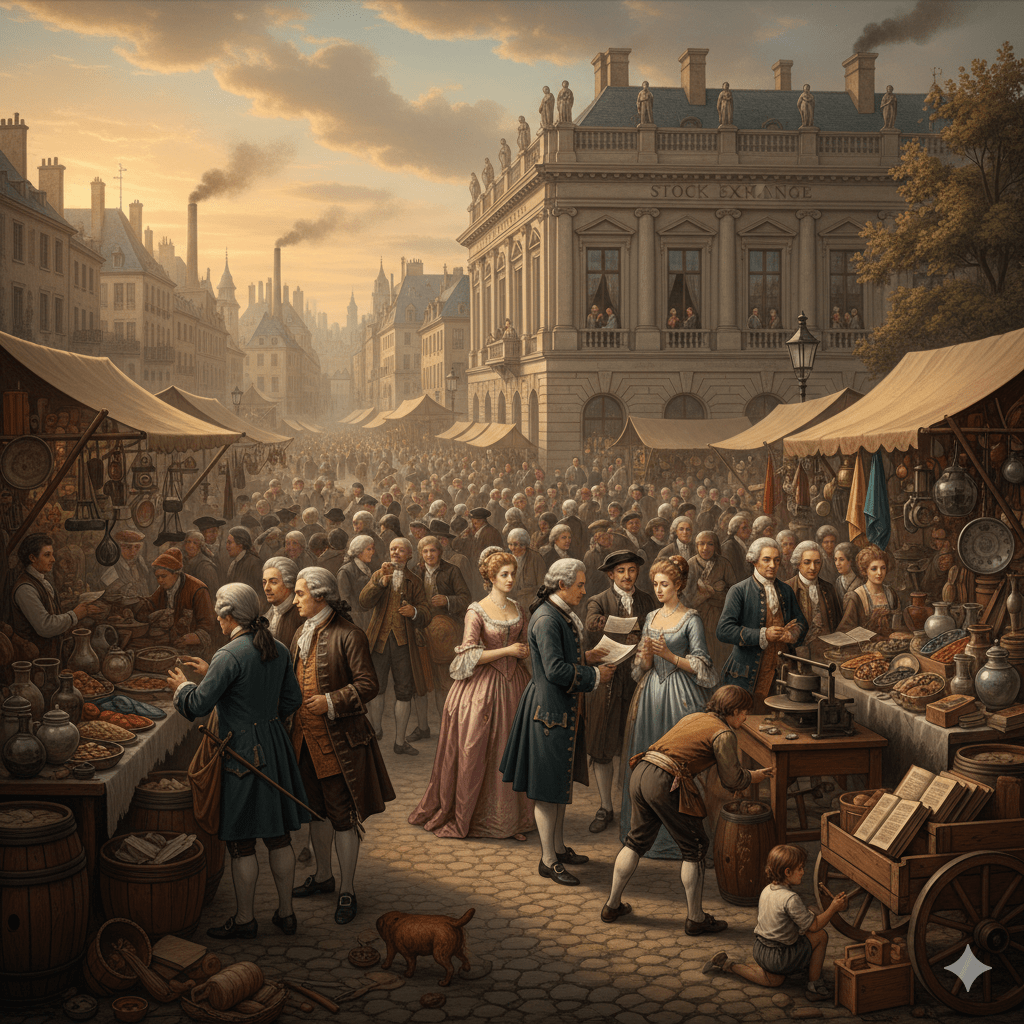
1. Definition: The Economic Expansion of Europe
The Commercial Revolution represents a pivotal era of European economic expansion that fundamentally altered the global social fabric between the 13th and 18th centuries. Defined with intellectual rigor by the renowned historian Fernand Braudel, this period was characterized by a massive surge in trade, commerce, and financial complexity, which collectively orchestrated the rise of capitalism. Braudel emphasized that the revolution was not merely a change in volume but a structural transformation where market logic began to penetrate traditional social relations. It involved the establishment of global trade networks that connected the European core with the distant peripheries of Asia, Africa, and the Americas, setting the stage for modern economic globalization.
At its core, this revolution signified the transition from localized, subsistence-based feudal economies to a money economy driven by profit motives and capital accumulation. For a sociologist, the definition of the Commercial Revolution extends beyond balance sheets; it is viewed as a total social fact (Marcel Mauss) that restructured class hierarchies, altered the nature of labor, and introduced the joint-stock company as a new form of collective social agency. This era successfully moved the study of value away from land ownership toward the liquidity of capital, providing the indispensable material foundation for the subsequent Industrial Revolution.
2. Concept & Intellectual Background
The conceptual origins of the Commercial Revolution lie in the late medieval period, specifically the Crusades, which reopened European access to the luxury goods of the East. This initial spark led to the Age of Discovery, where the quest for spices and precious metals drove European monarchs to finance transoceanic voyages. The intellectual background of this era is defined by the emergence of Mercantilism—the belief that a nation’s power is directly proportional to its accumulation of bullion. This ideology drove states to centralize their economies and establish overseas colonies, creating a symbiotic relationship between sovereign power and merchant capital.
As trade routes expanded, the traditional feudal order, based on reciprocity and fixed status, began to dissolve. In its place, early capitalist markets introduced financial innovations such as double-entry bookkeeping, marine insurance, and the banking systems of cities like Venice and Amsterdam. These innovations were not just technical; they represented a rationalization of social life (Max Weber), where risk was calculated and time was commodified. This background highlights that the Commercial Revolution was the primary engine of the "Great Divergence," where Western Europe began to outpace the rest of the world through the systematic monopolization of global commerce.
3. Detailed Sociological Perspectives
A. Max Weber’s Protestant Ethic: The Spirit of Capitalism
Max Weber provided a definitive sociological perspective on the Commercial Revolution by linking the rise of capitalism to the Protestant work ethic. In his seminal work, The Protestant Ethic and the Spirit of Capitalism, Weber suggested that religious values, particularly those of Calvinism, fostered the economic changes necessary for the revolution. The belief in "Worldly Asceticism" and the concept of the "Calling" encouraged individuals to work tirelessly and reinvest their profits rather than indulging in luxury. This psychological shift provided the cultural legitimacy for capital accumulation, transforming the pursuit of wealth from a moral sin into a sign of divine grace. Weber’s analysis proves that the Commercial Revolution was not just a result of new trade routes, but a rationalizing force that emerged from the depths of the European collective conscience.
B. Marxist Analysis: Primitive Accumulation and Class Shift
From a Marxist perspective, the Commercial Revolution is analyzed as the era of "Primitive Accumulation." Karl Marx argued that this period was the essential precursor to industrial capitalism, characterized by the violent separation of the producer from the means of production. The wealth generated through colonial exploitation and the Atlantic Slave Trade provided the "starting capital" for the European bourgeoisie. This perspective emphasizes that the revolution altered class relations, creating a new class of merchant capitalists who eventually challenged the traditional landed aristocracy. For Marxists, the Commercial Revolution was the moment when commodity fetishism began to take root, as the social relations between people were increasingly mediated by the exchange of goods in a global market.
C. World-Systems Theory: Core and Periphery
Immanuel Wallerstein’s World-Systems Theory suggests that the Commercial Revolution initiated the Modern World System, a global hierarchy defined by unequal exchange. Wallerstein argued that during this period, Western Europe emerged as the "Core," utilizing its superior naval and financial power to dominate the "Periphery" (colonies). The revolution facilitated the flow of raw materials from the periphery to the core, where they were processed into high-value goods. This sociological lens reveals that the Commercial Revolution was not a rising tide that lifted all boats; instead, it was a process of structural dependency that ensured the enrichment of Europe at the expense of the systemic underdevelopment of the Global South.
4. Indian Contextualization (Paper II Integration)
In the context of Indian Society, the Commercial Revolution arrived in the form of the European trading companies, most notably the British East India Company (EIC). Before this encounter, India was a manufacturing powerhouse, contributing nearly 25% of the world's GDP through its artisan-based textile industry. The Commercial Revolution restructured this reality by integrating India into a mercantilist network that prioritized the export of raw cotton and the import of finished British cloth. This process, often termed De-industrialization by Indian sociologists, led to the destruction of self-sufficient village economies and the ruralization of the population as artisans were forced back to the land.
Furthermore, the revolution impacted the Social Stratification of India. The emergence of a comprador bourgeoisie—local merchants who acted as intermediaries for European capital—created new status groups in urban centers like Calcutta and Bombay. These groups often adopted Westernization as a cultural tool for social mobility, creating a divide between the urban elite and the rural masses. Thus, the Commercial Revolution in India was a double-edged sword: it introduced modern capitalist institutions and a unified market, but it did so through a colonial logic that subordinated Indian interests to the requirements of the British Metropolis.
5. Real-Life Global Examples
- The Rise of Banking Centers: The development of advanced banking and credit systems in cities like Venice and later Amsterdam allowed Europe to finance large-scale voyages. This financial centralization enabled the Dutch East India Company (VOC) to become the world's first multi-national corporation, illustrating how financial innovation is a prerequisite for global commercial dominance.
- Colonial Trade Hubs: The transformation of ports like Canton (China) and Calcutta (India) into global trade hubs shows how the revolution reoriented local geographies toward the needs of international commerce. The forced opening of these markets through Gunboat Diplomacy represents the intersection of commercial interests and imperial power.
6. Case Study: The British East India Company
The British East India Company (EIC) serves as the definitive case study for the Commercial Revolution. Founded as a joint-stock company in 1600, it transitioned from a purely commercial entity into a sovereign political power. The EIC’s monopoly over trade in the Indian subcontinent allowed it to influence local politics, culminating in the Battle of Plassey (1757). This event transformed the company into the Diwan (Tax Collector) of Bengal, marking the moment when commercial extraction became a function of state governance.
Sociologically, the EIC represents the blend of commercial and colonial interests. It utilized bureaucratic centralization to manage its vast territories, creating the Covenant Civil Service to ensure efficient revenue collection. The company’s activities led to the Drain of Wealth (Dadabhai Naoroji), where Indian surplus was unilaterally transferred to Britain. This case study confirms the World-Systems claim that the Commercial Revolution was the mechanism through which the European core established hegemony over the global periphery, permanently altering the developmental trajectory of colonized nations.
Mains Mastery Dashboard
The Commercial Revolution, spanning the 13th to 18th centuries, was the foundational catalyst for the emergence of modern capitalism. According to Fernand Braudel, this era marked a structural shift from feudal subsistence to a money economy characterized by the surge in long-distance trade and the rationalization of finance. By introducing innovations like joint-stock companies and marine insurance, the revolution facilitated the concentration of capital, providing the necessary liquidity for the later Industrial Revolution. Max Weber further noted that this period was propelled by the Protestant Ethic, which transformed capital accumulation into a socially and religiously sanctioned rational calling.
However, the rise of capitalism was intrinsically linked to global inequalities, a phenomenon best explained by Immanuel Wallerstein’s World-Systems Theory. Wallerstein posits that the Commercial Revolution initiated a Modern World System divided into a high-technology "Core" (Western Europe) and an extractive "Periphery" (colonized regions). Through unequal exchange, the core utilized its financial and naval hegemony to siphon raw materials and labor from the periphery, stunting local development while fueling European wealth. In India, this was visible as the British East India Company dismantled the indigenous textile industry to serve the mercantilist needs of the Metropolis, leading to systemic De-industrialization.
In CONCLUSION, the Commercial Revolution was not merely an expansion of trade but a totalizing social transformation. While it birthed the modern market economy and global connectivity, its legacy remains one of structural dependency and persistent North-South disparity. Understanding this revolution is essential for sociologists to decipher how the current global economic hierarchy was historically constructed through the monopolization of commerce and the systemic exploitation of the periphery during the transition to early capitalism.
Revision Strategy: Keywords
- Mercantilism: Economic policy prioritizing bullion accumulation and colonial monopolies.
- Joint-Stock Company: A precursor to corporations allowing for the pooling of capital and risk.
- Core-Periphery: Wallerstein’s model of global structural inequality and dependency.
- Primitive Accumulation: The initial stage of capital formation via extraction and exploitation (Marx).
- Money Economy: A social system where currency replaces land/status as the primary medium of exchange.
- Rationalization: The Weberian process of applying calculation and efficiency to economic life.
