

Conflict Theory: The Dialectics of Power
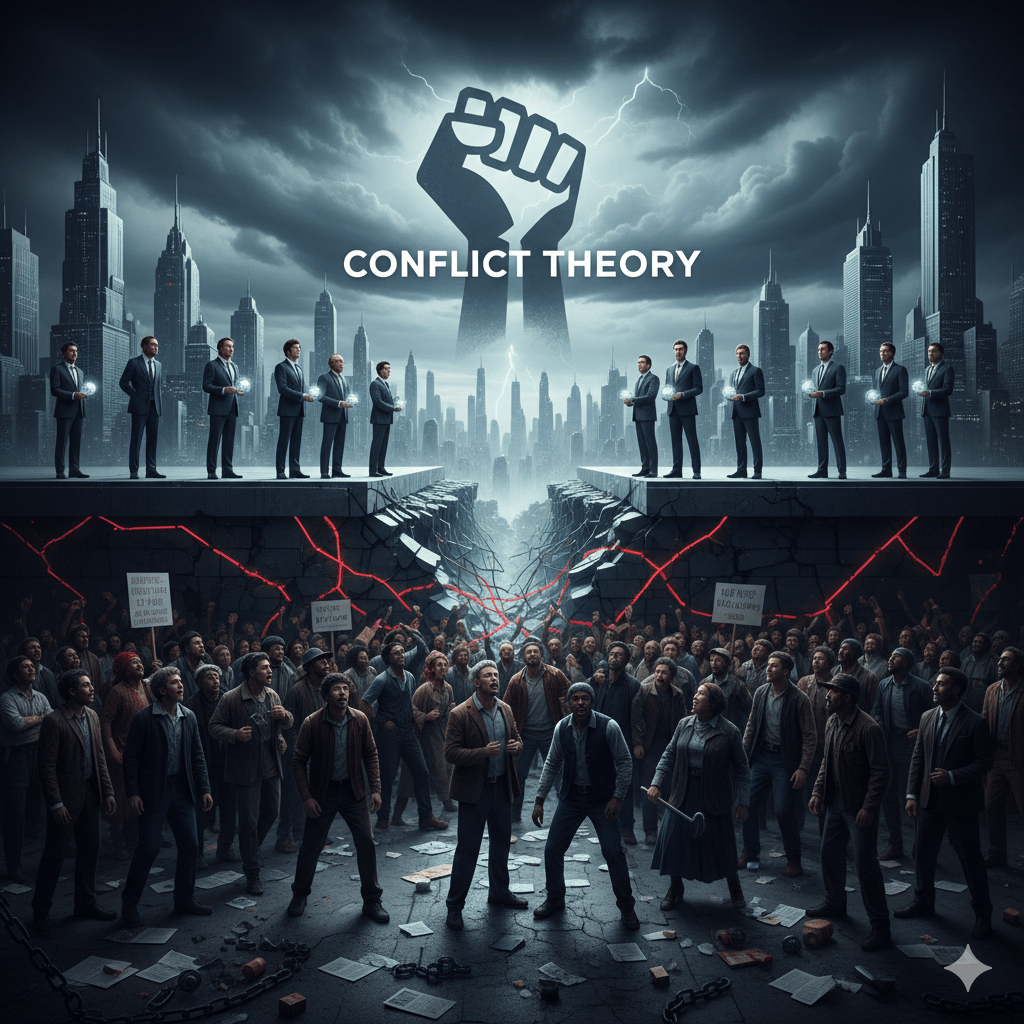
1. Definition: The Perpetual Struggle for Resources
Conflict Theory, fundamentally anchored in the intellectual legacy of Karl Marx, posits that social life is not characterized by consensus or stability but by a perpetual state of conflict and competition. At its core, the theory argues that society is a collection of diverse groups with competing interests, primarily driven by the unequal distribution of limited and valued resources such as wealth, power, and prestige. Social structures and institutions are seen not as functional organs of a harmonious body, but as the outcomes of power struggles where dominant groups establish rules to preserve their own advantages.
Unlike consensus-based models, Conflict Theory suggests that domination and coercion are the actual mechanisms that maintain social order. The definition emphasizes that inequality is not a natural occurrence but a structural outcome of historical processes where one group exercises control over another. For a sociologist, this perspective implies that every social interaction involves a subtle or overt negotiation of power, and that social change is only achieved through the disruption of these existing hierarchies by the marginalized or exploited classes.
2. Concept & Intellectual Background
The conceptual emergence of Conflict Theory in the mid-20th century served as a radical critique of Structural Functionalism. While functionalists like Talcott Parsons viewed society as a self-regulating system seeking equilibrium, conflict theorists argued that this view was inherently conservative and ignored the harsh realities of social exploitation. They asserted that functionalism served to legitimize the status quo by masking the ways in which social systems benefit the powerful at the expense of the disenfranchised. This shift was essential for the discipline to engage with the turbulent social movements of the 1960s and 70s.
The background of this theory is deeply rooted in Historical Materialism, which views the economic base of society (the mode of production) as the primary shaper of the legal and political superstructure. Intellectual history shows that conflict theory has evolved from a narrow focus on industrial class struggle to a broader examination of racial, ethnic, and gender-based conflicts. Understanding this concept requires recognizing that conflict is not necessarily violent or disruptive in the short term; rather, it is a continuous undercurrent that informs the development of laws, education, and religion, ensuring that the interests of the ruling class are consistently prioritized.
3. Detailed Sociological Perspectives
A. Classical Marxism: The Proletariat-Bourgeoisie Binary
Karl Marx argued that history is a series of class struggles between those who own the means of production (the Bourgeoisie) and those who must sell their labor to survive (the Proletariat). In this perspective, the capitalist system is inherently exploitative because the bourgeoisie extracts surplus value from workers, leading to inevitable alienation. Marx believed that as the contradictions of capitalism intensified, the proletariat would eventually develop class consciousness, transitioning from a "class-in-itself" to a "class-for-itself," ultimately resulting in a proletarian revolution that would dismantle private property and establish a classless society.
B. Weber’s Extension: Multi-Dimensional Conflict
Max Weber significantly expanded Conflict Theory by arguing that social conflict is not limited to economic factors alone. He introduced the trinity of stratification: Class (economic position), Status (social honor), and Party (political power). Weber emphasized that groups might compete for status or political influence even when their economic interests align. This perspective allows for a more nuanced understanding of how bureaucratic centralization and legal-rational authority create new sites of conflict, proving that power can be exercised through administrative control and social exclusion as much as through capital ownership.
C. Neo-Marxism and Ideological Control
Thinkers like Louis Althusser and Antonio Gramsci shifted the focus toward the role of ideology in maintaining control. Althusser introduced the concept of Ideological State Apparatuses (ISAs), arguing that institutions like the media, family, and education system work to socialize individuals into accepting ruling-class ideologies as "common sense." Gramsci’s concept of Cultural Hegemony further explains how the dominant group wins the spontaneous consent of the masses by controlling the cultural and intellectual narrative. This sociological lens reveals that conflict is often suppressed not through force, but through the subtle manipulation of consciousness.
4. Indian Contextualization (Paper II Integration)
In Indian Society, Conflict Theory provides a vital lens to analyze the Caste System not as a functional hierarchy of ritual purity, but as a rigid structure of economic and social exploitation. B.R. Ambedkar utilized a conflict-oriented approach to argue that the Varna model was a "graded inequality" designed to prevent the unified resistance of the lower castes. The contemporary rise of Dalit Consciousness and the demand for reservations can be seen as a direct manifestation of class and status conflict within the democratic framework, where traditional hierarchies are challenged by political mobilization.
Furthermore, the Agrarian Crisis and Tribal Land Struggles (e.g., in the Naxalite belt) exemplify the clash over natural resources between the state-backed corporate interests and the indigenous populations. Sociologists like A.R. Desai have applied Marxist frameworks to show how the Indian State often acts as an instrument of the National Bourgeoisie, leading to the dispossession of tribal communities. This highlights that in the Indian context, conflict is often intersectional, involving the overlapping dimensions of Caste, Class, and Ethnicity, making the struggle for social justice a central theme of modern Indian sociology.
5. Real-Life Global Examples
- Labor Strikes and Trade Unions: The history of the labor movement represents the classic clash between labor and management. Strikes over wages, safety, and working conditions highlight the inherent power imbalance in capitalist production and the use of collective action to negotiate a larger share of the surplus.
- Environmental Conflict: The global struggle between extractive industries and environmental activists (like the Standing Rock protests) illustrates conflict theory’s focus on the authoritative allocation of resources. It pits the economic goals of the global core against the survival and land rights of the periphery.
6. Case Study: The 1968 Student Protests in France
The May 1968 protests in France serve as a quintessential case study of Conflict Theory in action. What began as a student movement against the rigid and hierarchical educational system quickly evolved into a massive general strike involving over 10 million workers. This movement saw an unprecedented alliance between the intelligentsia and the proletariat, united by a shared sense of alienation under the Gaullist regime.
Sociologically, this event demonstrated how institutionalized inequality in the labor and education sectors can reach a breaking point, leading to widespread political upheaval. The protests challenged not just economic policies but the very Cultural Hegemony of the ruling elite, demanding a more participatory democracy. Although the movement did not result in a total revolution, it forced massive structural concessions and forever altered the social fabric of Western Europe, proving that conflict is the primary driver of social evolution and institutional reform.
Mains Mastery Dashboard
Conflict Theory, rooted in Marxian dialectics, posits that social change is the product of inherent contradictions within social structures. Karl Marx argued that the struggle between the Bourgeoisie and the Proletariat over the means of production is the "engine" of history, as each era’s conflict leads to a higher stage of social development. In this view, class conflict is the primary mechanism that disrupts the status quo, eventually leading to revolutionary transformation and the dismantling of exploitative structures.
Modern sociological extensions, however, emphasize that conflict is multi-dimensional. Max Weber expanded the theory by illustrating that Status groups and Political Parties are equally significant sites of struggle, where actors compete for social honor and administrative control. This is complemented by Neo-Marxists like Antonio Gramsci, who highlighted that Cultural Hegemony—the dominance of ruling-class values—must be challenged through ideological struggle. In the Indian context, the transition from a rigid Caste-based hierarchy to a competitive political democracy illustrates how conflict over reservations and identity has become the primary driver of upward mobility and social reform.
In CONCLUSION, while Structural Functionalism emphasizes stability, Conflict Theory provides a more realistic understanding of social dynamics. It proves that conflict is not merely a dysfunctional anomaly but a structural necessity that forces institutions to adapt and evolve. By recognizing that power struggles are embedded in all social relations—from labor strikes to student protests—sociologists can interpret social change as a continuous process of renegotiating the social contract, ensuring that the interests of the marginalized are eventually addressed through structural disruption and institutional evolution.
Revision Strategy: Keywords
- Dialectical Materialism: The theory that material conditions and their contradictions drive history.
- Class Consciousness: The awareness of one's objective position in the class hierarchy.
- Cultural Hegemony: The spontaneous consent given by the masses to the dominant group (Gramsci).
- Surplus Value: The profit created by workers that is appropriated by the bourgeoisie.
- Alienation: The estrangement of individuals from their work, self, and society under capitalism.
- Life Chances: Weber’s term for the opportunities individuals have to improve their quality of life.
