

Equality: Rights, Justice, and the Social Fabric
1. Definition: The Principle of Uniform Worth
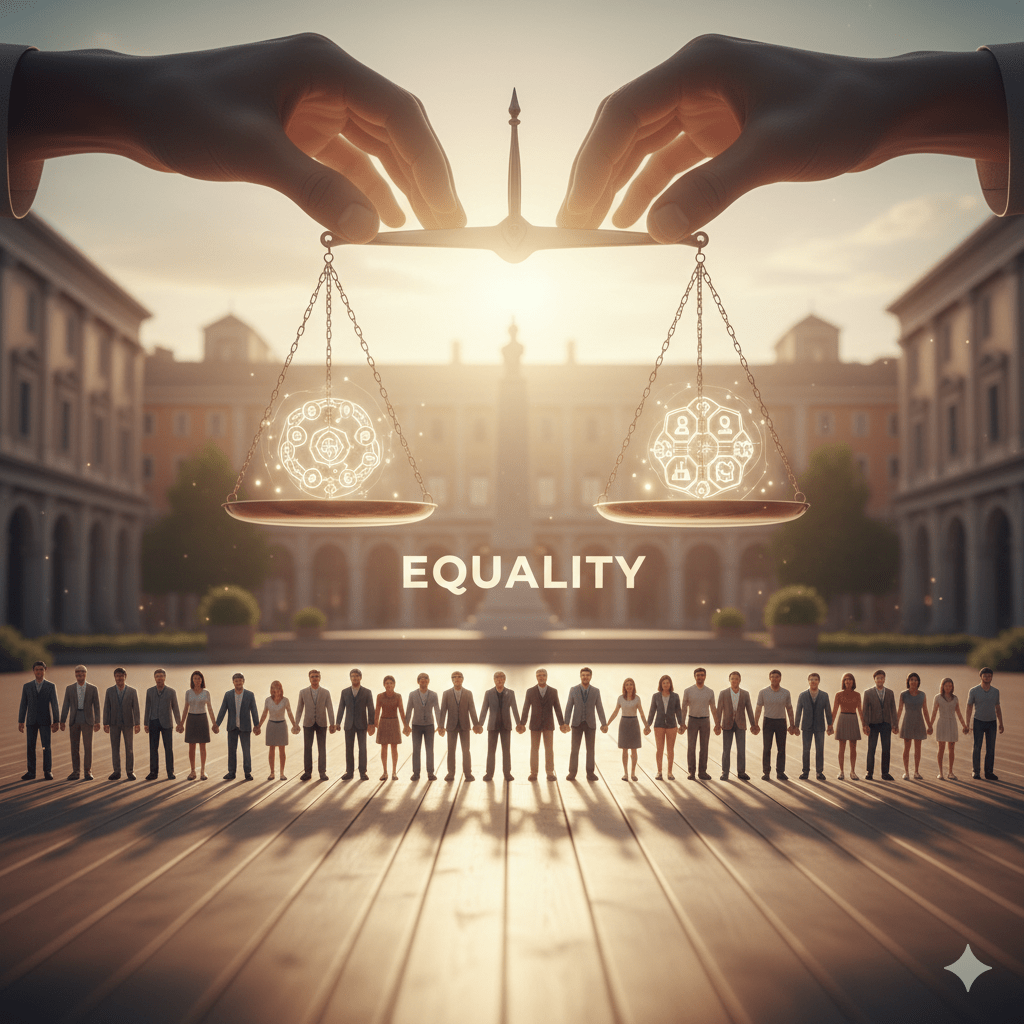
In the rigorous lexicon of social and political theory, Equality is defined as the state or condition of being equal, specifically regarding status, rights, and opportunities. It is the normative ideal that all individuals, by virtue of their shared humanity, possess an inherent worth that entitles them to impartial treatment within the social structure. Sociologically, equality is not merely a mathematical concept of "sameness" but a foundational principle for Social Justice. Early analysts like Alexis de Tocqueville famously examined equality in 19th-century democratic societies, particularly in his work Democracy in America, where he noted that the "passion for equality" was a defining characteristic of modern civilization that carried both the promise of Individual Empowerment and the risk of the "Tyranny of the Majority."
For a sociologist, the definition of equality is multifaceted, distinguishing between Formal Equality (de jure), where laws provide equal standing, and Substantive Equality (de facto), where individuals possess the actual means and resources to exercise their rights. By defining equality as a Social Construct, the discipline investigates how barriers—ranging from historical prejudice to contemporary economic concentration—prevent the realization of this ideal. Equality acts as the moral compass for the Modern State, providing the legitimacy required for Social Integration and the democratic allocation of values.
2. Concept & Dimensions: The Pursuit of Parity
The conceptual background of Equality represents the intellectual core of the Enlightenment project, which sought to replace the fixed, ascribed hierarchies of the feudal order with a meritocratic system based on reason and rights. Equality is analyzed across three primary dimensions: Class (economic parity), Status (social honor and prestige), and Power (political influence). This background emphasizes that systemic inequalities are not "natural" occurrences but are embedded into the design of social systems. Intellectual history shows that the quest for equality has evolved from a narrow focus on legal citizenship to a broader demand for intersectional justice.
Empirically, the background of equality is often illustrated through the Wealth and Income Gap. According to the Oxfam World Inequality Report (2024), the top 1% of the global population captured nearly 38% of all additional wealth accumulated since 1995, while the bottom 50% captured just 2%. These concrete numbers highlight the Structural Inequities that sociology seeks to deconstruct. Understanding this concept requires recognizing that equality is the prerequisite for Social Cohesion; high levels of inequality are consistently linked to social fragmentation, lower life expectancy, and the erosion of collective trust in institutions.
3. Perspective I: Conflict Theory and Materialism
From the Conflict perspective, Karl Marx viewed equality as an essential but impossible goal under the framework of Capitalism. Marx argued that capitalism inherently creates economic inequality because the Bourgeoisie (owners of the means of production) must exploit the Proletariat (laborers) to generate surplus value. For Marxists, true equality can only be achieved through the dismantling of private property and the establishment of a classless society where resources are distributed according to the principle: "From each according to his ability, to each according to his needs." This perspective highlights that the "equality" promised by liberal democracy is often a hegemonic mask that hides the reality of economic domination.
4. Perspective II: Functionalism and Necessary Inequality
In contrast to Marx, the Functionalist school, led by Emile Durkheim and later refined by Davis and Moore, suggests that some degree of inequality is not only inevitable but functional for society. Durkheim argued that as the Division of Labor becomes more complex, individuals must fill different roles based on their talents. Davis and Moore (1945) posited in their Functional Theory of Stratification that society must offer greater rewards (prestige and income) to the most important and difficult positions to ensure they are filled by the most competent people. In this view, equality of opportunity is the goal, but Equality of Outcome would be dysfunctional, as it would destroy the motivational structure required for societal progress and Organic Solidarity.
5. Perspective III: Feminist Theory and Gender Justice
Feminist scholars argue that equality can never be achieved without addressing Patriarchy—the systemic domination of women by men. Feminist theory critiques the "gender-blind" nature of classical sociology, revealing how institutions like the family and the labor market perpetuate Gender-Based Inequalities. The World Economic Forum’s Global Gender Gap Report (2023) estimated that at the current rate of progress, it will take 131 years to reach full global parity. Feminists advocate for Substantive Equality, which includes policies like equal pay for work of equal value and the recognition of "unpaid care work" as a social contribution. This perspective emphasizes that Individual Rights are hollow if one's gender restricts access to the public sphere or personal autonomy.
6. Indian Contextualization (Paper II Integration)
In Indian Society, the struggle for equality is defined by the intersection of Caste, Gender, and Class. The Constitution of India (Articles 14 to 18) enshrines equality as a fundamental right, seeking to abolish the traditional hierarchy of Untouchability. B.R. Ambedkar famously noted the contradiction of modern India: "In politics we will be recognizing the principle of one man one vote and one vote one value. In our social and economic life, we shall, by reason of our social and economic structure, continue to deny the principle of one man one value." This highlights the gap between Formal and Substantive Equality in the country.
The policy of Reservation (Affirmative Action) is the primary tool used by the Indian state to achieve Compensatory Equality for Scheduled Castes (SCs), Scheduled Tribes (STs), and Other Backward Classes (OBCs). The Mandal Commission (1980) identified that OBCs constituted 52% of the population, leading to the 27% reservation in government jobs to ensure Representative Equality. Furthermore, the PLFS (Periodic Labour Force Survey) 2022-23 reveals that despite progress, the female labor force participation rate remains at approximately 37%, and the top 10% of Indians hold 77% of the total national wealth. These statistics prove that in the Indian Context, achieving equality is an ongoing project of National Integration that requires dismantling both ritual hierarchies and modern economic concentrations.
7. Case Study: The US Civil Rights Movement
The Civil Rights Movement in the United States (1950s-60s) serves as the definitive case study for the transition from Formal Exclusion to Legal Equality. Before this movement, the "Jim Crow" laws enforced racial segregation under the "separate but equal" doctrine, which in reality ensured systemic inferiority for Black Americans. Led by figures like Martin Luther King Jr., the movement utilized non-violent resistance and legal challenges to demand Racial Equality.
The movement was influential because it resulted in the Civil Rights Act of 1964 and the Voting Rights Act of 1965, which dismantled legal segregation and provided the Formal Standing necessary for democratic participation. Sociologically, this case study reveals that equality is not granted by the benevolent state but is contested and reclaimed by social movements. It highlights that the struggle for equality must move beyond the "courtroom" to address Systemic Inequalities in housing, education, and wealth—proving that Legal Equality is the starting point, not the destination, for a truly equitable Social Order.
Mains Mastery Dashboard
The sociological discourse on Equality distinguishes between Formal Equality—the legal guarantee of impartial treatment—and Substantive Equality, which ensures that individuals possess the material and social Capabilities to participate equally in society. In a deeply stratified society like India, where historical Caste hierarchies dictated life chances, the mere provision of formal rights was deemed insufficient to achieve Social Justice. Consequently, the Indian state adopted the policy of Affirmative Action (Reservations) as a mechanism of Compensatory Equality to address the legacy of "graded inequality" (Ambedkar).
The success of affirmative action in bridging the gap between ritual status and secular reality is measurable but uneven. On one hand, reservations in higher education and government employment have facilitated the emergence of a Dalit and OBC Middle Class, successfully challenging the Brahminical Hegemony in the bureaucracy. For instance, the Mandal Commission implemented 27% OBC reservations, significantly diversifying the National Power Structure. However, the policy has faced challenges, including the "creamy layer" exclusion and the concentration of benefits within certain dominant sub-castes. Furthermore, while secular mobility is visible in urban centers, ritual stigmas often persist in Social Interactions and matrimonial choices, indicating that Formal Standing does not automatically translate into Social Honor.
In CONCLUSION, while affirmative action has been a powerful catalyst for Positional Mobility, it has not yet achieved Total Social Integration. The Oxfam 2023 report highlighting that the bottom 50% of the population holds only 3% of the wealth underscores the need to supplement Affirmative Action with Structural Reforms in health, land ownership, and quality education. Equality in India remains a Self-Reflexive Project, where the transition from a "Book-View" of rights to a "Field-View" of lived dignity requires reconciling Constitutional Morality with the material realities of a Globalizing Economy.
Revision Strategy: Keywords
- Formal vs Substantive Equality: Legal standing vs. Actual material ability to exercise rights.
- Compensatory Equality: Affirmative action to correct historical systemic injustices.
- Division of Labor: Durkheim’s idea that functional inequality maintains social stability.
- Patriarchy: The structural domination that creates gender-based inequality.
- Social Cohesion: The level of unity and trust in a society, often undermined by inequality.
- Intersectional Justice: Recognizing that multiple identities (race, caste, gender) overlap to create inequality.
