

Factory System: Industrialization and Social Change
1. Definition: The Spatio-Temporal Concentration of Production
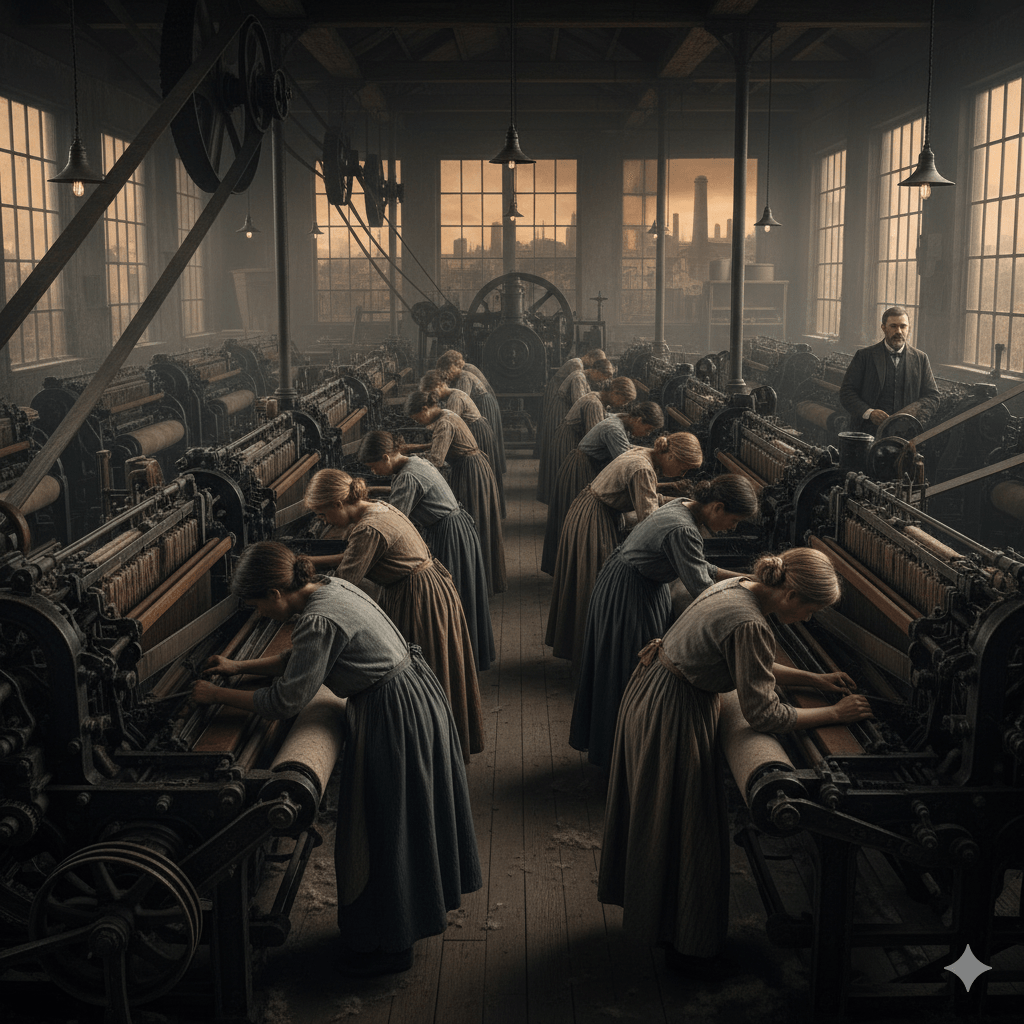
In the developmental history of industrial sociology, the Factory System is defined as a method of manufacturing that utilizes powered machinery, a centralized workplace, and a complex Division of Labor. It represents the decisive shift away from the decentralized "Putting-out" or "Domestic" systems where artisans worked in their own homes. The factory system is characterized by the spatio-temporal concentration of laborers under a singular administrative roof, where human effort is synchronized with the rhythm of machines. This definition implies a radical reorganization of the social structure, transforming the independent producer into a wage-earning member of the Proletariat.
For a sociologist, the definition of the factory system extends beyond technical efficiency to include Industrial Discipline. It involves the imposition of rigid work hours (the factory whistle), hierarchical supervision, and the standardization of output. By defining the factory as a site of social interaction, thinkers like Auguste Comte and Herbert Spencer viewed it as a primary organ of the Industrial Society, facilitating the transition from traditional communal bonds to the impersonal, rationalized associations of modernity. The factory system successfully moved the center of economic gravity from the village to the urban industrial belt, setting the stage for the professionalization of labor management.
2. Concept & Background: The Logic of Modernity
The conceptual background of the Factory System is inextricably linked to the Industrial Revolution in 18th-century England. The convergence of technological innovations—such as the steam engine and the power loom—required a massive scale of production that individual households could no longer sustain. This background represents a fundamental shift in the Mode of Production, where capital concentration became the prerequisite for economic survival. The background of the factory system is also a story of Urbanization; as factories centralized, they acted as magnets for rural populations, leading to the rapid growth of industrial cities like Manchester and Birmingham.
Intellectual history shows that the factory system was initially met with both awe and dread. While it increased economic productivity and technological progress, it also introduced harsh working conditions, subsistence-level wages, and the widespread use of child labor. This background moved the focus of social science toward the Social Costs of progress. Sociologists began to analyze how the factory environment reshaped Family Dynamics, as the workplace and the household became physically and conceptually separated. Understanding this concept requires recognizing the factory as the "laboratory of modernity" where the modern Social Contract between labor, capital, and the state was first negotiated through strikes and labor reforms.
3. Marxist Perspective: Alienation and Class Struggle
From a Marxist perspective, the factory system is analyzed as the ultimate tool of Capitalist Exploitation. Karl Marx argued that within the factory, the worker is reduced to a "mere appendage of the machine." Because the Bourgeoisie owns the Means of Production, they extract Surplus Value by paying the worker less than the total value of their labor. This structural relationship leads to four distinct levels of Alienation:
- Alienation from the Product: The worker creates an object that they do not own and cannot afford to buy.
- Alienation from the Process: Labor becomes repetitive, mindless, and controlled by the clock rather than human creativity.
- Alienation from Fellow Workers: The competitive nature of the factory pits workers against one another, destroying Social Solidarity.
- Alienation from the Self: The worker loses their Species-Being—the innate human drive to engage in free, conscious activity.
Marx predicted that the concentration of workers in large factories would eventually facilitate the development of Class Consciousness, as the shared experience of exploitation would transform a "class-in-itself" into a "class-for-itself," leading to the Proletarian Revolution.
4. Max Weber: Rationalization and the Iron Cage
Max Weber viewed the factory system not just as an economic entity but as a core component of the process of Rationalization. He emphasized that the factory is a Bureaucratic Organization characterized by hierarchy, written rules, and Legal-Rational Authority. While Weber acknowledged that this structure provided unparalleled Efficiency and predictability, he famously warned of the "Iron Cage"—a state where the drive for calculable results would strip social life of its mystical and humanistic dimensions.
Weber’s analysis focused on the Disenchantment of the World, where the factory's emphasis on technical competence replaced the traditional authority of the artisan. The factory system represents the Formal Rationality of capitalism, where the "bottom line" dictates social behavior. This perspective is vital for understanding Industrial Discipline, as it explains how individuals were socialized to accept the rigid, often dehumanizing requirements of the factory as "rational" and inevitable markers of modern Social Progress.
5. Functionalism: Organic Solidarity and Integration
In contrast to the conflict-oriented views, Functionalist sociologists like Emile Durkheim viewed the factory system as an essential mechanism for Social Integration in an industrial age. Durkheim argued in The Division of Labour in Society that the high degree of specialization within the factory creates Organic Solidarity. Because each worker performs a specific, limited task, they become functionally dependent on one another for the survival of the whole system.
From this viewpoint, the factory is a stabilizing force that provides individuals with a clear Social Role and identity. Functionalists acknowledge that rapid industrialization can lead to Anomie (normlessness) if not regulated, but they believe that through Collective Bargaining and state intervention, the factory system can achieve a healthy equilibrium. In this perspective, the factory is the primary engine of Industrial Society’s growth, facilitating the Social Differentiation required for a complex, modern social organism.
6. Indian Contextualization (Paper II Integration)
In Indian Society, the factory system arrived as a component of Colonial Modernity. The establishment of cotton mills in Bombay and jute mills in Calcutta in the 19th century fundamentally altered the Traditional Social Structure. Sociologists like M.N. Srinivas have noted that while the factory promoted Westernization and secularization, it often operated within a Caste-based hiring framework. Historically, "upper" castes often occupied managerial positions, while "lower" castes and migrants formed the bulk of the industrial labor force, proving that the factory did not automatically dissolve ritual hierarchies.
Furthermore, the Factories Act of 1948 represented the Indian state’s first major effort to regulate the factory system in a Welfare State framework. However, the contemporary era is marked by the Informalization of Labor. Even within formal factory belts (like the Gurgaon-Manesar industrial area), a majority of workers are "contractual" and lack the social security promised by the formal factory model. This has led to intense Labor Unrest (e.g., the Maruti Suzuki strikes), highlighting the persistence of Class Conflict in a globalizing economy. The study of the Indian factory system is thus a study of Dualism—where high-tech automated production coexists with exploitative, semi-formal labor practices in a deeply stratified society.
7. Case Study: The Lowell Mills
The Lowell Mills in 19th-century Massachusetts serve as a definitive case study of the factory system's impact on Gender and Labor. The mills predominantly employed young women ("Mill Girls") from rural areas, housing them in strictly regimented boarding houses. This was an early attempt at Paternalistic Capitalism, where the factory owners sought to regulate even the private morals and social habits of their workers to ensure a "virtuous" labor force.
Sociologically, this case study reveals the Double Burden of the female worker. While the factory provided an escape from the rural patriarchal household, it replaced it with the Industrial Patriarchy of the male overseer. However, the concentration of these women in a singular social space also facilitated the rise of Collective Agency. The Lowell women published their own magazine (The Lowell Offering) and organized some of the earliest strikes in the US against wage cuts. This proves that the factory system, while designed for Social Control, inadvertently creates the Subaltern spaces necessary for organized resistance and the reclamation of Labor Rights.
Mains Mastery Dashboard
The Factory System represents a transformative epoch in human history where the centralization of production facilitated a radical shift in the "Mode of Social Existence." Beyond its technical role in the Industrial Revolution, the factory became the primary site for the socialization of the modern individual. According to Karl Marx, this shift resulted in profound Alienation, as the worker was separated from the product of their labor and their own creative essence. By reducing complex artisanal tasks into repetitive, standardized motions, the factory system transformed labor into a commodity, effectively stripping the individual of their "Species-Being" and creating a new Proletarian identity defined by structural dependency on capital.
Complementing this, Max Weber identified the factory as a cornerstone of Rationalization. It imposed a Legal-Rational Authority structure that prioritized calculable efficiency and bureaucratic discipline over traditional communal bonds. This "Iron Cage" of industrial life socialized individuals into a culture of time-thrift and procedural rigidity, where the "factory whistle" replaced natural rhythms. In the Indian context, the factory system acted as a catalyst for Urbanization and secularization, though it often adapted to, rather than abolished, traditional Caste hierarchies. The transition from the "Book-View" of the self-sufficient village to the "Field-View" of the industrial slum highlights how the factory system reoriented the social fabric toward the requirements of global capital.
In CONCLUSION, the factory system was a Total Social Fact that restructured family life, urban space, and the human psyche. While it provided the material abundance required for Social Progress, it did so at the cost of subjective autonomy and traditional Social Solidarity. As we move into the era of Post-Fordist flexible specialization and the digital gig economy, the legacy of the factory system remains visible in the pervasive Surveillance and algorithmic control that define contemporary labor relations, proving that the factory was the blueprint for the disciplinary social order of modernity.
Revision Strategy: Keywords
- Division of Labor: The specialization of tasks within the production process.
- Industrial Discipline: The regulatory framework (time, rules) that governs factory behavior.
- Alienation: The state of being estranged or disconnected from one's humanity (Marx).
- Rationalization: The application of logic and efficiency to social organization (Weber).
- Species-Being: Marx’s term for the essential human nature to be free and creative.
- Docile Bodies: Foucault’s term for individuals trained for obedience by institutional discipline.