

Imperialism: Power, Exploitation, and the Global Order
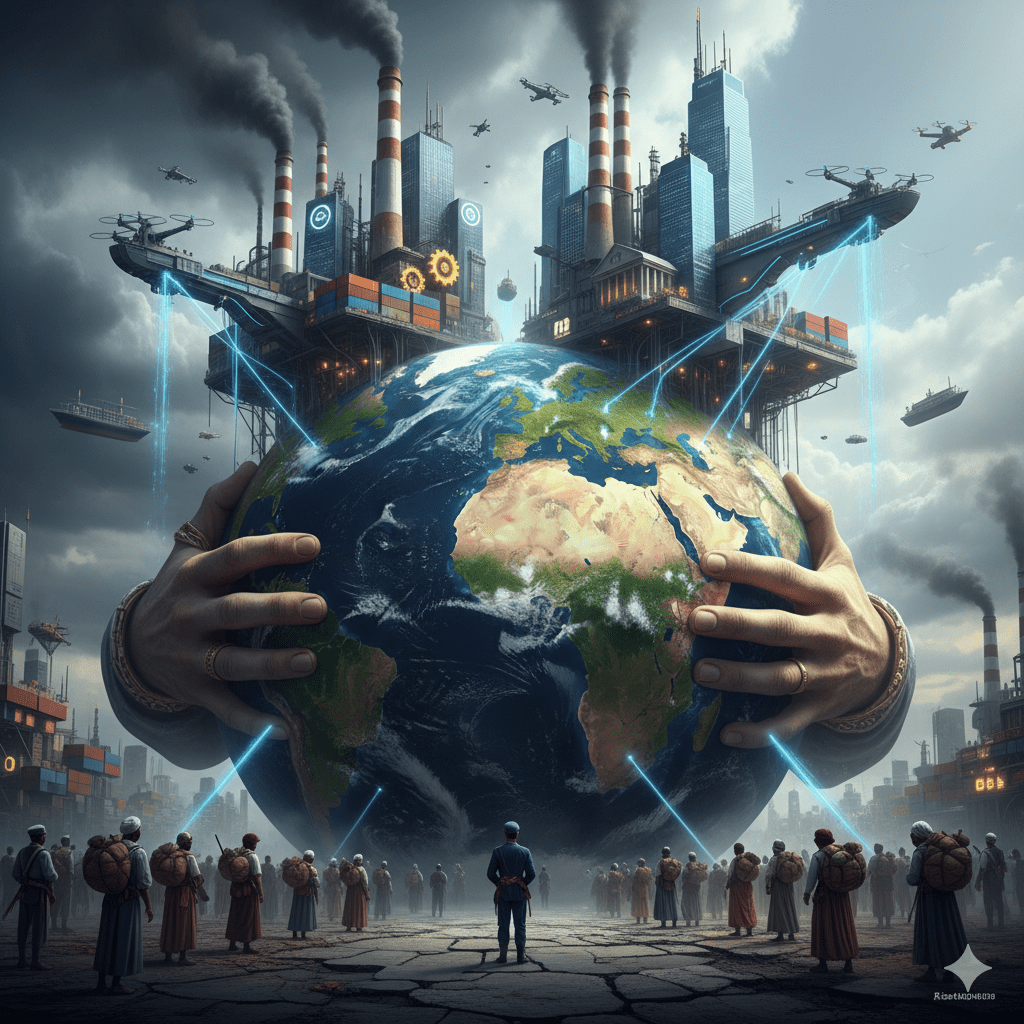
1. Definition: The Sovereignty of Capital and Empire
In the developmental history of global social stratification, Imperialism is defined as the systematic exercise of political, economic, and cultural domination by a powerful nation-state over a subordinate territory or population. While often conflated with Colonialism (the physical settlement of people), imperialism is the broader Ideological and Institutional framework that justifies and orchestrates the extraction of resources and the Authoritative Allocation of global power. Sociologists like Frantz Fanon and Edward Said have emphasized that imperialism is not merely a matter of military conquest but a "Total Social Fact" that fundamentally restructures the Collective Conscience and identity of both the colonizer and the colonized.
For a sociologist, the definition of imperialism signifies the birth of a Global Social Structure characterized by structural asymmetry. It involves the use of Rational-Legal Authority (through colonial laws) and Symbolic Violence (through the imposition of European languages and values) to ensure that the subordinate region serves the economic interests of the metropole. By defining imperialism as a relational process, sociology investigates how global inequalities are not "natural" accidents of history but are the product of deliberate Systemic Dispossession, facilitating a persistent transfer of wealth from the global South to the global North.
2. Concept & Background: The Mechanics of Domination
The conceptual background of Imperialism is rooted in the transition from Mercantile Capitalism to industrial monopoly. In the 19th and early 20th centuries, European powers—driven by the need for raw materials, cheap labor, and new markets—engaged in a "Scramble for Empire." This background represents a fundamental shift in the Mode of Production, where capitalist competition could no longer be contained within national borders. The background of imperialism is essentially the story of Globalized Modernity, where the technology of the Industrial Revolution (railways, steamships, telegraphs) was utilized as the infrastructure of Social Control across vast distances.
Intellectual history shows that imperialism created a Dual-Identity crisis in the periphery. It introduced the "modern" state, bureaucracy, and secular education, but utilized these tools to enforce Economic Dependency. This background moved the focus of social science toward the study of Internal Colonialism and the long-lasting effects on Social Mobility. Understanding this concept requires recognizing that the end of formal empire (decolonization) did not necessarily mean the end of imperialist logic. Contemporary Neo-Imperialism continues through global financial institutions and cultural hegemony, proving that the structural maps of the 19th century continue to dictate the Life Chances of billions in the 21st century.
3. Marxist Perspective: The Highest Stage of Capitalism
From the Marxist perspective, the definitive theory of imperialism was provided by V.I. Lenin in his 1916 work, Imperialism, the Highest Stage of Capitalism. Lenin argued that as capitalist firms became giant Monopolies, they saturated their domestic markets and exhausted their local investment opportunities. To prevent a fall in the rate of profit, capital had to be exported to the non-capitalist periphery. Lenin identified five core features of this stage:
- The Concentration of Production: Leading to the emergence of all-powerful monopolies.
- The Merger of Bank and Industrial Capital: Creating a "Financial Oligarchy" that directs state policy.
- The Export of Capital: Transitioning from exporting goods to exporting investment to extract Surplus Value globally.
- International Monopolies: The division of the world market among corporate cartels.
- The Territorial Division of the World: Completion of the physical partitioning of the globe by the great powers.
For Marxists, imperialism is an Inherent Property of late capitalism. It is the mechanism that delays the proletarian revolution in the West by using "super-profits" from the colonies to bribe the domestic working class (the Labor Aristocracy), effectively exporting the Class Conflict to the global periphery.
4. Postcolonial Theory: Frantz Fanon and the Colonized Mind
Postcolonial Theory, pioneered by Frantz Fanon, analyzes the Psychological and Cultural dimensions of imperialism. In Black Skin, White Masks, Fanon explored how imperial rule produces an Internalized Inferiority Complex among the colonized. He argued that imperialism utilizes Symbolic Violence to devalue the history, religion, and appearance of the "native," forcing them to adopt the culture of the colonizer to achieve social recognition.
For Fanon, imperialism is a Manichaean structure—a world divided into two mutually exclusive zones: the settler's town (light, paved, well-fed) and the native's quarters (dark, cramped, hungry). This perspective highlights that the primary site of imperial domination is Human Consciousness. Fanon famously advocated for Radical Resistance, arguing that since imperialism was established through violence, it could only be dismantled through a "cleansing" counter-violence that restores the colonized subject’s Agency and dignity.
5. World-Systems Theory: Wallerstein’s Core-Periphery Logic
Immanuel Wallerstein’s World-Systems Theory provides the macro-sociological framework for understanding modern imperialism. He argued that the global economy is a singular Social System characterized by an Axial Division of Labor between three regions:
- The Core: Wealthy, industrialized nations that control high-tech production and finance (e.g., the West).
- The Periphery: Resource-rich but economically subordinate nations that provide raw materials and low-wage labor.
- The Semi-Periphery: Nations that act as a "buffer," exhibiting features of both core and periphery (e.g., BRICS nations).
Wallerstein posits that imperialism is the structural tool used by the Core to enforce Unequal Exchange. By manipulating trade terms and global debt, the Core ensures that the Periphery remains in a state of Underdevelopment. This perspective proves that global poverty is not a "lack of development" but a functional requirement of the imperialist world system, which needs a dependent periphery to sustain the high-consumption lifestyle of the Core.
6. Indian Contextualization (Paper II Integration)
In Indian Society, imperialism represented a total Structural Reconfiguration. The British Raj utilized what Dadabhai Naoroji termed the "Drain Theory"—a systematic siphoning of Indian wealth to Britain through taxes, home charges, and unfair trade. Sociologically, this led to the De-industrialization of traditional artisanal sectors (like textiles), forcing the population back into an increasingly stratified Agrarian Structure.
Furthermore, British imperialism fundamentally altered the Caste System. Through the Census of India, the British sought to make the complex Indian social fabric "legible" for administration. This led to the Rigidification of Caste identities, as fluid ritual categories were fixed into rigid bureaucratic hierarchies to facilitate Divide and Rule. However, the imperial encounter also created the modern Indian Middle Class. Influenced by Westernization (Srinivas), this class utilized Enlightenment ideals of Liberty and Equality to mount a Counter-Hegemonic movement. The struggle for National Identity in India thus involves a continuous negotiation with these imperial legacies, attempting to build a Multiple Modernities framework that reconciles the "Steel Frame" of British bureaucracy with indigenous cultural agency.
7. Case Study: Fanon’s "The Wretched of the Earth"
Frantz Fanon’s The Wretched of the Earth (1961) serves as the definitive case study for the Sociology of Liberation. Writing during the Algerian War of Independence, Fanon analyzed how French imperialism utilized Cultural Decapitation to rule. He noted that the colonizer depicts the native as a "quintessence of evil," effectively dehumanizing them to justify Structural Violence.
Sociologically, this case study reveals that imperialism is a Pathological Social Order. It creates a state of Alienation where the colonized individual feels like a "stranger in their own land." Fanon’s analysis proved that decolonization is not merely a transfer of power but a Total Social Process of "creating new men." For sociologists, this work remains the blueprint for understanding Subaltern Resistance, demonstrating that the dismantling of empire requires both the physical removal of the occupier and the psychological De-colonization of the Mind.
Mains Mastery Dashboard
Imperialism, as conceptualized by V.I. Lenin, represents a transformative stage in Capitalist Accumulation where the concentration of production leads to the dominance of Monopolies and the Financial Oligarchy. Lenin argued that when domestic markets are saturated, capitalist nations must engage in the Export of Capital to the periphery to extract Surplus Value and prevent the falling rate of profit. This structural necessity drives the territorial and economic partitioning of the world, effectively transforming Class Conflict into a global struggle between imperialist "Cores" and colonized "Peripheries."
In the contemporary era, this concept remains highly relevant through Immanuel Wallerstein’s World-Systems Theory. Although formal territorial colonialism has largely ended, the Core-Periphery Model persists through mechanisms of Unequal Exchange and Dependency. Global financial institutions and trade regulations often act as a "Disguised Imperialism," ensuring that wealth continues to flow from the resource-rich South to the capital-intensive North. In the Indian context, this is visible in the struggle for Data Sovereignty and the impact of Global Value Chains on the informal labor force. The "Steel Frame" of colonial administration has evolved into a global Rational-Legal framework that maintains the Hegemony of the Core.
In CONCLUSION, imperialism is not a historical relic but a Total Social Fact that continues to define the Authoritative Allocation of global resources. While the "War of Movement" (Revolution) envisaged by Lenin remains elusive, the "War of Position" (Gramsci) through subaltern resistance and South-South cooperation offers a path to challenge this Structural Violence. Achieving a truly inclusive Global Progress requires dismantling these systemic asymmetries, ensuring that Knowledge, Power, and Agency are reclaimed by the Periphery to build a more rational and equitable international order based on Substantive Equality rather than imperial dependency.
Revision Strategy: Keywords
- Monopoly Capital: The stage where a few giant firms dominate the entire market (Lenin).
- Unequal Exchange: Trade where labor and resources of the periphery are undervalued (Wallerstein).
- Internalized Inferiority: The psychological damage caused by cultural hegemony (Fanon).
- Divide and Rule: The imperial strategy of exacerbating social fractures to maintain control.
- Drain Theory: The systematic transfer of Indian wealth to the British metropole (Naoroji).
- Financial Oligarchy: The alliance of banks and industry that dictates global policy.