

Organized Skepticism: The Normative Heart of Science
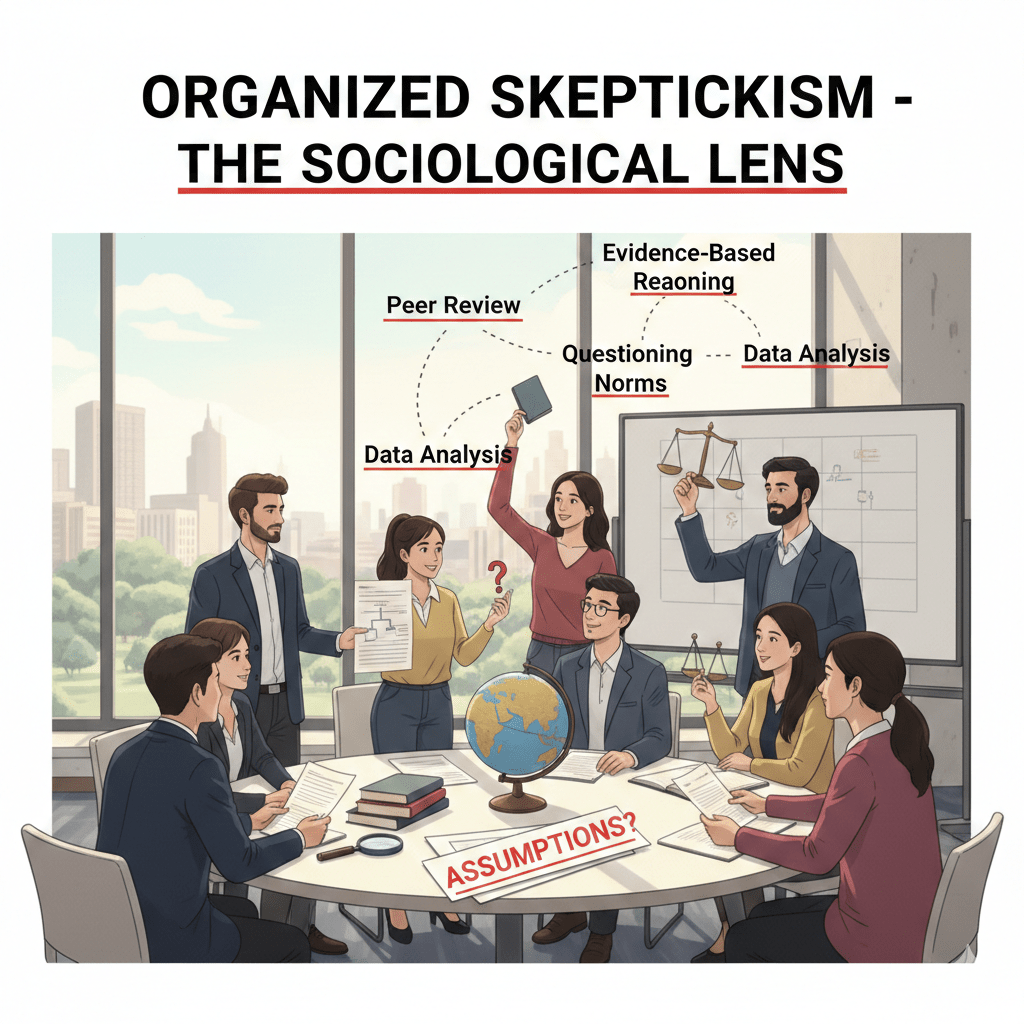
1. Definition: The Temporary Suspension of Belief
In the developmental architecture of the sociology of science, Organized Skepticism is defined as a core normative principle that demands the temporary suspension of judgment and the rigorous, systematic scrutiny of all knowledge claims, regardless of their source. It is not merely a personal attitude of doubt, but an Institutional Requirement within the scientific community. Historically, it was anchored by Robert K. Merton as one of the four essential "Ethos of Science." This definition implies that "Truth" is never a final destination but a contingent state of affairs that must be continuously earned through Empirical Validation and logical consistency. Organized skepticism acts as a Methodological Safeguard against dogmatism, ensuring that personal authority or traditional consensus does not override verifiable evidence.
For a sociologist, the definition of organized skepticism signifies the transition from Sacred Certainty to Secular Probability. It involves the Authoritative Allocation of credibility to evidence rather than to the status of the researcher. By defining science as a site of Collective Inquisitiveness, the principle investigate how the Scientific Community manages the tension between originality and accuracy. This successfully transitioned the study of humanity from "Social Philosophy" to a Rationalized Science, providing the analytical tools required to unmask Structural Violence and biased Hegemony, established through a rigorous internal moral code of Procedural Skepticism.
2. Robert Merton: The CUDOS Ethos
The conceptual background of Organized Skepticism was formalized by Robert K. Merton in 1942 as part of his CUDOS framework. Merton argued that modern science operates through a set of institutional imperatives that distinguish it from other social systems (like religion or art).
- Communism: Scientific knowledge is a shared public resource, not private property.
- Universalism: Truth claims must be evaluated on impersonal criteria, regardless of the scientist's race, religion, or nationality.
- Disinterestedness: Scientists must act for the advancement of knowledge rather than personal gain or ideological bias.
- Organized Skepticism: The final norm, which mandates that the community must critically evaluate all findings before they are accepted as part of the Scientific Consensus.
Merton’s analysis proves that skepticism is Functional; it prevents the "premature closing" of the mind. This perspective highlights the Duality of Authority, where the "sacredness" of the fact is dependent on its ability to survive the Cross-examination of the peers, established through a rigorous internal moral code of Scientific Integrity.
3. Positivism: Auguste Comte and the Law of Truth
Auguste Comte remains the definitive precursor to this principle. In his Law of Three Stages, he argued that the "Positive Stage" is characterized by the rejection of Theological Dogma and Metaphysical Speculation. Comte’s focus on Observable Facts required a radical skepticism toward any knowledge that could not be empirically verified.
From this perspective, organized skepticism is the "utility" required for the evolution of truth. Comte’s work established the foundation for Methodological Monism, asserting that the study of the Social Fabric should follow the same skeptical rigor as physics. This successfully moved the focus of the discipline toward Systematic Doubt, providing the Nomothetic Authority required to replace "superstition" with "social physics," proving that the progress of the Social Organism depends on the relentless application of reason to every traditional claim.
4. Karl Popper: Falsificationism as the Logic of Doubt
Karl Popper elevated organized skepticism to a formal logical principle through his theory of Falsificationism. Popper argued that a theory is only "Scientific" if it is Falsifiable—that is, if it specifies what evidence would prove it wrong. He famously stated that "science starts from problems and ends with problems."
For Popper, the goal of the scientist is not to "verify" their theory (which is impossible) but to ruthlessly attempt to refute it. This is organized skepticism in its purest form. This perspective highlights that Scientific Knowledge is always provisional. Popper’s analysis proves that the "Certainty" of the past was a Regulatory Fiction. For sociologists, this work remains the blueprint for identifying how Structural Shifts in Knowledge occur through the Refutation of established paradigms, reconciling Knowledge, Power, and the Body through the practice of intellectual humility.
5. Critique: The Frankfurt School and the Skepticism of Power
The Frankfurt School (Horkheimer, Adorno, Habermas) utilized organized skepticism to develop their Critical Theory. They argued that "Traditional Theory" (Positivism) was not skeptical enough of the Status Quo. They advocated for a skepticism that questions the Common Sense produced by the Culture Industry and the state.
From this viewpoint, organized skepticism is a tool for De-masking Ideology. It requires sociologists to be skeptical of the "Neutrality" of the market or the "Efficiency" of the bureaucracy. This critique reveals that the "Scientific Spirit" often acts as a Hegemonic Mask that hides Structural Violence and Alienation. For critical theorists, true skepticism is a form of Emancipatory Agency, established through a rigorous internal moral code of Justice, proving that logic without ethics is merely a new form of Social Control.
6. Institutional Practice: Peer Review and Methodology
In the real world, organized skepticism is operationalized through Peer Review. In this system, before a research paper is published, it is sent to anonymous experts who act as "Skeptical Guardians." They scrutinize the Sampling techniques, the Authoritative Allocation of Variables, and the logical consistency of the conclusions.
Furthermore, the use of Double-Blind Trials in social research is a manifestation of this principle. By ensuring that neither the researcher nor the participant knows who is receiving a treatment, the community minimizes the impact of Subjective Bias and the "Self-Fulfilling Prophecy." This institutionalized doubt proves that the Social Order of science depends on Disinterested Scrutiny, providing the Reliability required for sociological findings to influence National Policy and achieve Substantive Progress.
7. Indian Contextualization: The Scientific Temper (Paper II)
In Indian Society, organized skepticism is a constitutional imperative. Jawaharlal Nehru introduced the concept of "Scientific Temper"—a combination of skepticism, humanism, and the spirit of inquiry. This vision is institutionalized in the Constitution of India under Article 51A(h), which lists the development of scientific temper as a Fundamental Duty of every citizen.
Sociologically, this represents a Democratic Mobilization of reason against the Structural Violence of traditional rituals and superstitions. B.R. Ambedkar utilized organized skepticism to challenge the "divine" logic of the Shastras, subjecting the Caste System to a rigorous Historical and Philological critique. Furthermore, the "Field-View" introduced by M.N. Srinivas utilized the scientific spirit of Participant Observation to challenge the textual "Book-View" of Indology. This proves that in the Indian Context, organized skepticism is a Subaltern Weapon, used for Social Justice and the reclamation of Agency against the Hegemony of traditional orthodoxy.
8. Case Study: The Replication Crisis
The Replication Crisis (2010s-Present) in psychology and sociology serves as the definitive case study for Applied Organized Skepticism. Researchers discovered that many "landmark" studies could not be replicated when re-tested by independent teams.
Sociologically, this crisis reveals the failure of institutionalized skepticism to keep pace with the Pressure to Publish. It triggered a "Skeptical Turn" in methodology, leading to the Open Science Movement and Pre-registration of hypotheses. This study confirms that Knowledge is fragile and requires Constant Vigilance. For sociologists, the replication crisis remains the blueprint for identifying how Incentive Structures can compromise Scientific Integrity, reconciling Knowledge, Power, and the System in an ongoing quest for Objective Truth.
Mains Mastery Dashboard
Organized Skepticism represents the epistemological and ethical core of modern social science, acting as the primary institutional defense against Dogmatism and the "premature closing" of inquiry. As articulated by Robert K. Merton, this norm dictates that all truth claims must be subjected to detached scrutiny before they are accepted by the Scientific Community. By prioritizing Empirical Validation over the authority of the researcher, organized skepticism provided early sociology with its Scientific Authority, moving the study of humanity from "Armchair Speculation" to a rigorous inquiry into Social Dynamics and structural laws. This principle facilitates the Duality of Discovery, where the "old" is constantly interrogated to make space for "new" Knowledge.
In the contemporary era of "Post-Truth" and Digital Misinformation, the relevance of this Mertonian norm is characterized by a Structural Crisis. The rise of Algorithmic Hegemony on social media has created "Echo Chambers" where belief is reinforced rather than scrutinized. This represents a De-Institutionalization of skepticism, where the Authoritative Allocation of Labels is dictated by engagement-metrics rather than peer review. In the Indian context, the constitutional mandate for a "Scientific Temper" (Article 51A) serves as a Democratic Mobilization of doubt against the Structural Violence of fake news and communal polarization. Thus, organized skepticism is no longer just a laboratory norm; it is a Civilizational Requirement for the survival of the Public Sphere and the protection of the Sovereignty of Reason against Hegemonic distortions.
In CONCLUSION, organized skepticism is a Total Social Fact that remains the prerequisite for a Reflexive and equitable social existence. Its sustainability depends on achieving a Dynamic Equilibrium—ensuring that the "Digital Iron Cage" does not lead to the total erosion of Critical Agency. Achieving Substantive Progress in the 21st century requires moving beyond "Mechanical Doubt" toward a Pluralistic Scrutiny that honors the Human Dignity of all citizens. Ultimately, the quest for Objective Truth ensures that the Social Contract is anchored in reality rather than in manufactured consent, fulfilling the Constitutional Morality of a truly inclusive and rational republic.
Revision Strategy: Keywords
- CUDOS Ethos: Merton’s acronym for the four institutional norms of science.
- Falsifiability: Popper’s criterion that a theory must be testable and potentially refutable.
- Institutionalized Scrutiny: The formal process of review and critique by a community of peers.
- Scientific Temper: The Indian constitutional duty (Art 51A) to apply reason and doubt.
- Paradigm Shift: A fundamental change in basic concepts and experimental practices (Kuhn).
- Open Science: The modern movement to increase transparency and facilitate skepticism.
