

Social Construction of Reality: The Dialectics of Being
1. Definition: The Dialectic of World-Building
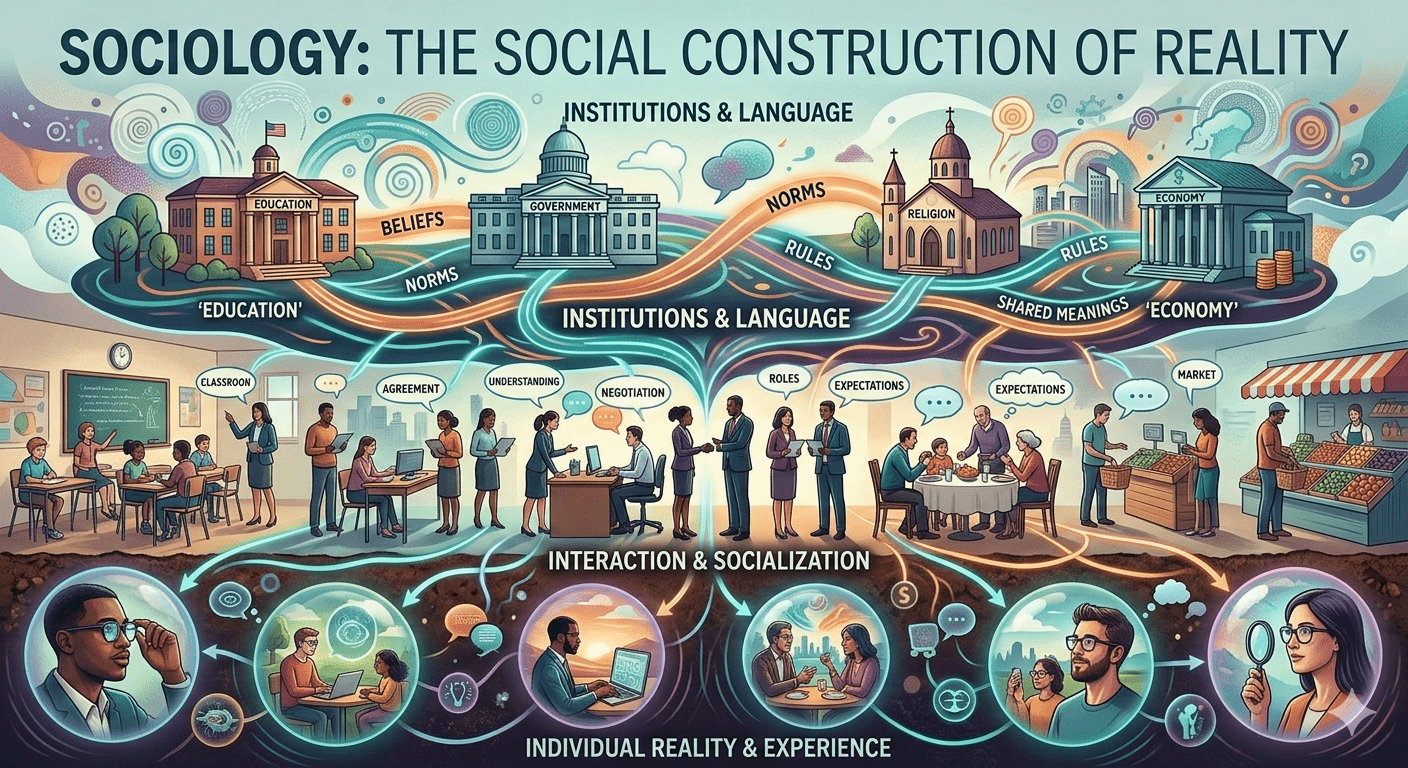
In the intellectual architecture of contemporary social theory, the Social Construction of Reality is defined as the foundational theoretical perspective which posits that the "reality" individuals inhabit is not a pre-given, objective fact, but a product of continuous social interaction and shared meanings. Formulated fundamentally by Peter Berger and Thomas Luckmann in their 1966 work, this theory argues that society is a human product, and that the individual is a social product. This definition implies a radical Epistemological Rupture, transitioning the study of humanity from the search for "natural laws" to a profound inquiry into the intersubjective structures that make the world appear stable and "real."
Berger and Luckmann identified a three-step dialectical process that defines this construction:
- Externalization: Individuals create social reality through their own agency and physical/mental activity (e.g., creating a new language or a law).
- Objectivation: These human products acquire a life of their own and appear to later generations as objective "things" or external social facts (Durkheim).
- Internalization: The objectivated social world is "re-translated" into the individual’s consciousness during socialization, where it is accepted as natural reality.
For a sociologist, this definition signifies that the Authoritative Allocation of Meaning is the primary mechanism of Social Order. It successfully transitioned the study of the social fabric from "social physics" to a phenomenological inquiry, established through a rigorous internal moral code of Inquiry Integrity.
2. Concept & Background: The Intersubjective Lifeworld
The conceptual background of Social Constructionism is rooted in the Phenomenology of Alfred Schutz and the Sociology of Knowledge pioneered by Karl Mannheim. Schutz argued that we inhabit a "Lifeworld" (*Lebenswelt*)—a world of taken-for-granted meanings. The background represents a fundamental shift in the Theory of Reality: the realization that the "Social Fact" is a Meaningful Achievement. This background is essential for understanding the Modernization process, as it reveals how traditional hegemonies are maintained through the Institutionalization of specific interpretations of the world.
Intellectual history shows that this concept emerged as a critique of Biological Determinism. This background moved the focus of social science toward the study of Symbolic Logic. Understanding this concept requires recognizing that reality is a Spatio-Temporal construct; what is "real" in a rural Indian village (the efficacy of a ritual) may be "unreal" in an urban tech hub. This perspective establishes the foundation for Methodological Pluralism, proving that the progress of the Social Organism depends on the continuous Re-negotiation of shared truths, providing the Analytical Authority required to bridge the gap between Knowledge, Power, and the Body.
3. Symbolic Interactionism and the Thomas Theorem
From the Symbolic Interactionist perspective (Mead, Blumer), social construction is an ongoing, micro-level performance. A central pillar of this view is the Thomas Theorem (1928): "If men define situations as real, they are real in their consequences." This theorem reveals the Power of Labels.
For instance, if a specific group is socially defined as "dangerous" (even without empirical evidence), the Authoritative Allocation of this label leads to concrete consequences: higher policing, restricted Life Chances, and Social Exclusion. Interactionists prove that reality is a Negotiated Order. This perspective highlights the Duality of Agency, where we are both the "authors" and the "characters" of our social scripts, reconciling the individual psyche with the Collective Conscience through the exchange of Significant Symbols.
4. Postmodernism: The Fragmentation of Reality
Postmodern theorists (Baudrillard, Lyotard) pushed the constructionist project to its extreme, arguing that in late capitalism, the "Social Construction" has been replaced by Hyperreality. They posit that the "Image" or the "Symbol" has become more real than the underlying reality (the Simulacrum).
From this viewpoint, there is no longer a singular National Identity, but a fragmented landscape of competing Cultural Narratives. Postmodernists argue that "Truth" is merely the Hegemonic Mask of power. This critique reveals that the Social Logic of the 21st century is one of Radical Contingency. For sociologists, this analysis is vital for identifying how Digital Technology and mass media act as the primary Forces of Production for contemporary reality, proving that the struggle for Social Justice is now a struggle for Narrative Sovereignty.
5. Indian Contextualization: Caste as a Social Construct (Paper II)
In Indian Society, the social construction of reality is most visible in the Caste System. While traditional "Book-Views" (Indology) presented Caste as a divine, biological hierarchy, a constructionist lens reveals it as a Pathological Social Construct. B.R. Ambedkar utilized this perspective to argue for the Annihilation of Caste, proving that the "Social Honor" of the Brahmin and the "Stigma" of the Dalit are not natural facts but products of Structural Violence and Ideological Hegemony.
Furthermore, the construction of Communal Identity in India illustrates the Politicization of Reality. Sociologists like T.N. Madan have analyzed how "Secularism" and "Communalism" are constructed categories that determine the Authoritative Allocation of political space. Contemporary India witnesses a Conflict of Realities, where the "Digital India" of the middle class and the "Agrarian Crisis" of the rural subaltern coexist as separate Lifeworlds. This proves that in the Indian Context, the construction of reality is a Synthetic process, resulting in Multiple Modernities where the Constitutional Morality of the state struggles against the Symbolic Logic of tradition.
6. Case Study: Judith Butler & Gender Performativity
Judith Butler’s 1990 work Gender Trouble serves as the definitive case study for Social Constructionism. Butler argued that gender is not an internal essence or a biological result, but a Performance—an "active doing" rather than a "being."
Sociologically, this case study reveals the Transformative Agency of repetition. Butler posits that through the repetitive performance of gendered acts (speech, dress, gait), the illusion of a "natural" gender is created. This study confirms that Identity is a diachronic outcome of Social Regulation. For sociologists, Butler’s framework remains the blueprint for identifying how Structural Norms are inscribed on the Body, reconciling Knowledge, Power, and the Individual in a quest for Substantive Liberation from binary constraints.
7. Global Realities: The Quantified Construct
The power of social constructs is visible in concrete socioeconomic metrics globally. Even constructs with no biological basis have Material Consequences:
- US Census & Race: According to 2020 US Census data, the number of people identifying as "Multiracial" increased from 9 million to 33.8 million (a 276% change). This shift is not a biological event but a change in the Social Construction of Identity and the Authoritative Allocation of Labels.
- Gender Wage Gap: Globally, women earn about 77 cents for every dollar earned by men. This 23% gap is a constructed disparity in the "Authoritative Value" of labor, rather than a reflection of skill or output.
- Indian Poverty Line: The construction of the BPL (Below Poverty Line) index in India (e.g., the Rangarajan vs. Tendulkar committee benchmarks) determines the Authoritative Allocation of welfare for over 270 million citizens, proving that the definition of "Poor" is a legislative achievement with life-and-death consequences.
Mains Mastery Dashboard
The Social Construction of Reality represents a decisive epistemological rupture in sociology, transitioning the discipline from the measurement of external objects to the interpretation of Intersubjective meanings. As articulated by Peter Berger and Thomas Luckmann, reality is a dialectical product of human activity. Through the processes of Externalization, Objectivation, and Internalization, human creations (like laws or social hierarchies) eventually take on the appearance of "natural facts." This "taken-for-granted" reality provides the Social Fabric with its stability, ensuring that the Authoritative Allocation of social positions is perceived as legitimate by the Collective Conscience. Thus, the world we inhabit is essentially a Performance of shared definitions, established through a rigorous internal moral code of Inquiry Integrity.
In the Indian context, this framework is essential for deconstructing the "Sacred Reality" of the Caste System. While traditionalists view Caste as an immutable, divine hierarchy, a constructionist lens—as utilized by B.R. Ambedkar—reveals it as a product of Structural Violence and ideological "closed systems." The "Stigma" associated with untouchability is an Internalized Construct that limits the Agency and Life Chances of the Subaltern. By unmasking the Hegemonic nature of this construct, the modern Indian state, through Constitutional Morality, attempts to "re-construct" social reality based on the principles of Liberty, Equality, and Fraternity. This transition proves that the "Naturality" of Caste is a Regulatory Fiction, highlighting that Substantive Progress depends on achieving Cognitive Justice for marginalized groups.
In CONCLUSION, social constructionism is a Reflexive Project that remains the prerequisite for Human Liberation. The sustainability of a modern social order depends on its ability to recognize that our most "solid" institutions are actually Human Achievements that can be challenged and changed. Reconciling Knowledge, Power, and Agency in the 21st century requires moving beyond "Mechanical Objectivity" toward a Deliberative Humanism. By unmasking the constructed nature of inequality, sociology facilitates a more rational and equitable social existence, proving that the Sovereignty of the Individual can be reclaimed from the Hegemonic narratives of the past.
Revision Strategy: Keywords
- Intersubjectivity: The shared social reality that exists between multiple minds.
- Lifeworld (Lebenswelt): The taken-for-granted everyday world of meaning (Schutz).
- Simulacrum: A copy with no original; a symbol that replaces reality (Baudrillard).
- Performativity: The idea that identity is created through repeated acts (Butler).
- Objectivation: When human products are perceived as external facts.
- Reification: Treating an abstract construct as if it were a physical thing.
