

Social Darwinism: The Biology of Inequality
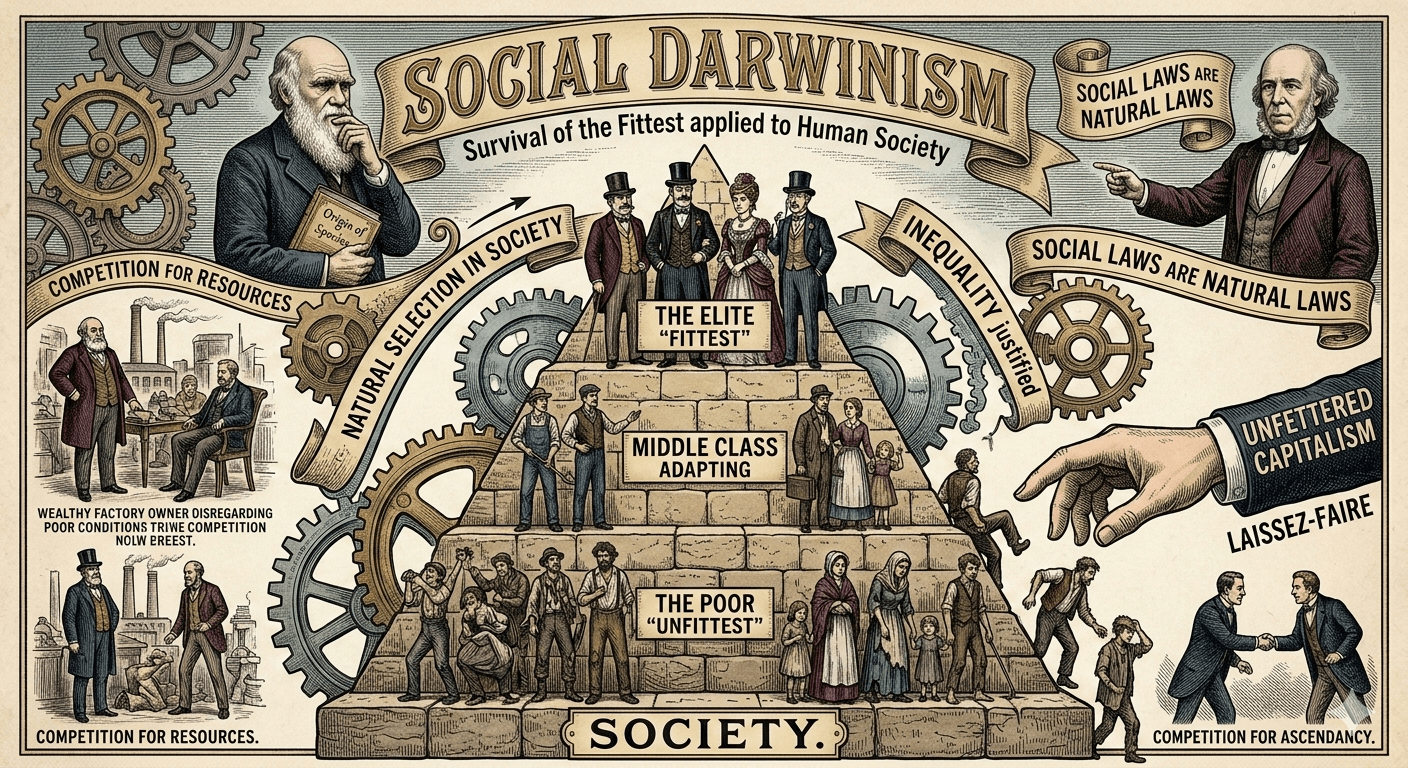
1. Definition: The Naturalization of Social Struggle
In the developmental history of 19th-century social theory, Social Darwinism is defined as a sociological framework that misapplies Charles Darwin’s biological principles of natural selection and the "survival of the fittest" to the study of human societies. It posits that social progress and evolution are driven by unregulated competition between individuals, groups, and nations. Fundamental to this perspective is the belief that social inequality is not a product of historical injustice but a natural outcome of biological differences in capability and drive. While Darwin focused on the adaptation of species to their environment, social Darwinists—fundamentally led by Herbert Spencer—argued that the "weak" should not be assisted by the state, as this would impede the Authoritative Allocation of evolutionary progress to the "strong."
For a sociologist, the definition of Social Darwinism signifies the birth of Scientific Racism and the biological justification for Laissez-faire capitalism. It involves the belief that society is a Mechanical system governed by immutable natural laws. By defining poverty as a sign of biological "unfitness," the theory provided the Analytical Authority required to dismantle the welfare obligations of the state. This successfully transitioned the study of humanity from "Social Philosophy" into a pseudo-scientific inquiry that naturalized Structural Violence, established through a rigorous internal moral code of Invidious Comparison between the "civilized" and the "primitive."
2. Concept & Background: The Logic of Survival
The conceptual background of Social Darwinism is rooted in the mid-Victorian era’s fascination with Progress and Industrialization. Although named after Darwin, the concept was pioneered by Herbert Spencer before On the Origin of Species was published. Spencer’s background represents a radical Individualism: the realization that the Social Organism evolves from "simple to complex" through the differentiation of its parts. The background of this theory is inextricably linked to the Commercial Revolution and Imperialism, providing the ideological infrastructure required to justify the Hegemony of Western powers over the "uncivilized" world.
Intellectual history shows that Social Darwinism provided the "Cultural Capital" for the rejection of Social Solidarity. This background moved the focus of social science toward the study of Competition and Conflict as the only valid engines of change. Understanding this concept requires recognizing that Social Darwinism assumed a Linear Path of development: from the "Military" society to the "Industrial" society. This perspective established the foundation for Modernization models that prioritized economic growth over Substantive Justice, proving that the stability of the system depends on the unfettered agency of the successful, established through a rigorous internal moral code of Meritocracy and Elitism.
3. Herbert Spencer: The Organic Analogy
Herbert Spencer remains the definitive champion of the Social Darwinist model. He utilized the Organic Analogy to argue that society functions exactly like a biological organism. Just as an organism’s health depends on the functional integration of its cells, a society’s progress depends on the Structural Differentiation of its institutions.
However, Spencer’s unique addition was the Survival of the Fittest (a phrase he coined). He argued that any attempt by the state to intervene in the Market or provide for the poor was a "violation of nature." From this perspective, the Authoritative Allocation of Power should reside only with those who have proven their fitness through wealth and achievement. Spencer’s analysis proves that the "Social Fabric" is a competitive battlefield. This perspective highlights the Duality of Agency: the individual is either the "architect" of their success or the "victim" of their own biological failure, reconciling Knowledge, Power, and the Body through a lens of biological determinism.
4. Conflict Theory: The Marxist Critique of Ideology
In contrast to Spencer’s natural laws, Conflict Theorists (Marx, Engels) viewed Social Darwinism as a Hegemonic Mask. They argued that the Bourgeoisie utilized biological metaphors to distract from the reality of Class Struggle and the extraction of Surplus Value.
From a Marxist viewpoint, Social Darwinism is an Ideological Superstructure that serves the Economic Base of capitalism. It "naturalizes" Exploitation by claiming that the worker is poor because they are "unfit," rather than because they are alienated from the Means of Production. This critique reveals that Social Darwinism often acts as a tool for Social Control, preventing the development of Class Consciousness among the Proletariat. For Marxists, true evolution is not biological but Historical Materialism, proving that the dismantling of inequality requires a Social Revolution rather than a "natural" selection process.
5. Functionalist Rebuttal: Durkheim and Cooperation
While Émile Durkheim shared Spencer’s interest in the organic analogy, he profoundly rejected Social Darwinism’s focus on Conflict and Competition. Durkheim argued that society is a Moral Entity (sui generis) that requires Social Solidarity—not struggle—to survive.
In his study of the Division of Labor, Durkheim distinguished between "Mechanical" and "Organic" solidarity. He warned that if a society operates purely on the logic of "Survival of the Fittest," it would succumb to Anomie (normlessness) and social disintegration. Durkheim’s analysis proves that Consensus and Integration are the prerequisites for stability. This perspective highlights that the "Social Organism" persists not because of the victory of the strong, but because of the Internalization of shared norms and the Collective Conscience, providing the Reflexive Agency required to protect the vulnerable through Moral Regulation.
6. Indian Contextualization: Colonialism and Caste (Paper II)
In Indian Society, Social Darwinism was a primary ideological tool for Colonial Hegemony. The British justified their rule through the "White Man’s Burden," a Social Darwinist concept suggesting that Europeans were biologically "more evolved" and thus had a duty to civilize the "primitive" Indians.
Furthermore, Social Darwinist logic was applied to the Caste System by colonial ethnographers like Herbert Hope Risley. Risley utilized Anthropometry (measuring nasal indices) to argue that the Varna hierarchy was based on racial "fitness," with the "Aryan" castes being biologically superior to the "Dravidian" castes. This represents a radical Epistemological Rupture, where a ritual hierarchy was transformed into a Pathological biological reality. B.R. Ambedkar utilized Social Darwinism’s language to critique Graded Inequality, but he rejected its conclusions, arguing that the "unfitness" of the Subaltern was a product of Structural Violence and Institutionalized Stigma. This proves that in the Indian Context, Social Darwinism is a Hegemonic Ghost, used to construct a National Identity based on exclusion rather than Constitutional Morality.
7. Case Study: The Eugenics Movement
The Eugenics Movement (Early 20th Century) serves as the definitive case study for the Pathologies of Social Darwinism. Founded by Francis Galton, eugenics sought to improve the "racial stock" through Authoritative Allocation of breeding rights and the forced sterilization of the "unfit" (the poor, the disabled, the mentally ill).
Sociologically, this case study reveals the Transformative Agency of pseudo-science. It proved that Knowledge-Power can be used to construct a Disciplinary Society that treats human beings as livestock. This study confirms that Social Darwinism leads to Totalitarianism, as seen in the Nazi Germany Holocaust, where the "Survival of the Fittest" became a state mandate for Extermination. For sociologists, the eugenics movement remains the blueprint for identifying how Scientific Authority can be weaponized to enforce Structural Injustice, reconciling Knowledge, Power, and the Individual in a horrific systemic aggregate.
Mains Mastery Dashboard
Social Darwinism represents a decisive epistemological transformation in 19th-century thought, acting as the primary justification for the Laissez-faire economy and the naturalization of Structural Inequality. As articulated by Herbert Spencer, the theory utilizes the Organic Analogy to posit that society is a self-regulating organism that evolves through the Survival of the Fittest. In this view, Social Stratification is a natural outcome of biological "fitness," and any state intervention—such as welfare or labor laws—is seen as a "violation of nature" that hinders the Structural Differentiation necessary for progress. This framework provided the state with its Nomothetic Authority to abandon the Subaltern, framing poverty as a biological inevitability rather than a social failure.
However, this naturalization of struggle is profoundly challenged by the Marxian perspective. Marxists argue that Social Darwinism is a Hegemonic Mask created by the Bourgeoisie to justify the extraction of Surplus Value and the Alienation of the worker. By framing Class Conflict as a "biological struggle," the theory prevents the development of Class Consciousness, ensuring the spontaneous consent of the marginalized to their own exploitation. In the Indian context, this was visible in the Racialization of Caste by colonial ethnographers like Risley, who used anthropometry to ground ritual status in "natural fitness." Thus, Social Darwinism acts as a Regulatory Fiction that hides Structural Violence behind a veneer of scientific objectivity, established through a rigorous internal moral code of Elitism.
In CONCLUSION, Social Darwinism is a Total Social Fact that remains a cautionary tale for modern sociology. The sustainability of a democratic social order depends on achieving a Dynamic Equilibrium between individual competition and Substantive Progress for all. Reconciling Knowledge, Power, and Agency in the 21st century requires moving beyond "Biological Determinism" toward a Reflexive Humanism. By unmasking the Hegemonic forces that treat humans as biological "stock," sociology ensures that the Social Contract is anchored in Human Dignity rather than in a manufactured struggle for survival in a globalized, fragmented world.
Revision Strategy: Keywords
- Survival of the Fittest: Spencer’s term for the victory of the most adaptable social actors.
- Organic Analogy: Comparing the parts of society to the organs of a living body (Spencer).
- Laissez-faire: The economic principle of absolute state non-interference in the market.
- Scientific Racism: The use of biological data to justify racial hierarchy and exclusion.
- Structural Differentiation: The process where institutions become more specialized and complex.
- Graded Inequality: Ambedkar’s term for the layered hierarchy of Caste (critique of Social Darwinism).
