

Social Evolution: The Trajectory of Complexity
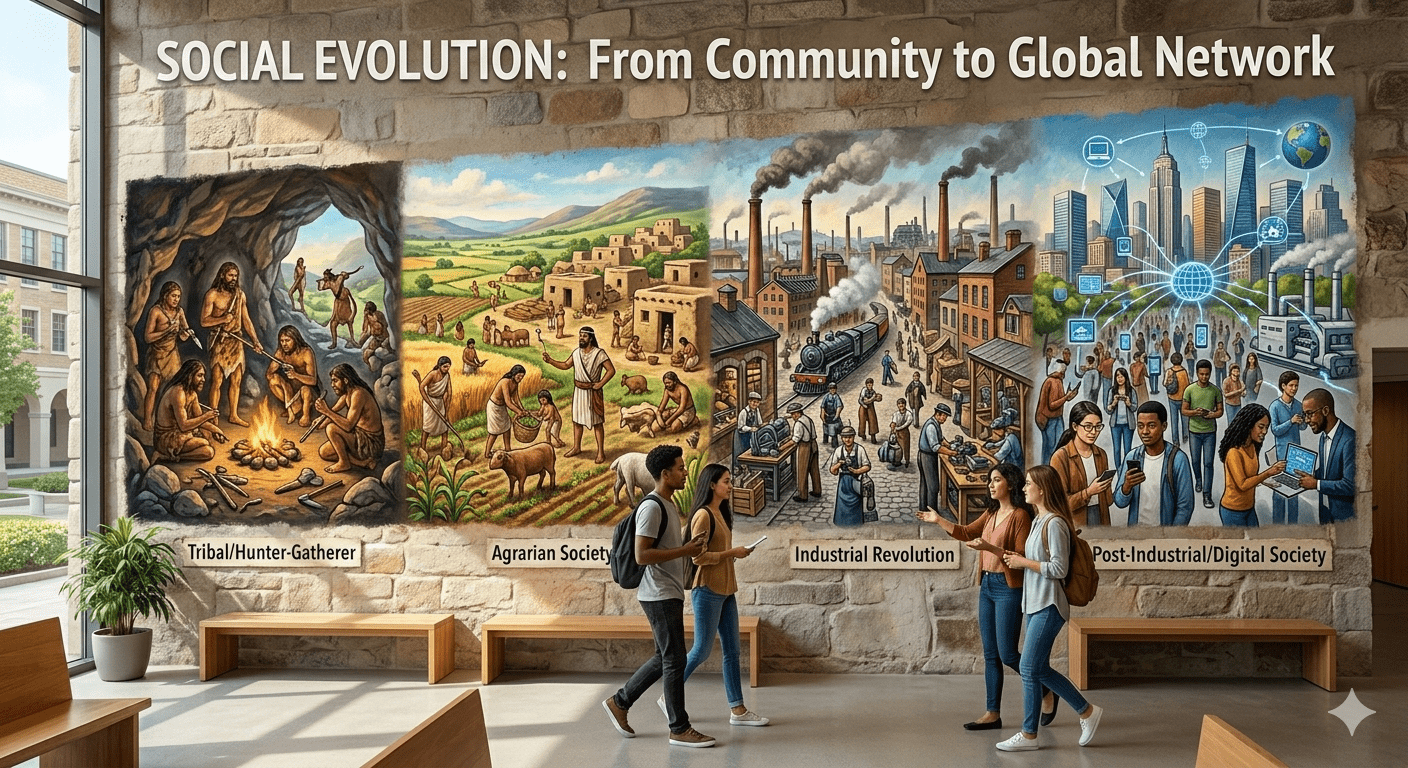
1. Definition: The Diachronic Shift toward Complexity
In the rigorous architectural landscape of social inquiry, Social Evolution is defined as a theoretical framework which posits that human societies undergo a directional, cumulative, and increasingly complex process of structural and cultural transformation over time. Unlike biological evolution, which relies on genetic inheritance, social evolution involves the Authoritative Allocation of learned behaviors and institutional forms from one generation to the next. Introduced fundamentally by 19th-century pioneers like Herbert Spencer and Lewis Henry Morgan, the theory initially assumed a Unilinear path, where all societies progress through fixed stages of "advancement." This definition implies a commitment to Structural Differentiation, where the social organism moves from a state of simple homogeneity to a state of complex, interdependent heterogeneity.
For a sociologist, the definition of social evolution signifies the study of the Mechanisms of Adaptation. It involves the belief that social reality is an emergent process rather than a static fact. By defining evolution as a Meaningful Performance of societal survival, the discipline investigate how Knowledge, Power, and Technology converge to rewrite the National Identity of a civilization. This successfully transitioned the study of humanity from "Social Philosophy" to a rigorous inquiry into Social Dynamics, providing the Analytical Authority required to distinguish between transitory changes and the long-term Structural Transformations that define the modern world, established through a rigorous internal moral code of Scientific Rigor.
2. Concept & Background: The Victorian Epochal Shift
The conceptual background of Social Evolution is rooted in the 19th-century Industrial Revolution and the subsequent fascination with Progress. Historically, early sociologists sought to apply the logic of Natural Selection to human systems, creating a background of "Unilinear Evolutionism." The background represents a fundamental shift in the Epistemology of Discovery: the realization that the "Social Fact" is a historical product with a discoverable genealogy. However, this early background was deeply saturated with Eurocentrism, assuming that Western industrial society was the pinnacle of human achievement toward which all other "primitive" cultures were inevitably moving.
Intellectual history shows that social evolution provided the "Cultural Capital" required to justify the Modernization process. This background moved the focus of social science toward the study of Secularization and the Rational-Legal framework of the state. Understanding this concept requires recognizing that social evolution assumed a Mechanical system of development. This perspective established the foundation for Functionalism, proving that the stability of the Social Fabric depends on the Value Consensus required to manage the friction of increasing complexity, providing the Nomothetic Authority required to Establishing the universal laws of social change.
3. Herbert Spencer: Structural Differentiation
Herbert Spencer remains the definitive champion of the Evolutionary model in sociology. He utilized the Organic Analogy to argue that society, like a biological organism, evolves from a "simple, incoherent homogeneity" to a "complex, coherent heterogeneity." Spencer identified Structural Differentiation as the primary engine of evolution: as a society grows, its parts become more specialized (e.g., the separation of the economy from the family).
From this perspective, social evolution is a natural law. Spencer argued that the Authoritative Allocation of progress occurs through the integration of these differentiated parts. His analysis proves that Social Integration is the prerequisite for survival in an increasingly complex world. This perspective highlights the Duality of Agency: while individual actors make choices, the overall Social Organism follows a trajectory of Adaptive Upgrading, reconciling Knowledge, Power, and the Body within a systemic aggregate.
4. Lewis Henry Morgan: The Technological Stages
Lewis Henry Morgan (1877) provided a more granular, materialist background for social evolution. In his work Ancient Society, he categorized human history into three major ethnical periods: Savagery, Barbarism, and Civilization. He argued that each stage was triggered by a specific Technological Force of Production (e.g., the discovery of fire, the bow and arrow, pottery, or literacy).
Morgan’s analysis suggested that Social Institutions like the family and private property evolve in lockstep with technology. This perspective was so influential that it provided the Theoretical Engine for Marx and Engels to develop their theory of Historical Materialism. Morgan successfully moved the focus of the discipline toward the Authoritative Value of Material Culture, proving that the "Soul" of a society is a diachronic outcome of its Productive Capacity.
5. Durkheim: From Mechanical to Organic Solidarity
Émile Durkheim provided a functionalist refinement of evolution in The Division of Labor in Society. He argued that the evolution of society is characterized by a shift in Moral Density and the nature of Social Solidarity:
- Mechanical Solidarity: Found in "simple" societies where individuals are similar, share a strong Collective Conscience, and are bound by Repressive Laws.
- Organic Solidarity: Found in "complex" industrial societies where individuals are specialized and interdependent, bound by Restitutive Laws and mutual need.
Durkheim’s analysis proves that evolution is not just about complexity but about integration. This perspective reveals that the stability of the Social Fabric depends on the Authoritative Allocation of Meaning to individual roles, established through a rigorous internal moral code of Reciprocity, reconciling the individual psyche with the Collective Conscience.
6. Neo-Evolutionism: White and Steward
In the mid-20th century, Neo-Evolutionists sought to rescue the theory from its ethnocentric past. Leslie White proposed a "Universal Evolution" based on energy consumption: culture evolves as the amount of energy harnessed per capita per year increases. Julian Steward introduced Multilinear Evolution, arguing that different societies follow different paths based on their Ecological Adaptation.
This perspective proves that there is no singular Hegemonic Path to modernity. By integrating Spatio-Temporal variables, neo-evolutionists reveal that Social Order is a locally negotiated achievement. This successfully moved the focus of the discipline toward the study of Environmental Determinism and Cultural Ecology, proving that the progress of the Social Organism is contingent on the Authoritative Allocation of resources within specific ecological niches.
7. Indian Contextualization (Paper II Integration)
In Indian Society, the linear model of social evolution has been profoundly challenged. M.N. Srinivas argued that India does not follow a simple path from "primitive" to "modern." Instead, he introduced the concept of Sanskritization—where "lower" groups adopt traditional ritual markers to achieve Social Mobility. This represents a "backward-looking" evolution that coexists with Westernization.
Furthermore, Yogendra Singh in his work Modernization of Indian Tradition, analyzed the "Evolutionary Orthogenesis" of Indian society. He argued that the Caste System has not "evolved away" into class; rather, it has "Modernized" into interest groups and vote banks. Post-independence India illustrates Multiple Modernities, where the "Sacred" and the "Rational-Legal" exist in a Reflexive Tension. This proves that in the Indian Context, social evolution is a Synthetic process, used for Democratic Mobilization and the reclamation of Subaltern Agency, reconciling the "Steel Frame" of the state with the fluid identities of Caste and Class.
8. Case Study: Morgan’s "Ancient Society"
Lewis Henry Morgan’s 1877 study, Ancient Society, serves as the definitive case study for Unilinear Social Evolution. Morgan analyzed the Iroquois Confederacy and other indigenous groups to prove that all human progress follows a Calculable Path from "Promiscuity" to the "Monogamous Family" and from "Communal Property" to "Private Property."
Sociologically, this case study reveals the Power of Labels. It categorized living people as "ancestral fossils," providing the Scientific Authority for colonial administrations to treat indigenous groups as "wards" of the state. This study confirms that Evolutionary Ideology can act as a Hegemonic Mask that obscures Structural Violence. For sociologists, Morgan’s work remains the blueprint for identifying how Scientific Authority can be weaponized to enforce Structural Injustice, reconciling Knowledge, Power, and the individual in a hierarchical global fabric.
Mains Mastery Dashboard
The sociological understanding of Social Evolution represents an epistemological transition from Mechanical Determinism to Reflexive Complexity. In the 19th century, as articulated by Herbert Spencer, evolution was viewed through the Organic Analogy as a universal, Unilinear process of Structural Differentiation. Spencer posited that all societies move from a "simple, homogeneous" state to a "complex, industrial" one, framed by the Survival of the Fittest. This model provided the Scientific Authority required for the Victorian Hegemony, naturalizing Social Inequality as a stage of evolutionary progress and treating non-Western societies as "primitive" antecedents of the industrial West.
However, the 20th-century Neo-Evolutionist turn, pioneered by Julian Steward, dismantled this singular narrative. Steward’s Multilinear Evolution argued that social change is contingent on Ecological Adaptation and local history, proving that there are multiple valid paths to Modernity. In the Indian context, this shift is essential for analyzing the "Modernization of Indian Tradition" (Yogendra Singh). Unlike Spencer’s prediction, Indian social institutions like Caste did not wither away; instead, they "evolved" into Democratic Interest Groups. This process of Sanskritization and Westernization acting in tandem highlights that evolution is a Synthetic Achievement, where the Authoritative Allocation of meaning is re-negotiated to include Subaltern Agency and Constitutional Morality.
In CONCLUSION, social evolution is a Total Social Fact that is inherently contingent. The sustainability of a modern social order depends on achieving a Dynamic Equilibrium—ensuring that Instrumental Progress does not lead to the total Alienation of the spirit. Reconciling Knowledge, Power, and Agency in the 21st century requires moving beyond "Mechanical Progress" toward a Reflexive Humanism. By unmasking the ethnocentric biases of the past, sociology ensures that the Social Contract remains a pluralistic achievement, proving that the "Evolution of Society" is ultimately a quest for Substantive Justice and Human Dignity in a globalized world.
Revision Strategy: Keywords
- Structural Differentiation: The process where institutions become more specialized and complex (Spencer).
- Unilinear Evolution: The 19th-century belief that all societies follow a single path of progress.
- Organic Solidarity: Integration based on the interdependence of specialized roles (Durkheim).
- Sanskritization: Mobility process where lower castes adopt traditional high-caste markers (Srinivas).
- Multilinear Evolution: The theory that societies follow diverse paths based on ecology (Steward).
- Technological Determinism: The belief that changes in tools and energy drive social evolution (White/Morgan).
