

Social Groups: The Microworld of Social Structure
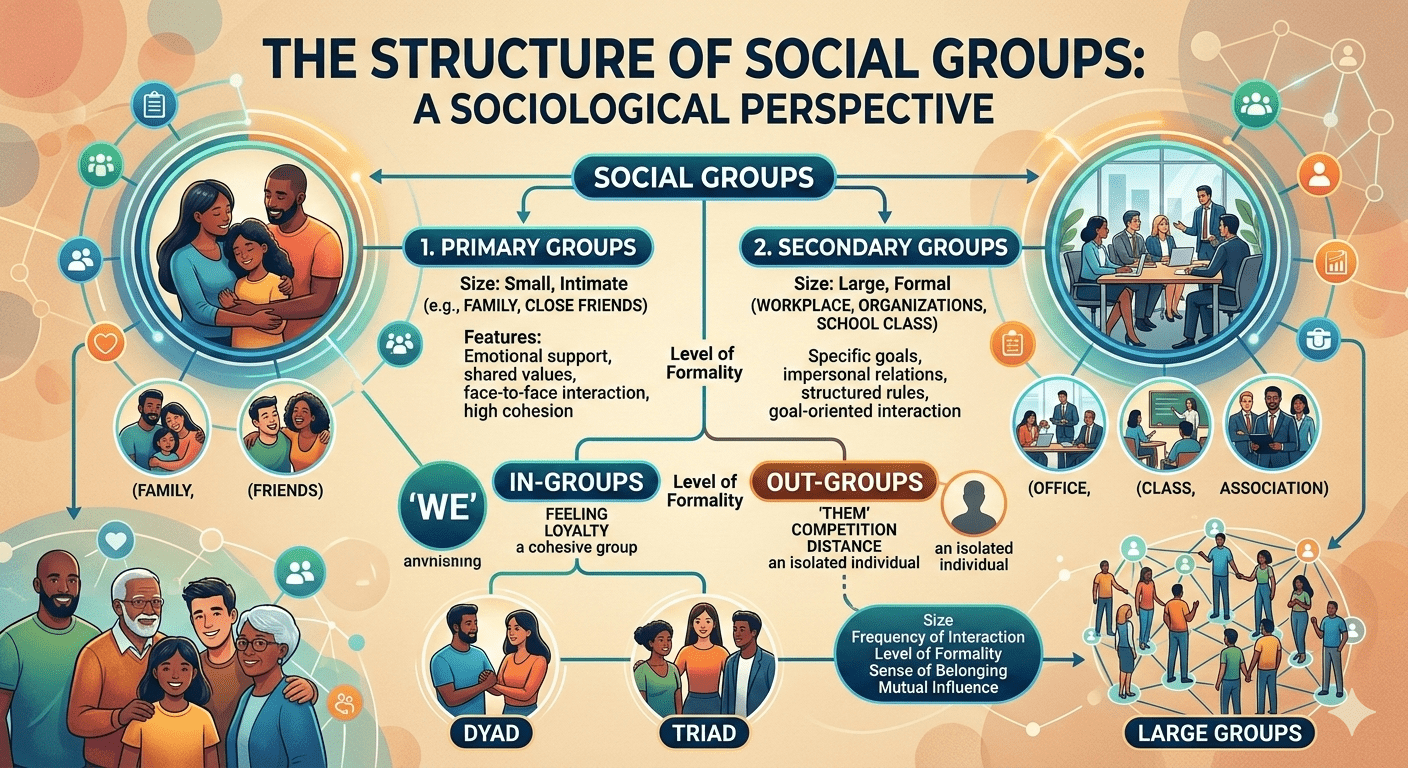
1. Definition: The Building Blocks of the Social Fabric
In the developmental architecture of sociological inquiry, a Social Group is defined as a collection of two or more individuals who interact with one another, share similar characteristics (interests, values, or heritage), and possess a collective sense of unity. Unlike a Social Aggregate (people at a bus stop) or a Social Category (all people aged 25), a social group requires sustained interaction and reciprocal expectations. Émile Durkheim fundamentally anchored this definition by emphasizing the Collective Conscience—the set of shared beliefs and sentiments that act as the "social glue" binding individuals to the group. This definition implies that social groups are not mere additions of individuals but sui generis entities that exert Social Control over their members.
For a sociologist, the definition of a social group signifies the study of the Authoritative Allocation of Identity. It involves the belief that the "Self" is a social product, constructed through group participation. By defining groups as sites of Meaningful Performance, the discipline investigate how In-group loyalty and Out-group prejudice are cultivated. This successfully transitioned the study of humanity from "individual psychology" to a rigorous inquiry into Social Dynamics, providing the Analytical Authority required to distinguish between intimate associations and the large-scale Bureaucratic organizations that characterize the modern National Identity.
2. Concept & Background: The Primary vs. Secondary Divide
The conceptual background of Social Groups is rooted in the early 20th-century effort to understand the impact of Urbanization on human relationships. Charles Horton Cooley (1909) provided the definitive classification:
- Primary Groups: Characterized by intimate, face-to-face association and cooperation (e.g., the family, playgroups). These are the "nurseries of human nature" where the Looking-Glass Self is formed.
- Secondary Groups: Characterized by impersonal, contractual, and goal-oriented relationships (e.g., a corporation, a political party). Relationships here are a means to an end rather than an end in themselves.
Intellectual history shows that this background moved the focus of social science toward the Mechanisms of Socialization. Understanding this concept requires recognizing that as societies modernize, the Authoritative Allocation of time shifts from primary to secondary groups. This perspective established the foundation for Symbolic Interactionism, proving that the stability of the Social organism depends on the individuals' ability to navigate these diverse group requirements, established through a rigorous internal moral code of Role Performance.
3. Ferdinand Tönnies: Gemeinschaft & Gesellschaft
Ferdinand Tönnies provided a profound macro-sociological background for group dynamics by tracing the transition of the Social Fabric through two "Ideal Types":
- Gemeinschaft (Community): Relationships based on Natural Will, shared tradition, and kinship. Here, the group precedes the individual (e.g., a rural village).
- Gesellschaft (Association): Relationships based on Rational Will, contract, and individual interest. Here, the individual precedes the group (e.g., the modern city).
Tönnies’ analysis proves that the evolution of Social Order is characterized by a shift from the "Sacred" ties of community to the "Secular" ties of association. This perspective highlights the Alienation inherent in modern group life, where Social Solidarity is no longer organic but is a calculated Legal-Rational framework designed for efficiency and predictability.
4. Robert K. Merton: Reference Group Theory
Robert K. Merton expanded the study of groups by identifying that individuals are influenced not only by the groups they belong to (Membership Groups) but also by groups they aspire to join or use as a benchmark. This is the Reference Group.
Merton introduced the concept of Relative Deprivation—the feeling of being disadvantaged when comparing oneself to a reference group. For instance, a worker may feel poor not because of their absolute wage, but because they compare themselves to the "Executive Group." This perspective reveals that Subjective Reality is a product of social comparison. For sociologists, Merton’s work remains the blueprint for identifying how Social Mobility and Frustration are generated within a stratified system, reconciling Knowledge, Power, and the Self through the lens of aspirational identity.
5. Conflict Theory: Groups as Sites of Power
In contrast to the functionalist focus on cohesion, Conflict Theorists (Marx, Dahrendorf) view social groups as Interests Groups locked in a struggle for Hegemony. They argue that the Authoritative Allocation of resources is determined by which group can mobilize the most power.
From this viewpoint, In-groups (the dominant elite) use Social Closure (Weber) to exclude Out-groups (the marginalized) from the Life Chances afforded by the system. This perspective highlights that group identity is often a Tactical Interaction designed to protect privilege or resist Structural Violence. This successfully moved the focus of the discipline toward the study of Collective Mobilization, proving that the progress of the Social Organism depends on the friction between competing group interests.
6. Indian Contextualization: Caste and SHGs (Paper II)
In Indian Society, the most powerful and persistent social group is Caste (Jati). While traditional "Book-Views" saw it as a ritual hierarchy, sociologists like G.S. Ghurye defined Caste as a "Segmentary Group" characterized by Social Closure and endogamy. M.N. Srinivas observed that Caste functions as a Reference Group for mobility through Sanskritization—where "lower" groups emulate the life-world of "upper" groups to negotiate for Social Honor.
Furthermore, modern India witnesses the rise of new, empowering social groups like Self-Help Groups (SHGs). These are primary groups that foster Subaltern Agency among rural women. By pooling resources and providing mutual support, SHGs challenge the Structural Violence of patriarchy and poverty. Contemporary India also illustrates the Politicization of Groups, where traditional identities are utilized for Democratic Mobilization and the creation of Vote Banks. This proves that in the Indian Context, social groups are a Synthetic process, resulting in Multiple Modernities where the "Sacred" ties of kinship are repurposed for "Secular" political gains.
7. Case Study: Sherif’s "Robbers Cave" Experiment
Muzafer Sherif’s (1954) experiment serves as the definitive case study for Intergroup Conflict and Cooperation. Sherif divided a group of boys into two separate social groups ("Eagles" and "Rattlers"). By introducing competition for resources, he successfully manufactured intense Out-group hostility and In-group solidarity.
Sociologically, this study reveals the Arbitrary nature of Group Identity. It proved that conflict is not a product of individual "personality" but of Structural Competition. Most importantly, Sherif showed that conflict could be resolved through Superordinate Goals—tasks that required both groups to work together. For sociologists, the Robbers Cave remains the blueprint for identifying how Systemic Cooperation can overcome Prejudice, reconciling Knowledge, Power, and the Individual in a quest for a more integrated National Identity.
Mains Mastery Dashboard
Social Groups represent the epistemological core of social integration, acting as the primary site where the Individual Psyche is socialized into the Macroscopic Social Structure. As articulated by Charles Horton Cooley, these groups are categorized into "Primary" (intimate) and "Secondary" (impersonal) forms. In the traditional Indian context, the Primary group was synonymous with the Joint Family and the Jati, providing the actor with a holistic National Identity and moral regulation. However, the process of Modernization has facilitated a shift toward Gesellschaft (Association), where individuals increasingly participate in Secondary Groups—such as labor unions, NGOs, and professional organizations—characterized by Rational-Legal authority and instrumental goal-attainment.
The changing nature of social groups in India is uniquely reflected in the rise of Self-Help Groups (SHGs). SHGs represent a Synthetic Achievement: they combine the emotional intimacy and Face-to-face interaction of a primary group with the Economic and Political goals of a secondary group. By facilitating Democratic Mobilization among the Subaltern, SHGs challenge the Structural Violence of traditional hierarchies, providing a new site for Substantive Equality. Furthermore, the role of Caste has transformed; while it remains a membership group, it now acts as a Reference Group for Sanskritization (Srinivas) and political interest-group mobilization. This transition proves that social groups in India are not disintegrating but are Re-configuring to manage the Anomie of urban capitalism and the requirements of a modern republic.
In CONCLUSION, social groups are Total Social Facts that remain the prerequisite for a Reflexive and equitable social existence. The sustainability of the Indian Republic depends on the ability of these groups to foster Solidarity while respecting the Constitutional Morality of individual rights. Reconciling Knowledge, Power, and Agency in the 21st century requires moving beyond "Atomized Individualism" toward a Relational Humanism. Sociology ensures that the Social Contract remains a dynamic negotiation among diverse groups, proving that the progress of the Social Organism is measured by the inclusivity and strength of its constituent associations in a globalized world.
Revision Strategy: Keywords
- Collective Conscience: The shared moral and spiritual bond of a group (Durkheim).
- Primary Group: Intimate, long-term associations like family (Cooley).
- Secondary Group: Large, impersonal groups based on tasks (Cooley).
- Gemeinschaft: Rural, traditional community based on "Natural Will" (Tönnies).
- Gesellschaft: Urban, modern association based on "Rational Will" (Tönnies).
- Reference Group: A group used as a standard for self-evaluation (Merton).
- Relative Deprivation: Dissatisfaction arising from comparing oneself to a reference group.
