

Social Institution: The Blueprint of Social Order
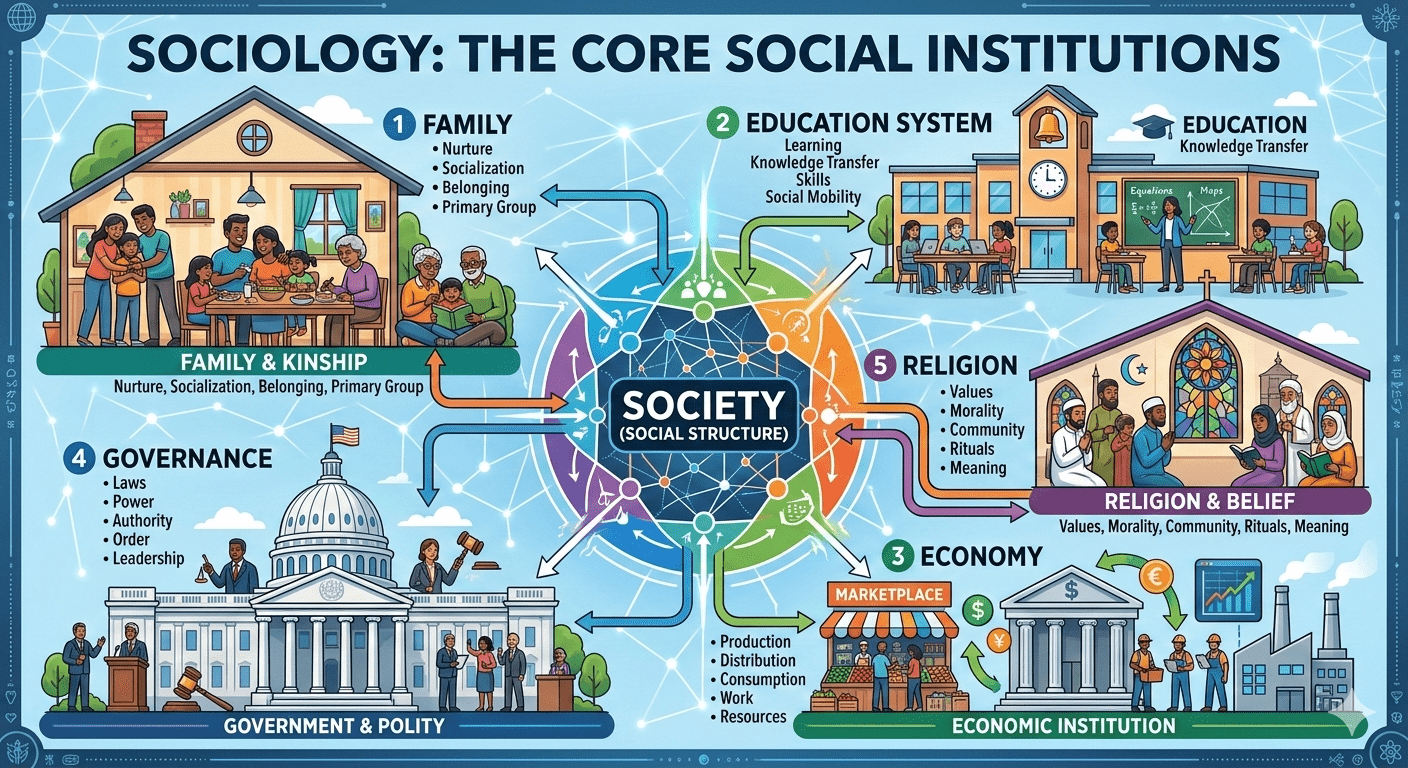
1. Definition: The Enduring Patterns of Collective Life
In the rigorous architectural landscape of sociological theory, a Social Institution is defined as a complex, integrated system of social norms, organized practices, and status-roles that organize and govern human behavior in pursuit of fundamental societal needs. Unlike an Association (which is a specific group of people), an institution is the abstract system of rules that survives individuals. Talcott Parsons fundamentally anchored this definition by describing institutions as the primary mechanism for Social Stability, asserting that they are the "functional prerequisites" that ensure the Social Organism avoids Anomie. This definition implies that institutions like the family, the state, and the economy are the "organs" that fulfill specific tasks required for the survival of the Social Fabric.
For a sociologist, the definition of a social institution signifies the study of the Authoritative Allocation of Values. It involves the belief that institutions are "Social Facts" (Durkheim) that exist external to the individual and exert a coercive influence. By defining institutions as sites of Meaningful Performance, the discipline investigate how Primary and Secondary Socialization embed the Collective Conscience within the person. This successfully transitioned the study of humanity from "Social Philosophy" to a rigorous inquiry into Social Dynamics, providing the Analytical Authority required to distinguish between transitory social groups and the long-term Structural Transformations that define a National Identity.
2. Concept & Background: The Pillars of Human Continuity
The conceptual background of Social Institutions is rooted in the 19th-century effort to understand the Great Transformation from tradition to modernity. Historically, sociologists have identified five "Universal Institutions" found in almost all societies: The Family, Religion, Economy, Polity, and Education. The background represents a fundamental shift in the Epistemology of Discovery: the realization that human survival is not based on instinct but on Institutionalized Behavior.
Intellectual history shows that this background moved the focus of social science toward the Mechanisms of Social Control. Bronisław Malinowski (Functionalist) argued that institutions arise to satisfy Human Needs (biological, instrumental, and integrative). Understanding this concept requires recognizing that institutions are the Theoretical Foundation of social order. They provide the "Recipes for Action" that allow for Predictability and Efficiency. This perspective established the foundation for Structural Functionalism, proving that the stability of the Social organism depends on the Value Consensus mediated through these pillars, established through a rigorous internal moral code of Reciprocity.
3. Functionalist Perspective: Parsons’ AGIL Schema
From the Functionalist perspective, as articulated by Talcott Parsons, social institutions are specialized organs that perform specific Functional Prerequisites to maintain system equilibrium. Parsons categorized these into the AGIL Schema:
- Adaptation (Economy): Institutions like the market and production systems that adapt the environment to meet material needs.
- Goal Attainment (Polity): The state and political institutions that define collective goals and mobilize resources.
- Integration (Law & Religion): Institutions that regulate the relationships between different parts of the system and ensure Social Solidarity.
- Latency (Family & Education): Institutions that maintain and renew the Value-Orientation and motivation of individuals (Pattern Maintenance).
This perspective proves that institutions are interdependent. A failure in the "Economic" organ triggers a compensatory reaction in the "Political" or "Familial" organs. Functionalism highlights the Homeostatic nature of society, where institutions work in Consensus to ensure the survival of the Social Logic against external shocks.
4. Conflict Theory: Institutions as Hegemonic Masks
In contrast to the consensus model, Karl Marx and later Conflict Theorists view social institutions through the lens of Power and Exploitation. Marx argued that institutions like the law, religion, and the family form the Ideological Superstructure that serves the Economic Base.
From this viewpoint, institutions are not neutral organs but tools used by the Bourgeoisie to maintain Class Dominance. Religion is viewed as the "Opium of the people" that provides a Hegemonic Mask for suffering, while the state acts as the "executive committee" of the ruling class. Louis Althusser expanded this by identifying Ideological State Apparatuses (ISAs)—like schools and media—that manufacture the spontaneous consent of the Proletariat. This perspective reveals that the primary site of Structural Violence is the "Authoritative Definition" of truth provided by dominant institutions, proving that Subaltern Agency can only be reclaimed through the dismantling of these exploitative structures.
5. Symbolic Interactionism: The Negotiated Order
Symbolic Interactionists (Mead, Goffman, Blumer) challenge the macro-view that institutions are rigid, external structures. They argue that institutions only exist through the ongoing interactions and shared meanings of the individuals within them.
From this viewpoint, an institution is a "Negotiated Order." For instance, the "Education system" is not just a building or a curriculum, but the thousands of daily interactions between teachers and students where Social Roles are performed, contested, and reinforced. This perspective highlights the Transformative Agency of individuals, proving that while institutions guide behavior, they are also constantly Re-constructed through micro-level performance, reconciling Knowledge, Power, and the individual within a fluid social landscape.
6. Indian Contextualization (Paper II Integration)
In Indian Society, social institutions are characterized by the tension between tradition and modernity. The Joint Family has historically been the primary institution for Primary Socialization and economic security. However, sociologists like I.P. Desai and M.S. Gore have analyzed the shift toward "structural nuclearity" while maintaining "functional jointness."
Furthermore, the Caste System serves as a quintessential, uniquely Indian social institution. While the state aims for its Annihilation (Ambedkar), Caste has adapted into modern Interest Groups and Vote Banks within the political system. The Jajmani System illustrated the institutionalization of Reciprocity and Structural Inequality in rural India. Contemporary India also sees the State acting as a "Modernizing Institution," utilizing Constitutional Morality to reform traditional institutions like marriage (e.g., Hindu Marriage Act). This proves that in the Indian Context, institutions are a Synthetic process, resulting in Multiple Modernities where the "Sacred" and the "Secular" coexist in a complex, reflexive National Identity.
7. Case Study: Durkheim’s Study of Religion
Émile Durkheim’s 1912 study, The Elementary Forms of Religious Life, serves as the definitive case study for Institutional Functionalism. Durkheim analyzed the totemism of Australian aborigines to prove that Religion is the prototype for all other social institutions.
Sociologically, this case study reveals that religion functions as the Institutionalization of the Collective Conscience. By dividing the world into the Sacred and the Profane, religious rituals produce Collective Effervescence, reinforcing Social Solidarity. This study confirms that what we call Social Order is essentially a religious achievement. For sociologists, Durkheim’s work remains the blueprint for identifying how Structural Integration is maintained through the Authoritative Allocation of Meaning, reconciling Knowledge, Power, and the Body within a symbolic systemic aggregate.
Mains Mastery Dashboard
Social Institutions represent the epistemological and structural core of social inquiry, acting as the primary mechanisms for Institutional Differentiation and social order. From a Functionalist perspective, as articulated by Talcott Parsons, institutions are the "organs" of the Social Organism that fulfill essential Functional Prerequisites. In the context of Education, the institution performs the critical tasks of Adaptation and Latency by socializing individuals into the dominant Value-Orientation and meritocratically allocating roles based on Technical Competence. This "Pattern Maintenance" ensures a state of Dynamic Equilibrium, where the Authoritative Allocation of positions is perceived as legitimate by the Collective Conscience, thereby fostering Organic Solidarity in a complex society.
However, this consensus-based model is profoundly challenged by Conflict Theory. For Marxists, institutions are not neutral organs but components of the Ideological Superstructure designed to protect the Economic Base of the Bourgeoisie. In the Indian context, the institution of education often operates through a "Hidden Curriculum" that reproduces Caste and Class disparities rather than eliminating them. By emphasizing the "Rational-Legal" norms of the elite, education can act as a Hegemonic Mask that obscures the Structural Violence inherent in a stratified society. As noted by B.R. Ambedkar, the "Authoritative Word" of traditional institutions often suppressed the Agency of the Subaltern, proving that the struggle for Social Justice requires a radical reconfiguration of institutional power to achieve Substantive Equality.
In CONCLUSION, social institutions are Total Social Facts that remain inherently reflexive. Their sustainability depends on achieving a Dynamic Balance between the need for order and the quest for Human Liberation. Reconciling Knowledge, Power, and Agency in the 21st century requires moving beyond "Mechanical Stability" toward a Reflexive Humanism. By unmasking the exploitative potentials of institutions while recognizing their role in Social Integration, sociology facilitates a more rational and equitable social existence. Ultimately, the study of society ensures that the "Blueprint of Order" serves the ends of Substantive Progress, proving that institutions are not static cages but Human Achievements capable of transformation in a globalized world.
Revision Strategy: Keywords
- Functional Prerequisite: A task that must be performed for a society to survive (Parsons).
- Value Consensus: Shared agreement on goals and norms within institutions.
- Superstructure: The social/cultural institutions that arise from the economic base (Marx).
- Negotiated Order: The idea that institutions are constructed through interactions (Interactionism).
- Structural Jointness: The persistence of Joint Family functions in modern nuclear structures.
- Authoritative Allocation: The process by which society distributes values and resources (Easton).
