

Social Morphology: The Anatomy of Social Space
1. Definition: The Physical Structure of the Social Body
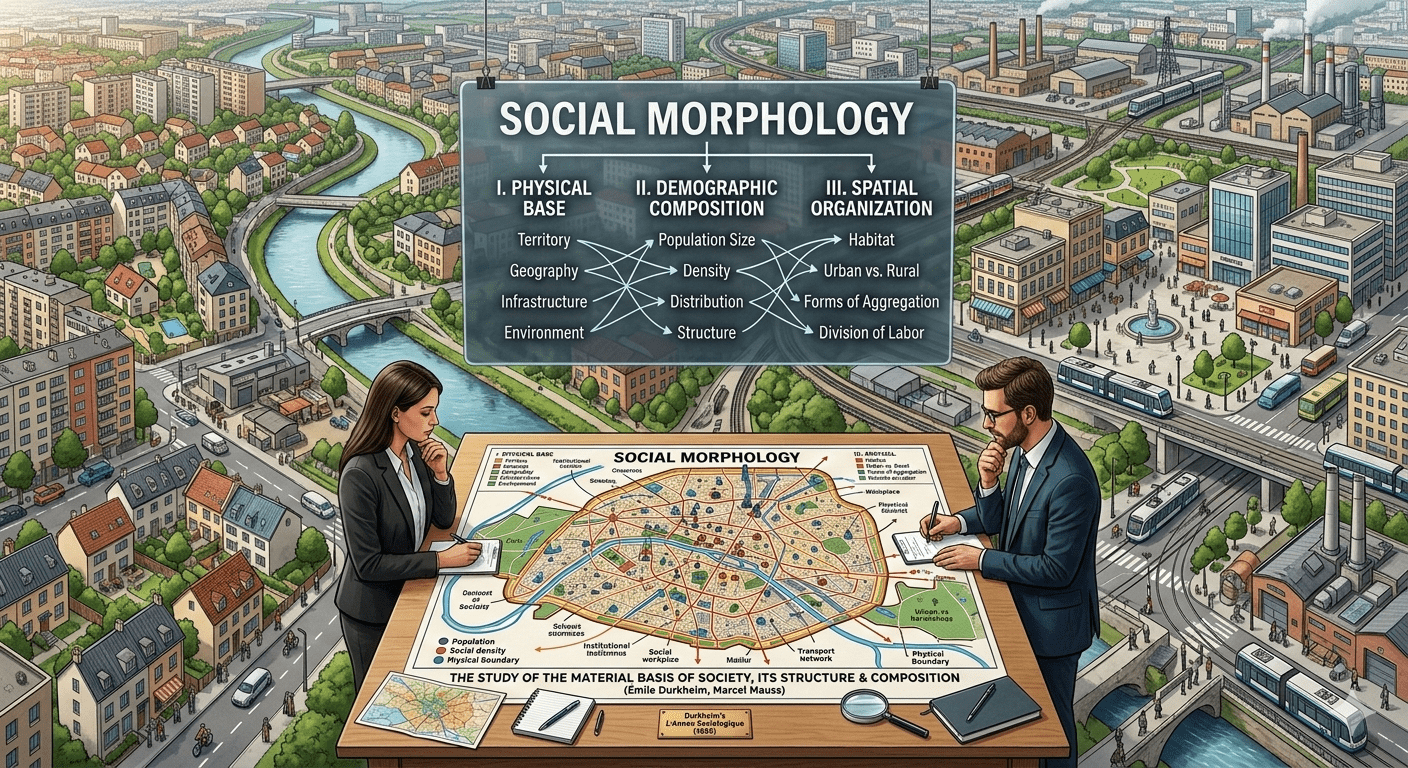
In the rigorous architectural landscape of classical sociology, Social Morphology is defined as the branch of the discipline that investigates the physical, material, and structural substrate of society. It focuses on the anatomical form of social groups, examining factors such as the size and density of the population, its spatial distribution (Rural vs. Urban), the nature of its habitats, and the communication networks that link these elements. Pioneered fundamentally by Émile Durkheim, social morphology treats these material arrangements as Social Facts that exert a coercive influence on collective life. This definition implies that the "Form" of a society—the way it is distributed across space—is the primary determinant of its "Function" and the nature of its Social Solidarity.
For a sociologist, the definition of social morphology signifies the study of the Material Foundation of Meaning. It involves the belief that social interactions are bounded by Spatio-Temporal constraints. By defining morphology as a Morphological Fact, the discipline investigates how the Authoritative Allocation of space (e.g., zoning laws or caste-based segregation) dictates the frequency and intensity of social contact. This successfully transitioned the study of humanity from "abstract philosophy" to a Rationalized Science of demographics and ecology, established through a rigorous internal moral code of Inquiry Integrity, providing the foundational logic for modern Urban Sociology.
2. Émile Durkheim: Morphological Facts and Social Life
Émile Durkheim introduced the concept of social morphology in his effort to classify Social Facts. He distinguished between Physiological facts (currents of thought, norms, and religious dogmas) and Morphological facts (the physical constitution of society). Durkheim argued that morphology is the "stable part" of the social fabric—it changes slowly but provides the rigid frame within which social life flows.
In his work The Rules of Sociological Method, he posited that morphological facts—like the number of people in a territory or the proximity of dwellings—are "ways of being" that determine the Collective Conscience. From this perspective, morphology is the "utility" required for Integration. For instance, the transition from Mechanical to Organic Solidarity was not a result of a change in ideas, but a result of a Morphological Transformation: the increase in the number of individuals and the intensity of their interactions, which Durkheim termed Dynamic Density.
3. Concept & Background: The Logic of Dynamic Density
The conceptual background of social morphology is anchored in the theory of Dynamic Density. Durkheim argued that as population grows (Volume) and the number of social interactions increases (Density), the Social Organism experiences a state of Structural Tension. To resolve this tension, individuals can no longer perform identical roles (Mechanical Solidarity); instead, they must specialize through the Division of Labor (Organic Solidarity).
Intellectual history shows that this background moved the focus of social science toward the study of Evolutionary Differentiation. Understanding this concept requires recognizing that Social Progress is driven by physical changes in the social body. This perspective establishes the foundation for Functionalism, proving that the stability of the Social Fabric depends on the spatial organization required to facilitate Efficiency and Reciprocity. This successfully moved the focus of the discipline toward Nomothetic Authority—establishing universal laws relating population pressure to structural change.
4. Ecological Theory: The Chicago School (Urban Morphology)
In the 20th century, the study of social morphology was radicalized by the Chicago School (Robert Park, Ernest Burgess). They utilized biological models to study the Urban Morphology of the modern city, treating it as an Ecological System. Burgess’s Concentric Zone Model is the quintessential morphological map, dividing the city into zones (Loop, Zone of Transition, Workingmen’s homes, etc.) based on Economic Competition.
From this viewpoint, Urbanization is a morphological process of "Invasion, Succession, and Dominance." This perspective reveals how the physical layout of a city dictates Social Behavior—for instance, how the "Zone of Transition" (slums) produces higher rates of Deviance due to Anomie. This study proves that Space dictates Logic, reconciling Knowledge, Power, and Geography within a mechanical systemic aggregate, providing the Analytical Authority required for Rational Social Planning.
5. Marcel Mauss: Seasonal Social Morphology
Marcel Mauss, a student of Durkheim, provided a profound refinement of morphology in his study of the Eskimos (Inuit). He discovered that their entire Social Fabric—religious life, family structure, and law—changed according to their Seasonal Morphology.
- Winter Morphology: High concentration of people in longhouses. This resulted in an intense Collective Effervescence, high religiosity, and strong social control.
- Summer Morphology: Dispersion of nuclear families for hunting. This resulted in a "Secular" period of Individualism, weak social control, and mundane existence.
This analysis proves that Morphology dictates Psychology. Mauss successfully demonstrated that the collective conscience is not a static cloud but a fluctuating state that expands or contracts based on the Physical Proximity of individuals, established through a rigorous internal moral code of Reciprocity.
6. Indian Contextualization (Paper II Integration)
In Indian Society, social morphology is a high-stakes Political Site. Traditionally, the morphology of the Indian Village was defined by Spatial Segregation based on Caste. The Agrahara or upper-caste clusters were physically separated from the Cheris or Dalit settlements, often located on the periphery or downwind. This morphology was the physical manifestation of Structural Violence and the logic of Purity and Pollution.
Contemporary India illustrates a radical shift through Over-urbanization—a process where urban population grows faster than infrastructure and industrial jobs. Sociologists like Ashish Bose have analyzed the "Census Towns" and the rise of Slums (e.g., Dharavi) as morphological failures. Furthermore, the Gated Communities of "Digital India" represent a new Social Closure, where the elite utilize Spatial Technology to isolate themselves from the Subaltern. This proves that in the Indian Context, morphology is a tool for Democratic Mobilization or Hegemonic Control, reconciling the "Rational-Legal" plan of the Smart City with the fluid, intersectional identities of Caste and Class in a quest for Substantive Equality.
7. Case Study: Urbanization in the Industrial Revolution
The Industrial Revolution serves as the definitive case study for Total Morphological Transformation. It triggered a massive shift from low-volume, dispersed rural life to high-volume, concentrated urban existence.
Sociologically, this case study reveals the Transformative Agency of morphology. It was this physical concentration of the Proletariat in factories and tenement housing that facilitated the birth of Class Consciousness. It proved that without a specific Morphological Opening (bringing people together), the Collective Mobilization required for revolution would have been impossible. For sociologists, the Industrial city remains the blueprint for identifying how Structural Shifts in Space lead to a total reconfiguration of the Social Contract, reconciling Knowledge, Power, and the Body.
Mains Mastery Dashboard
Social Morphology represents the epistemological and material core of social inquiry, acting as the primary substrate that orchestrates the nature of Social Solidarity. As articulated by Émile Durkheim, the social body is structured by Morphological Facts—the size, density, and spatial distribution of the population. Durkheim’s theory of "Dynamic Density" posits that as the volume of people and the frequency of their interactions increase, the social system is forced to move from Mechanical to Organic Solidarity through Structural Differentiation. In this view, morphology is the "Material Engine" that drives the Division of Labor, providing the Authoritative Allocation of roles required for system Equilibrium.
However, in the Indian context, morphology has historically functioned as a mechanism of Structural Violence. The spatial layout of the traditional Indian Village serves as a quintessential example of Institutionalized Stigma. By physically segregating Dalit habitations from the village center, the morphology enforced Social Closure (Weber) and limited the Life Chances of the Subaltern. This "Materialization of Caste" ensured that the Collective Conscience remained fragmented and hierarchical. Thus, the struggle for Social Justice in modern India involves a radical Re-morphology of space—moving from segregated hamlets to integrated urban environments where the Rational-Legal framework of the state can challenge traditional ritual boundaries.
In CONCLUSION, social morphology is a Total Social Fact that remains the prerequisite for a Reflexive and equitable social existence. The sustainability of a modern social order depends on achieving a Dynamic Equilibrium—ensuring that Urbanization leads to Emancipation rather than the creation of new "Digital Ghettoes." Reconciling Knowledge, Power, and Agency in the 21st century requires moving beyond "Mechanical Spacing" toward a Humanistic Urbanism. Sociology ensures that the "Anatomy of society" serves the ends of Human Liberation, proving that the progress of a nation is measured by the inclusivity of its Social Space in a globalized world.
Revision Strategy: Keywords
- Morphological Facts: The physical substrate or form of a society (Durkheim).
- Dynamic Density: The combination of population size and intensity of interaction.
- Urban Ecology: The study of cities as biological-environmental systems (Chicago School).
- Spatio-Temporal: Relating to the dimensions of space and time in social life.
- Census Towns: Indian areas that are statistically urban but lacks urban governance.
- Collective Effervescence: High-intensity energy produced by physical concentration (Mauss/Durkheim).