

Social Statics and Dynamics: The Twin Pillars of Comte
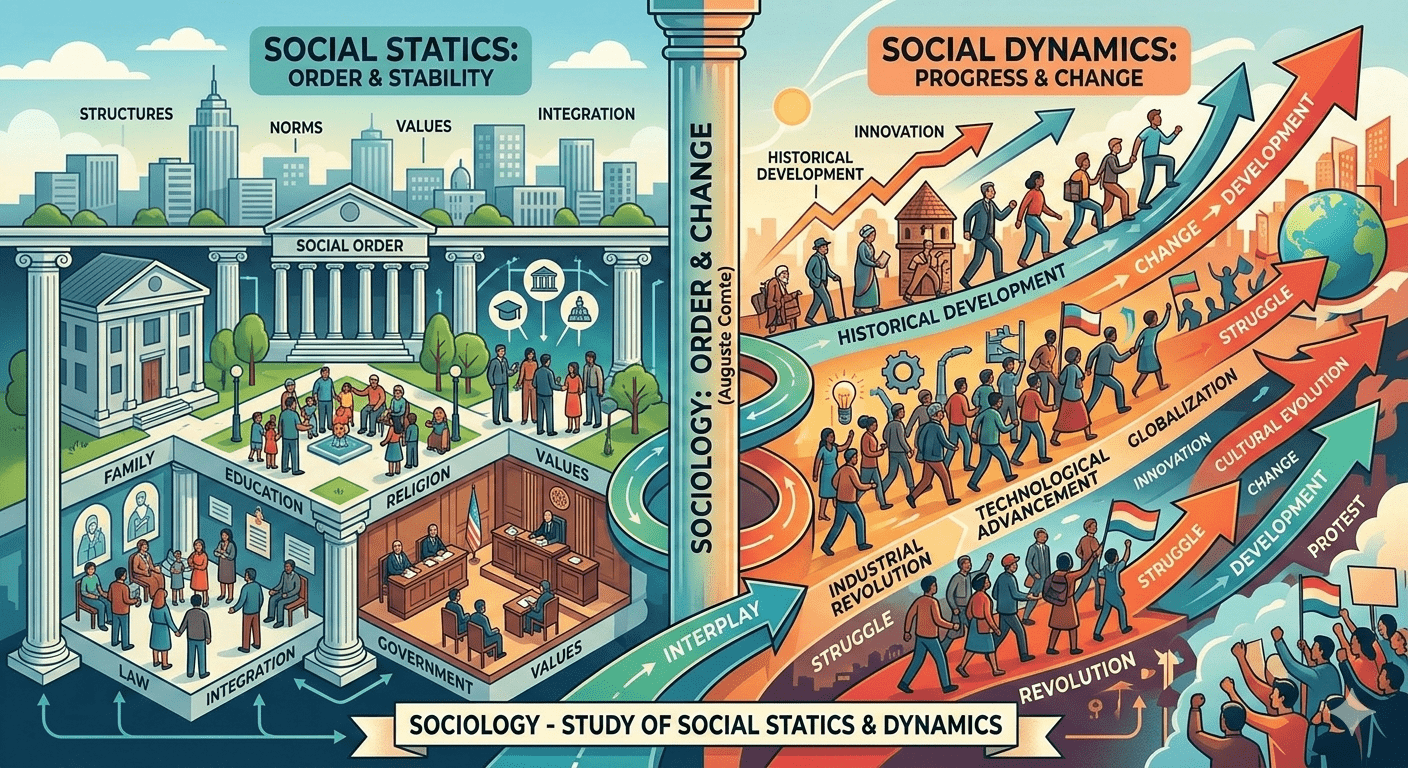
1. Definition: The Dialectic of Order and progress
In the rigorous foundational landscape of sociology, Social Statics and Social Dynamics are defined as the two primary branches of social inquiry introduced by Auguste Comte to distinguish between the study of social stability (Order) and social change (Progress). Borrowing terminology from biological sciences and physics, Comte conceptualized society as a Social organism that can be analyzed in two states: its structural equilibrium at a specific moment and its evolutionary trajectory over time. This definition implies that "Order" is the prerequisite for "Progress," and "Progress" is the continuous development of "Order." Sociologically, this represents the birth of Social Physics, transitioning the study of humanity from philosophical speculation to a Nomothetic Science established through a rigorous internal moral code of Inquiry Integrity.
For a sociologist, the definition of these concepts signifies the study of the Collective Conscience in both its static and dynamic modes. It involves the Authoritative Allocation of meaning to institutions that preserve the Social Fabric while acknowledging the Transformative Agency that drives history forward. This successfully moved the focus of the discipline toward the Mechanisms of Integration and Adaptation, providing the analytical tools required to understand how a National Identity is maintained despite seismic shifts in the Economic Mode of Production.
2. Social Statics: The Anatomy of Social Order
Social Statics focuses on the structural arrangements and Functional Prerequisites that ensure the stability and persistence of a society. Comte viewed statics as the "Anatomy" of the social body, investigating the interdependence of institutions. In this background, the focus is on Social Solidarity and the consensus of the parts.
Comte identified three primary elements of social statics:
- The Individual: Not viewed as a separate atom, but as a component whose egoism must be subordinated to altruism through Socialization.
- The Family: The fundamental unit of social statics—the "social cell"—where the first lessons of Solidarity and Authority are learned.
- The State & Religion: Institutions that provide the Sacred Canopy and Authoritative Allocation of Values to maintain the Collective Conscience.
This perspective established the foundation for Structural Functionalism, proving that the stability of the Social organism depends on the Value Consensus mediated through these pillars, established through a rigorous internal moral code of Reciprocity.
3. Social Dynamics: The Physiology of Social Progress
Social Dynamics refers to the "Physiology" of the social body—the study of the laws of Social Evolution and the successive stages of human intelligence. Comte argued that societies progress according to a Linear Path of intellectual development. The conceptual background of dynamics is rooted in the belief that human history is a process of Rationalization.
Intellectual history shows that social dynamics move the focus of social science toward the study of Social Change as a cumulative process. Understanding this concept requires recognizing that Progress is the diachronic outcome of the accumulation of Knowledge. For Comte, the motor of dynamics was not economic (as for Marx) but Cerebral. This perspective reveals that the Social Fabric is not just "being" but is constantly "becoming," reconciling Knowledge, Power, and the Body within a developmental systemic aggregate.
4. Comte's Law of Three Stages: The Master Law of Dynamics
The definitive law governing social dynamics is the Law of Three Stages, which posits that both the human mind and society pass through three distinct developmental epochs:
- The Theological Stage: The "Infancy" of humanity, where all phenomena are explained by supernatural agents or Sacred Narratives. Social statics here is based on Absolute Monarchy and religious authority.
- The Metaphysical Stage: The "Adolescence" of humanity, where abstract forces and philosophical concepts replace gods. This is a transitional stage characterized by Epistemological Rupture and social instability.
- The Positive (Scientific) Stage: The "Manhood" of humanity, where the mind gives up the search for absolute causes and instead uses Observation and Reason to discover the Relative Laws governing the world. Social statics in this stage is managed by Sociologists (Industrial Priests) and scientists.
This law proves that Dynamics dictates Statics: as our way of thinking changes, our social structures must adapt to maintain Equilibrium. Comte’s work provided the Nomothetic Authority required to believe in the possibility of a "Positive Science" of society.
5. Functionalist Perspective: Parsons and the AGIL Synthesis
Talcott Parsons refined the statics-dynamics duality through his Structural Functionalism. His AGIL Schema acts as a bridge between the two:
- Statics (Integration & Latency): These functions maintain the internal Value Consensus and institutional stability of the system.
- Dynamics (Adaptation & Goal Attainment): These functions allow the Social organism to respond to environmental shifts and achieve Social Change through resource mobilization.
For functionalists, social change (dynamics) is viewed as a Homeostatic movement—a process of Adaptive Upgrading where the system re-establishes Equilibrium at a higher level of complexity. This perspective proves that the stability of the Social Logic depends on the system’s ability to reconcile Structural Differentiation with Functional Integration.
6. Conflict Theory: Change through Rupture
In contrast to the Comtean focus on "Order as the condition of Progress," Conflict Theorists (Marx, Dahrendorf) argue that social dynamics are driven by Class Conflict and Structural Violence. Marx posited that "The history of all hitherto existing society is the history of class struggles."
From this viewpoint, social statics (institutions) are often a Hegemonic Mask that preserves the interests of the Bourgeoisie. Social dynamics, therefore, occur through Social Revolution—a violent rupture of the old order to create a new Economic Mode of Production. This perspective highlights that Substantive Progress can only be achieved by overcoming the Alienation inherent in the current state of "Order," proving that the Sovereignty of the People is the ultimate dynamic force.
7. Indian Contextualization: Tradition (Statics) and Modernity (Dynamics)
In Indian Society, the interplay of statics and dynamics is uniquely manifested in the "Modernization of Indian Tradition." Sociologist Yogendra Singh argued that India did not simply move from a "Theological" to a "Positive" stage. Instead, traditional Social Statics (Caste, Joint Family, Village Community) have "Modernized" from within.
M.N. Srinivas observed this through Sanskritization (a dynamic process of mobility within a static hierarchy) and Westernization (a dynamic exogenous force). Furthermore, the 1991 LPG reforms triggered a seismic shift in social dynamics, leading to Urbanization and the rise of a consumerist middle class. However, the Caste System remains a resilient static element, adapting into modern Interest Groups and Vote Banks. This proves that in the Indian Context, statics and dynamics are a Synthetic process, resulting in Multiple Modernities where the "Sacred" and the "Secular" coexist in a complex, reflexive National Identity.
8. Case Study: Industrialization as a Dynamic Force
The Industrial Revolution serves as the definitive case study for Total Social Transformation. It was a dynamic movement that completely reconfigured the Social Statics of 18th-century Europe.
Sociologically, this case study reveals the Transformative Agency of technology. It led to the breakdown of the Joint Family, the rise of Bureaucratic Rationalization, and the transition from Mechanical to Organic Solidarity (Durkheim). For sociologists, industrialization remains the blueprint for identifying how Structural Shifts in Production lead to a total reconfiguration of the Social Contract, reconciling Knowledge, Power, and the Body within a mechanical systemic aggregate.
Mains Mastery Dashboard
The sociological understanding of Social Statics and Dynamics, introduced by Auguste Comte, represents the epistemological and structural core of modern social inquiry. Comte posited that society must be analyzed as a Social Organism where "Order" (Statics) provides the structural stability through the interdependence of institutions like the family and state, while "Progress" (Dynamics) provides the evolutionary trajectory through the Law of Three Stages. In this view, order is not a static cage but the "condition" that allows for the cumulative development of human intelligence and Scientific Authority. This duality successfully transitioned the study of humanity from philosophy to Positivism, providing the Nomothetic Authority required for Rational Social Planning and the maintenance of the Social Fabric.
In the Indian context, this dialectic is uniquely visible in the "Modernization of Indian Tradition." As argued by Yogendra Singh, India’s social dynamics are not a simple linear progression from tradition to modernity. Instead, traditional Social Statics, such as the Caste System and the Joint Family, have shown remarkable resilience by "modernizing" their functions. Through Sanskritization, marginalized groups utilize dynamic mobility to achieve higher status within a ritualistically static hierarchy, while the rise of Democratic Mobilization has transformed Caste into a modern Interest Group within the Polity sub-system. This transition proves that in India, "Progress" is a Synthetic Achievement, where the "Sacred" and the "Rational-Legal" exist in a state of Dynamic Equilibrium, ensuring Substantive Progress without the total Alienation of the spirit.
In CONCLUSION, social statics and dynamics are Total Social Facts that remain the prerequisite for a Reflexive and equitable social existence. The sustainability of a modern social order depends on its ability to move beyond "Mechanical Stability" toward a Humanistic Progress. Reconciling Knowledge, Power, and Agency in the 21st century requires recognizing that the "Blueprint of Order" must serve the ends of Human Liberation. Sociology ensures that the study of collective life serves the ends of Substantive Justice, proving that the progress of a nation is measured by the inclusivity of its Social Space and the strength of the bonds that allow its citizens to coexist in Human Dignity in a globalized world.
Revision Strategy: Keywords
- Social Physics: Comte’s original name for the scientific study of society.
- Law of Three Stages: The theological, metaphysical, and positive phases of social evolution.
- Functional Prerequisites: Tasks that must be fulfilled to maintain social stability (Parsons).
- Structural Differentiation: The process where institutions become more specialized during progress.
- Homeostasis: The tendency of a social system to re-establish equilibrium after change.
- Multiple Modernities: The idea that different cultures have unique paths to becoming modern.