

Social System: The Integrated Matrix of Collective Action
1. Definition: The Integrated Systemic Aggregate
In the rigorous foundational landscape of sociological theory, a Social System is defined as a complex network of interrelated parts—individuals, groups, and institutions—that interact with each other in a stable, structured manner to achieve collective goals and maintain overall social order. Borrowing terminology from biological and mechanical sciences, sociology views the system as a total structural aggregate where the "whole" is greater than the sum of its parts. Talcott Parsons fundamentally anchored this definition by conceptualizing the social system as a plurality of individual actors interacting with each other in a situation which has at least a physical or environmental aspect. This definition implies a commitment to Functional Integration, where the stability of the Social organism depends on the Authoritative Allocation of roles and duties, established through a shared Value Consensus.
For a sociologist, the definition of a social system signifies the study of the Status-Role Matrix. It involves the belief that social reality is clinical and can be mapped through its internal consistency. By defining society as a Mechanical system of actions, the discipline investigate how Socialization and Social Control ensure that individual motivations align with system requirements. This successfully transitioned the study of humanity from "abstract philosophy" to a Rationalized Science of social mechanics, providing the Nomothetic Authority required to predict how the Social Fabric responds to internal friction or external shocks.
2. Concept & Background: The Logic of Dynamic Balance
The conceptual background of the Social System is rooted in the 19th-century organic analogy of Herbert Spencer and the Functionalist tradition of Émile Durkheim. Historically, the shift occurred from seeing society as a "collection of individuals" to seeing it as an Autopoietic (self-producing) entity. The background represents a fundamental shift in the Epistemology of Discovery: the realization that the "Social Fact" is a systemic product. This background is inextricably linked to the rise of Modernization, as complex industrial societies require sophisticated Structural Differentiation to handle increasing Moral Density.
Intellectual history shows that the social system provided the "Cultural Capital" required for Rational Social Planning. It moved the focus of social science toward the study of Equilibrium—the state where the system’s parts are in a mutually reinforcing balance. Understanding this concept requires recognizing that a social system assumes Interdependence: a change in the "Economic" subsystem inevitably triggers a compensatory change in the "Political" or "Familial" subsystems. This perspective established the foundation for General Systems Theory, proving that the stability of the National Identity depends on the Homeostatic mechanisms of its constituent institutions, established through a rigorous internal moral code of Reciprocity.
3. Parsonian Functionalism: The AGIL Grid
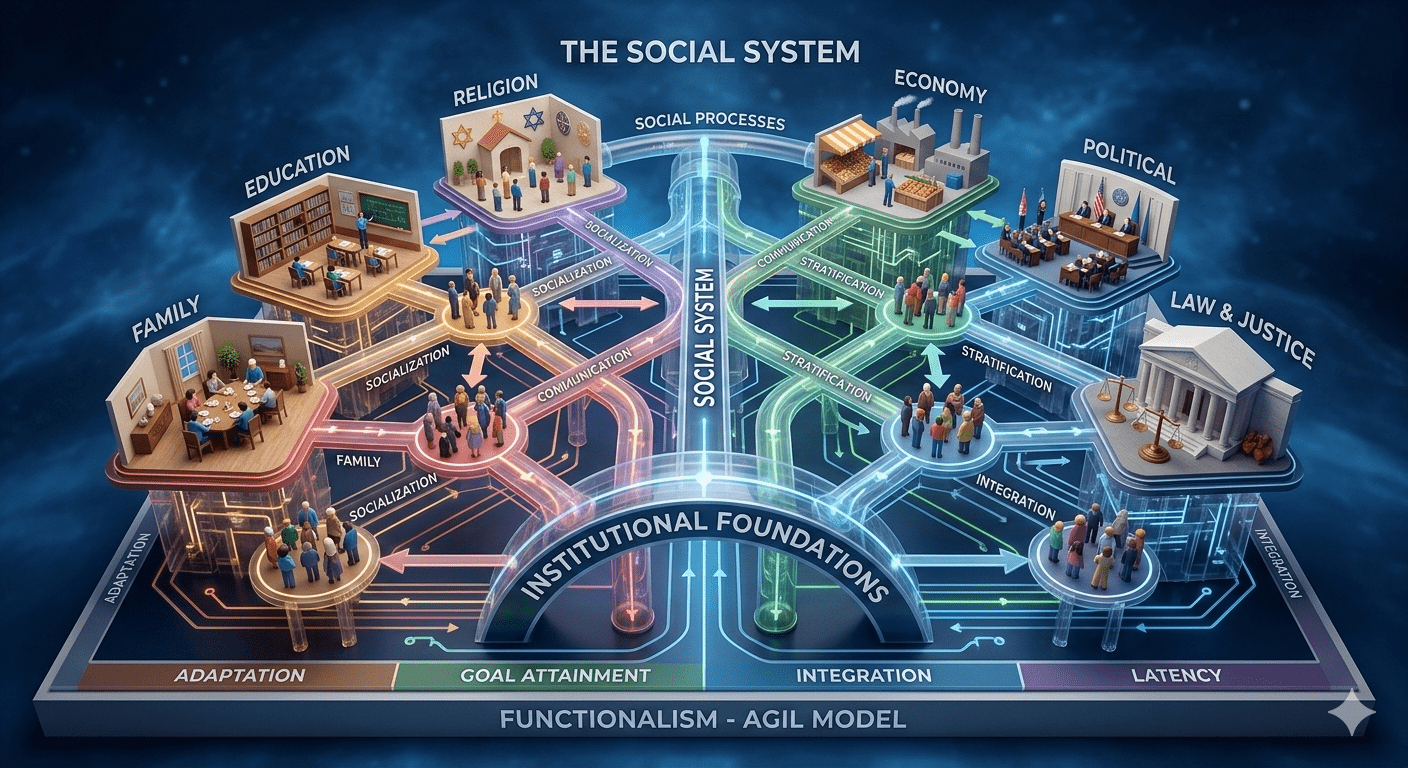
Talcott Parsons provided the definitive analytical framework for the social system through his AGIL Schema. He argued that for any system to survive and remain in Equilibrium, it must fulfill four Functional Prerequisites:
- Adaptation (A): The system must secure sufficient resources from its environment and distribute them. This function is specialized in the Economic Subsystem.
- Goal Attainment (G): The system must define its objectives and mobilize resources to achieve them. This is the primary function of the Polity (Political Subsystem).
- Integration (I): The system must coordinate the relationships between its parts to ensure Social Solidarity. This is managed by the Legal System and Religion.
- Latency (L): Also known as "Pattern Maintenance," the system must maintain and renew the Value-Orientation of individuals. This is fulfilled by the Family and Education organs.
Parsons’ analysis proves that the "utility" of any institution is measured by its contribution to these four needs. This perspective highlights the Mechanical nature of social life, where the Authoritative Allocation of meaning ensures that the Collective Conscience remains resilient against the threat of Anomie.
4. The Hierarchy of the Action System
Beyond the AGIL grid, Parsons identified a Cybernetic Hierarchy that governs social systems. He posited that the Social System is embedded within a larger General System of Action, consisting of four levels of increasing complexity:
- Behavioral Organism: The biological substrate providing the energy for action.
- Personality System: The individual’s needs, motivations, and Individual Agency.
- Social System: The network of Status-Roles and interactions.
- Cultural System: The shared Symbolic Logic, values, and beliefs that provide the blueprint for the other systems.
Parsons argued that the Cultural System is the "Highest Information" system, meaning it controls the others by providing the Value Consensus. This perspective reveals that Social Order is ultimately a Cognitive Achievement, reconciling Knowledge, Power, and the Body within a developmental systemic aggregate.
5. Niklas Luhmann: Communication and Autopoiesis
In the late 20th century, Niklas Luhmann radicalized systems theory by stripping it of human individuals. He argued that the "Elementary Unit" of a social system is not a person, but Communication. Luhmann viewed society as an Autopoietic System—a system that produces and reproduces its own components through its internal operations.
From this viewpoint, social systems are Closed Systems of meaning. For instance, the "Legal System" only communicates in the language of "Legal/Illegal," and the "Economic System" only in "Paid/Unpaid." This perspective highlights the Rationalized complexity of modern life, where the Authoritative Allocation of Labels occurs within specialized silos, proving that the progress of the Social organism is a diachronic outcome of Recursive communication rather than conscious human intent.
6. Conflict Theory: System as a site of Tension
In contrast to the functionalist focus on consensus, Conflict Theorists (Marx, Dahrendorf) view the social system as an inherently unstable aggregate. They argue that the "interdependence" described by functionalists is often a Hegemonic Mask that obscures Structural Violence.
From this viewpoint, the system is maintained not by consensus, but by the Domination and Coercion of the ruling class. Conflict theorists argue that Social Change occurs when the "Parts" of the system—the Oppressed Classes—develop Class Consciousness and challenge the Authoritative Allocation of resources. This critique reveals that what Parsons calls "Equilibrium" is actually a state of Suppressed Tension, proving that the sustainability of the Social Fabric depends on the continuous management of Conflict and Agency.
7. Indian Contextualization (Paper II Integration)
In Indian Society, the concept of the social system is uniquely manifested in the Jajmani System and the Caste-Varna complex. Traditionally, the Indian village functioned as a self-sufficient social system where different Jatis were bound by Ritual Reciprocity and economic interdependence. Sociologists like William Wiser analyzed Jajmani as a functional social system providing Social Security.
However, B.R. Ambedkar challenged this functionalist view, arguing that the Caste system was a Pathological Social System based on Graded Inequality. He posited that the system lacked Fraternity (Integration) and was maintained through the Structural Violence of the Shastras. Post-independence India illustrates a shift toward a Democratic Social System, where the State act as the primary engine of Integration through Constitutional Morality and Reservations. This proves that in the Indian Context, the social system is a Synthetic process, resulting in Multiple Modernities where traditional "Sacred" systems are being re-engineered for "Secular" Substantive Equality.
8. Case Study: The Education System as a Social System
The Education System serves as the definitive case study for an Applied Social System. It perfectly illustrates the AGIL functions:
- Adaptation: Training students for the labor market (Economy).
- Goal Attainment: Achieving National Literacy targets defined by the state (Polity).
- Integration: Bringing diverse groups together to foster National Identity.
- Latency: Socializing children into the Collective Conscience and dominant values.
Sociologically, this case study reveals the Transformative Agency of the system. However, it also illustrates the Paradox of Reproduction: the system often replicates existing Class and Caste hierarchies through its "hidden curriculum." For sociologists, education remains the blueprint for identifying how Structural Shifts in Knowledge lead to a total reconfiguration of the Social Contract, reconciling Knowledge, Power, and the Individual in a quest for progress.
Mains Mastery Dashboard
The concept of the Social System, fundamentally theorized by Talcott Parsons, represents the epistemological and structural core of social inquiry, acting as the primary mechanism for maintaining Social Order. Parsons posited that a society is a self-regulating organism that achieves Dynamic Equilibrium by fulfilling the four Functional Prerequisites of the AGIL schema. In this view, the system is not a static cage but a diachronic outcome of Adaptive Upgrading, where institutions specialized in Adaptation (Economy) and Latency (Culture) ensure the National Identity remains resilient against the friction of Social Change. This "Action System" provides the Authoritative Allocation of meaning required for Social Integration.
In the Indian context, the transformation of the Joint Family system serves as a quintessential example of this systemic logic. Historically, the joint family performed all AGIL functions—acting as a unit of Production (Adaptation) and Socialization (Latency). Under the pressure of Modernization and Urbanization, the system experienced Structural Strain. However, instead of total disintegration, the Indian social system orchestrated what I.P. Desai termed "Structural Nuclearity but Functional Jointness." This represents a Homeostatic movement where the family organ adapted to the modern economy while preserving the Sacred bonds of Reciprocity. Thus, the system achieved a new Equilibrium through Value Generalization, proving that the Social Fabric is characterized by Structural Continuity despite radical shifts in its morphology.
In CONCLUSION, the social system is a Total Social Fact that remains the prerequisite for a Reflexive and equitable social existence. Its sustainability depends on achieving a Dynamic Balance—ensuring that Instrumental Progress (Adaptation) does not lead to the total Alienation of the spirit (Integration). Reconciling Knowledge, Power, and Agency in the 21st century requires moving beyond "Mechanical Stability" toward a Reflexive Humanism. Sociology ensures that the study of systemic life serves the ends of Human Liberation, proving that the "Blueprint of Order" is a living achievement that must be re-negotiated to ensure Substantive Justice in a globalized world.
Revision Strategy: Keywords
- AGIL Schema: Parsons’ grid for Adaptation, Goal-attainment, Integration, and Latency.
- Autopoiesis: The property of a system to reproduce itself internally (Luhmann).
- Value Consensus: Shared agreement on values that acts as the "social glue."
- Status-Role Matrix: The structural positions and behavioral expectations within a system.
- Homeostasis: The tendency of a social system to return to equilibrium after a disturbance.
- Jajmani System: Traditional system of reciprocity and interdependence in rural India.
