

Sovereignty: The Epistemological Base of the State
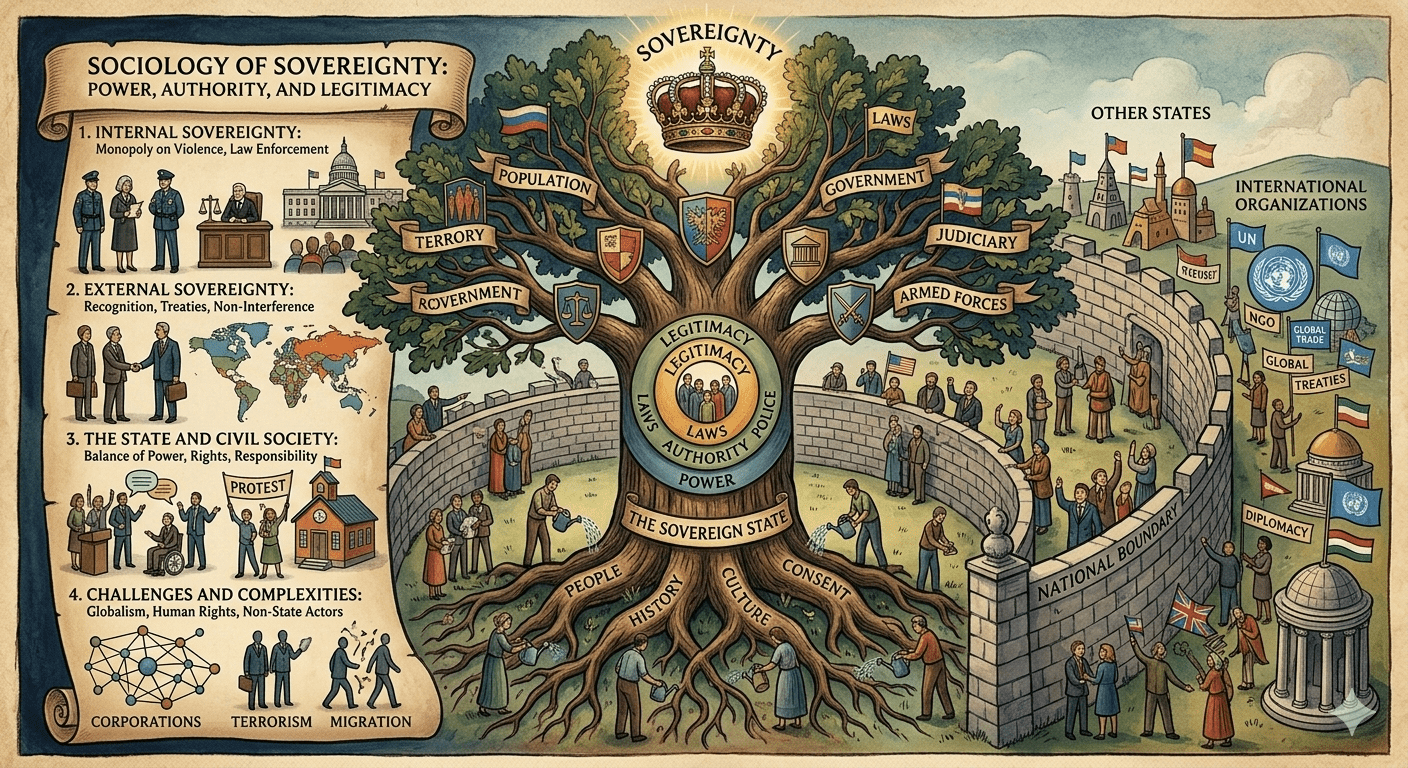
1. Definition: The Authoritative Allocation of Finality
In the rigorous foundational architecture of political sociology, Sovereignty is defined as the supreme, independent, and absolute authority of a state over its territory and population, signifying the absence of any higher power or external interference in its internal governance. It is the definitive "Authoritative Allocation" of the right to rule. Sociologically, sovereignty is not merely a legal status but a Social Construction that determines the Life Chances of individuals by defining the boundaries of Legal-Rational Authority. It involves the transition from the "Divine Right" of kings to the Sovereignty of the People or the Constitution, representing an Epistemological Rupture in how social order is legitimized.
For a sociologist, the definition of sovereignty encompasses two dimensions: Internal Sovereignty (the state’s supremacy over all individuals and groups within its borders) and External Sovereignty (the recognition of the state’s independence by other international actors). By defining the state as the primary site of Social Integration, sovereignty investigate how National Identity is manufactured and maintained through the Authoritative Allocation of Labels such as "citizen" or "alien." This successfully transitioned the study of governance from "moral philosophy" to a Rationalized Science of power dynamics, established through a rigorous internal moral code of Administrative Neutrality.
2. Concept & Background: The Westphalian Epoch
The conceptual background of the modern social system of sovereignty is rooted in the Treaty of Westphalia (1648). Historically, this event signaled the end of the Sacred Canopy of the Holy Roman Empire, establishing the National State as the primary Spatio-Temporal unit of human organization. The background represents a fundamental shift in the Theory of Legitimacy: authority was no longer derived from a universal church but from the Territoriality of the state.
Intellectual history shows that sovereignty provided the "Cultural Capital" required for the Modernization of the bureaucracy. It moved the focus of social science toward the study of Secularization and the Social Contract. Understanding this concept requires recognizing that sovereignty assumes a Mechanical system of borders. This perspective established the foundation for Functionalism (Parsons), proving that the stability of the Social organism depends on the state’s ability to fulfill the Goal Attainment (G) function—mobilizing society to achieve collective objectives without external veto, established through a rigorous internal moral code of National Interest.
3. Max Weber: The Monopoly on Legitimate Force
Max Weber provided the definitive sociological anchor for sovereignty. He defined the state as a "human community that (successfully) claims the monopoly of the legitimate use of physical force within a given territory." In the Weberian framework, sovereignty is the prerequisite for Legal-Rational Authority.
From this perspective, sovereignty is the "utility" required for Rationalization. Without a sovereign center, the Authoritative Allocation of meaning would be fragmented, leading to Anomie. Weber’s analysis proves that sovereignty is not just about "law," but about the Calculability of the system. The sovereign provides the Nomothetic Authority required to establish the Iron Cage of bureaucracy, ensuring that social interaction is predictable and managed through Procedural Propriety rather than charismatic whim.
4. Stephen Krasner: Typologies of Sovereignty
Sociologist and political scientist Stephen Krasner radicalized the study of sovereignty by arguing it is an "Organized Hypocrisy." He identified four distinct types of sovereignty that characterize the modern Social Fabric:
- International Legal Sovereignty: The mutual recognition of states as independent entities in the Symbolic Logic of international law.
- Westphalian Sovereignty: The exclusion of external actors from domestic authority structures—the "non-interference" principle.
- Domestic Sovereignty: The actual Authoritative Allocation of control within the state through Bureaucratic Rationalization.
- Interdependence Sovereignty: The ability of the state to regulate flows of information, capital, and people across its borders.
Krasner’s typologies prove that sovereignty is processual and contingent. A state may have "recognition" but lack "control," highlighting the Duality of Reality in a globalized world where Structural Violence often bypasses formal legal boundaries.
5. Globalization and De-territorialization
The primary challenge to sovereignty in the 21st century is Globalization. Theories of De-territorialization (Appadurai) suggest that as capital, ideas, and Subaltern groups move rapidly across the globe, the "Border" loses its Authoritative Value.
From this viewpoint, sovereignty is undergoing a Reflexive transformation. Supranational bodies like the WTO, IMF, and UN increasingly dictate the Authoritative Allocation of Policies once reserved for the national parliament. This perspective reveals that the Social Logic of the state is being "stretched" by the Transnational Class. For sociologists, this analysis is vital for identifying how Global Power Dynamics lead to the Alienation of the local citizen, as the "Sovereign" becomes a diachronic outcome of Financialization rather than democratic will.
6. Saskia Sassen: The Unbundling of Authority
Saskia Sassen, in her work Territory, Authority, Rights, argues that we are witnessing an "Unbundling" of sovereignty. She posits that sovereignty is no longer a "Total Fact" centered on the state but is being redistributed to Global Cities and private algorithmic systems.
From this viewpoint, Global Cities like Mumbai, New York, or London act as new sites of sovereignty where Knowledge-Power is concentrated. Sassen’s analysis proves that the Social organism is moving toward a Multiple Modernities framework where the "Sovereign" state must compete with Transnational Corporations for the Authoritative Allocation of Labels. This study reveals that Substantive Progress in the 21st century depends on how states re-negotiate their Reflexive Agency within these global networks.
7. Indian Contextualization (Paper II Integration)
In Indian Society, sovereignty represents a radical Epistemological Synthesis. The Preamble to the Constitution of India declares India a "Sovereign Socialist Secular Democratic Republic." B.R. Ambedkar utilized sovereignty as a Political Tool for Democratic Mobilization, arguing that popular sovereignty is meaningless without Social Democracy and the Annihilation of Caste.
Contemporary India illustrates a Crisis of Sovereignty in the face of Digital Modernization. The rise of "Cyber-Sovereignty"—the attempt to localize data and regulate platforms like Twitter or WhatsApp—represents a Mechanical effort to reclaim Authoritative Allocation of the digital Public Sphere. Furthermore, the 1991 LPG reforms (Liberalization, Privatization, Globalization) were analyzed by sociologists like Amartya Sen as a trade-off: India gained Economic Progress but surrendered a degree of Sovereign control over its market to global Capitalism. This proves that in the Indian Context, sovereignty is a Synthetic process, resulting in Multiple Modernities where the "Sacred" duty to protect the Subaltern must navigate the "Secular" requirements of the global market.
8. Case Study: Brexit and the Supranational Challenge
The Brexit (2016-2020) movement serves as the definitive case study for the Reactive Mobilization of Sovereignty. Driven by the slogan "Take Back Control," the UK sought to dismantle its Integration with the European Union.
Sociologically, this case study reveals the Transformative Agency of National Identity. It proved that the Collective Conscience can reject Instrumental Reason (the economic benefits of the EU) in favor of the Sacred value of sovereignty. This study confirms that Sovereignty is the primary prerequisite for a sense of Belonging in a fragmented world. For sociologists, Brexit remains the blueprint for identifying how Structural Shifts in Power trigger a Backlash of traditional Social Solidarity against the "Iron Cage" of supranational bureaucracy.
Mains Mastery Dashboard
Sovereignty represents the epistemological and structural core of modern statehood, acting as the primary mechanism for the Authoritative Allocation of social order. Historically, the Westphalian model, anchored in Max Weber’s concept of the Monopoly on Legitimate Force, defined the state as a supreme regulator within a fixed territory. However, the process of Globalization has orchestrated an "Unbundling of Sovereignty" (Saskia Sassen). As capital and Symbolic Logic de-territorialize, the state is increasingly pressured to act as a "Market Coordinator," facilitating global investment while surrendered its Nomothetic Authority over key economic and social sectors to supranational organizations and Transnational Corporations.
In the Indian context, this transition is characterized by a Synthetic Tension. The 1991 LPG reforms marked the shift from a "Sovereign Welfare state" to a participant in global Capitalism, leading to a state of Underdevelopment in traditional regulatory capacity. However, India has responded with the concept of "Cyber-Sovereignty." By asserting Authoritative Control over data localization and digital platforms, the state utilizes Technological Agency to protect the National Identity from Algorithmic Hegemony. This represents a Democratic Mobilization of sovereignty to ensure that the Social Fabric remains anchored in Constitutional Morality rather than external corporate logic. Thus, sovereignty in India is a Reflexive project aimed at achieving Substantive Equality in a globalized systemic aggregate.
In CONCLUSION, sovereignty is a Total Social Fact that is undergoing a profound Institutional Differentiation. The sustainability of a modern social order depends on achieving a Dynamic Equilibrium—ensuring that Global Efficiency does not lead to the total Alienation of the citizen from the Social Contract. Reconciling Knowledge, Power, and Agency in the 21st century requires moving beyond "Closed Borders" toward a Networked Sovereignty. Sociology ensures that the study of power serves the ends of Human Liberation, proving that the "Rebirth of the Republic" is possible only if sovereignty is used to protect Human Dignity in a de-territorialized, post-secular world.
Revision Strategy: Keywords
- Monopoly on Force: Weber’s definition of the state’s exclusive right to use violence.
- De-territorialization: The process where social relations transcend geographical borders (Appadurai).
- Unbundling: Sassen’s term for the distribution of state power to private and global actors.
- Organized Hypocrisy: Krasner’s view that states claim absolute power while following global rules.
- Cyber-Sovereignty: The state’s assertion of authority over the digital and information space.
- Westphalian Model: The traditional system of independent, equal, and territorial states.
