

Status Quo: The Mechanics of Continuity and Change
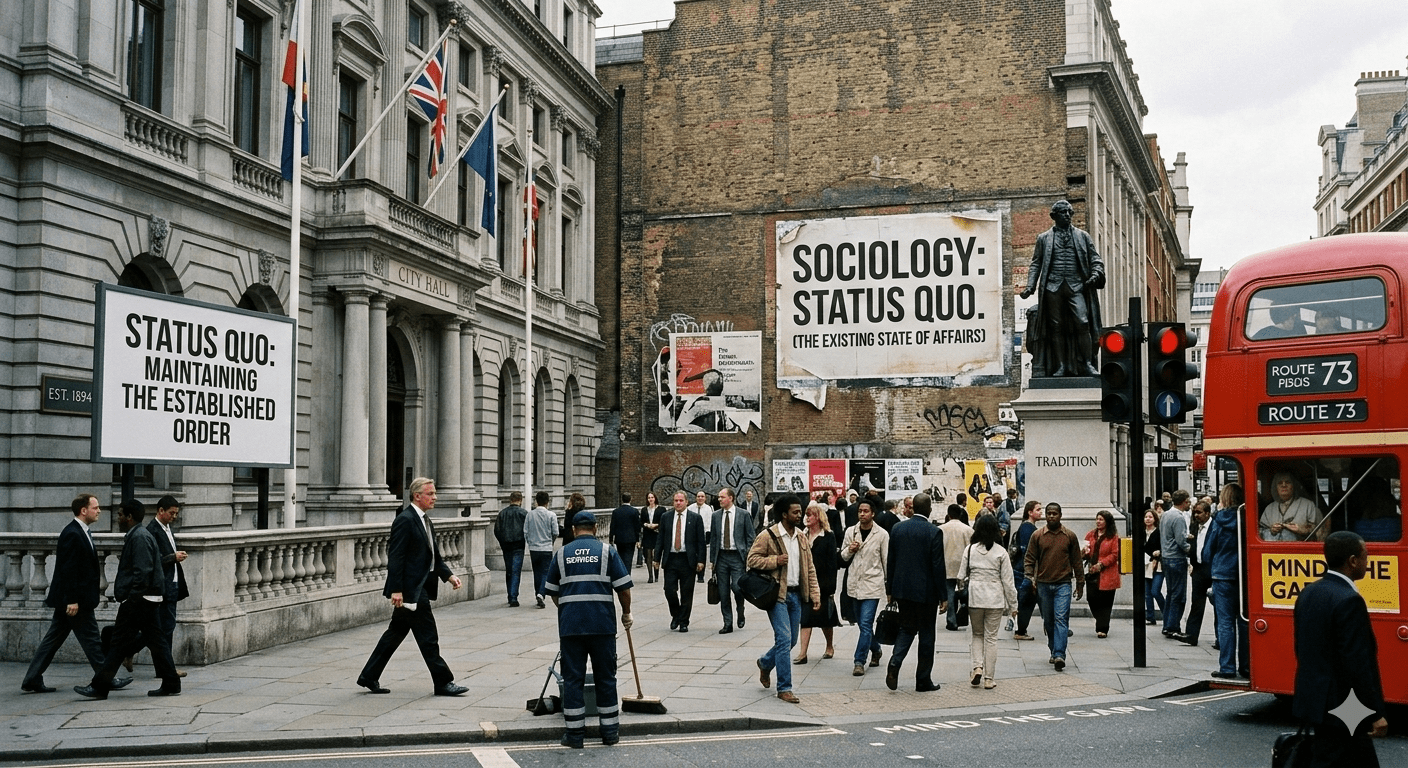
1. Definition: The Authoritative Allocation of Persistence
In the rigorous theoretical landscape of modern social inquiry, the Status Quo is defined as the existing state of affairs—the prevailing social, political, economic, and cultural conditions that characterize a society at a given point in time. Unlike a "snapshot" of the present, the status quo in sociology represents the Institutionalized Stability of a system. It involves the set of norms, power relations, and Social Institutions that are accepted as "natural" or "given" by the majority. Pioneered fundamentally by conflict and functionalist theorists, the study of the status quo is the study of Social Continuity. This definition implies a Duality of Reality: the status quo provides the Order and Predictability required for daily life, but it also acts as a Regulatory Fiction that often masks underlying Structural Violence and inequality.
For a sociologist, the definition of the status quo signifies the investigation of Intersubjective Stability. It involves the belief that society is a Mechanical system of habits that resists change unless acted upon by a significant force. By defining the status quo as the Authoritative Allocation of Normality, the discipline investigate how Collective Conscience is utilized to marginalize Deviance. This successfully transitioned the study of humanity from "history" to a Rationalized Science of structural persistence, providing the Analytical Authority required to distinguish between transitory reforms and the radical Substantive Progress that challenges the core of the system, established through a rigorous internal moral code of Status Consistency.
2. Concept & Background: Social Inertia vs. Transformative Agency
The conceptual background of the Status Quo is rooted in the 19th-century effort to understand the Great Transformation from tradition to modernity. Historically, the status quo was anchored in the Sacred Canopy of religious dogma and hereditary authority. The background represents a fundamental shift in the Theory of Social Order: the realization that the "Social Fact" of stability is not a divine gift but a Human Achievement maintained through socialization and Social Control.
Intellectual history shows that the maintenance of the status quo provided the "Cultural Capital" required for the survival of the National Identity during periods of crisis. This background move the focus of social science toward the study of Social Statics (Comte). Understanding this concept requires recognizing that the status quo is never purely static; it is a state of Dynamic Equilibrium. This perspective established the foundation for Institutionalism, proving that the stability of the Social organism depends on the Authoritative Allocation of Power to those who benefit from the current Economic Mode of Production, established through a rigorous internal moral code of Tradition and Legitimacy.
3. Functionalist Perspective: Parsons and Moving Equilibrium
From the Functionalist perspective, as articulated by Talcott Parsons, the status quo is the primary prerequisite for Social Integration. In his AGIL Schema, the status quo is maintained through Pattern Maintenance (Latency)—the process where values are transmitted and reinforced through the family and education systems.
Parsons introduced the concept of "Moving Equilibrium," suggesting that while the status quo appears stable, it is constantly making minor Homeostatic adjustments to external shocks to prevent Anomie. From this viewpoint, preserving established norms is essential for Social Solidarity. Any radical disruption of the status quo is viewed as a "dysfunction" that threatens the survival of the Social Fabric. Functionalists prove that the stability of the system depends on the Value Consensus, where individuals conform to the status quo because they have internalized the Nomothetic Authority of the state.
4. Conflict Theory: Gramsci and Cultural Hegemony
In contrast to the "consensus" view, Karl Marx and Antonio Gramsci viewed the status quo as a Hegemonic Mask. Marx argued that "the ideas of the ruling class are in every epoch the ruling ideas." For Marxists, the status quo is the Structural Violence of the Bourgeoisie protecting their property rights.
Antonio Gramsci radicalized this through his theory of Cultural Hegemony. He argued that the ruling class maintains the status quo not just through force (The State), but through Civil Society (schools, churches, media). By manufacturing the spontaneous consent of the Proletariat, the elite ensure that the current status quo is seen as "Common Sense." This critique reveals that the Authoritative Allocation of meaning is the most powerful tool of Social Control. For critical theorists, the struggle for Social Justice is essentially a Counter-Hegemonic struggle to dismantle the "False Consciousness" that preserves the exploitative status quo.
6. Indian Contextualization: Tradition, Caste, and Rupture (Paper II)
In Indian Society, the status quo is characterized by the Synthesis of Graded Inequality and modern democracy. Traditionally, the Caste System and Patriarchy formed an immutable status quo based on the ritual logic of Purity and Pollution. This status quo was the physical manifestation of Structural Violence.
However, the Constitution of India acted as a "Revolutionary Disruptor" of this traditional status quo. B.R. Ambedkar utilized Constitutional Morality to challenge the Hegemony of the twice-born. Post-independence India illustrates a Conflict of Realities: while the state aims for Substantive Equality, traditional institutions utilize Social Closure (Weber) to maintain their privilege. The 1991 LPG reforms triggered a radical shift in the economic status quo, leading to Urbanization and the rise of a new consumerist middle class. This proves that in the Indian Context, the status quo is a Synthetic process, where the "Sacred" tradition and "Secular" progress exist in a complex, reflexive National Identity.
7. Global Statistics: The Quantified Status Quo
The cost of maintaining a stagnant status quo is visible in concrete socioeconomic metrics globally:
- Global Wealth Inequality (Oxfam 2024): Since 2020, the richest 1% have captured nearly two-thirds of all new wealth. This persistence of wealth concentration is a diachronic outcome of an economic status quo that prioritizes Capital over Labor.
- Gender Pay Gap: According to the World Economic Forum (2023), it will take 131 years to reach full parity at the current rate of change. This illustrates the Social Inertia of patriarchal status quo in the Authoritative Value of labor.
- Indian Poverty (NFHS-5): While multidimensional poverty has dropped from 24.8% to 14.9%, the status quo of Regional Disparity remains, with states like Bihar showing significantly higher deprivation than Kerala, proving that the National Identity is spatially uneven.
8. Case Study: The US Civil Rights Movement
The Civil Rights Movement (1954-1968) serves as the definitive case study for the Substantive Disruption of a racialized status quo. For nearly a century, "Jim Crow" laws formed a stable status quo of Institutionalized Stigma.
Sociologically, this case study reveals the Transformative Power of Collective Effervescence. Through Democratic Mobilization (marches, boycotts), the Subaltern groups unmasked the Pathological nature of the status quo. It proved that Knowledge-Power could be reclaimed by those who are excluded. The movement forced the Bureaucratic Rationalization of civil rights, proving that a total reconfiguration of the Social Contract is possible when individuals move beyond "Mechanical Obedience" toward Emancipatory Agency. For sociologists, this remains the blueprint for identifying how Structural Shifts lead to a more rational and equitable social existence.
Mains Mastery Dashboard
The Status Quo represents the epistemological and structural core of modern social inquiry, acting as the primary mechanism for the Institutionalization of Society. Rather than a neutral state, it is a manufactured achievement that serves specific interests. As articulated by Antonio Gramsci, the status quo is maintained through "Cultural Hegemony," where the ruling class utilizes Civil Society—schools, media, and religion—to win the spontaneous consent of the masses. By transforming elite interests into a non-reflexive "Common Sense," hegemony ensures that the Collective Conscience remains aligned with the existing Economic Mode of Production, making any challenge to the status quo appear irrational or "deviant." This successfully moved the focus of the discipline toward Ideological Hegemony as the primary engine of Social Control.
In the Indian context, the resilience of the Caste status quo serves as a quintessential example of this logic. Despite the Constitutional Morality of the state, the traditional status quo of Graded Inequality persists through Social Closure (Weber) and endogamy. The "Sacred" hierarchy of Caste is a Regulatory Fiction that has adapted to the "Secular" requirements of modern Democratic Mobilization, resulting in what Yogendra Singh termed the "Modernization of Tradition." The elite utilize Structural Violence and Institutionalized Stigma to preserve their Authoritative Allocation of social honor and resources. Thus, the status quo in India is a Total Social Fact that acts as a structural barrier to Substantive Equality, proving that the progress of the National Identity is contingent on the continuous dismantling of these internalized hierarchies.
In CONCLUSION, the study of the status quo is a Reflexive Project that remains the prerequisite for Human Liberation. The sustainability of a modern social order depends on its ability to recognize that its most "solid" institutions are actually Human Achievements that can be re-negotiated. Reconciling Knowledge, Power, and Agency in the 21st century requires moving beyond "Mechanical Stability" toward a Deliberative Humanism. By unmasking the Hegemonic forces that treat inequality as a "natural law," sociology ensures that the Social Contract remains an inclusive achievement, proving that the "Rebirth of the Individual" is possible through the collective reclamation of the Social Logic of dignity and Substantive Progress in a globalized world.
Revision Strategy: Keywords
- Homeostasis: The tendency of a social system to re-establish equilibrium (Parsons).
- Cultural Hegemony: Spontaneous consent achieved through controlling ideological institutions (Gramsci).
- Moving Equilibrium: Small, continuous adjustments to maintain structural stability.
- Social Inertia: The resistance of a social system to any change in its state of motion or rest.
- Graded Inequality: Ambedkar’s term for the layered hierarchy of the Indian status quo.
- Counter-Hegemony: The process by which marginalized groups challenge and replace the dominant ideology.

5. Social Change Theory: The Dynamics of Disruption
Social change theory investigates the Forces of Production and cultural shifts that render the status quo obsolete. It identifies three primary disruptors:
This perspective highlights the Transformative Agency of individuals, proving that while the status quo guides behavior, it is also constantly Re-negotiated through Tactical Interactions, reconciling Knowledge, Power, and the Body in a fluid social landscape.