

Subjectivity: The Epistemological Core of Action
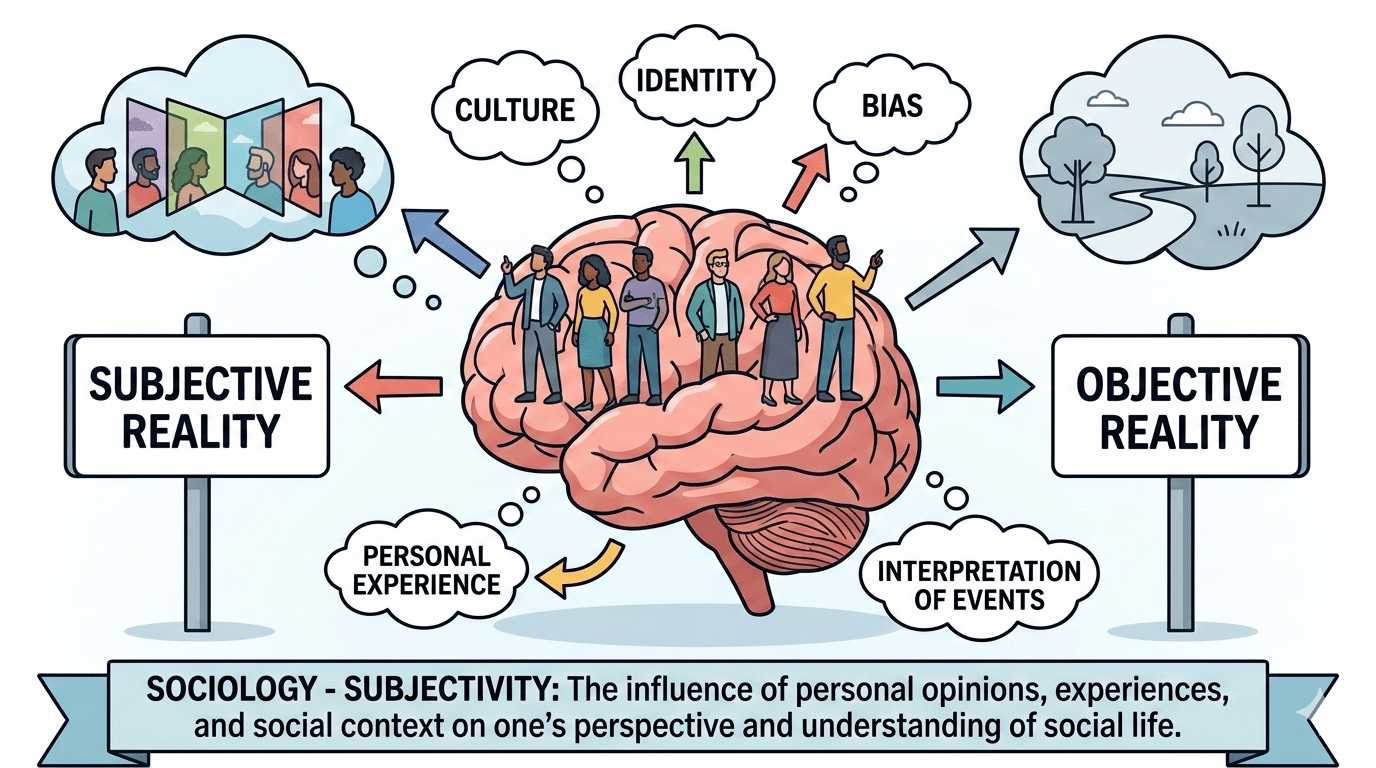
1. Definition: The Intersubjective Reality
In the developmental history of interpretive sociology, Subjectivity is defined as the unique cluster of personal perspectives, emotional states, and internalized cultural meanings that individuals utilize to perceive and interpret their social environment. Unlike the Positivist focus on external, "objective" social facts, subjectivity investigates the "interiority" of human action. It posits that there is no singular, universal reality; rather, reality is a diachronic outcome of intersubjective agreement. This definition implies a radical Epistemological Rupture, transitioning the focus of the discipline from the measurement of external variables to a profound inquiry into the Symbolic Logic that motivates the Individual Agency.
For a sociologist, the definition of subjectivity signifies the study of the Authoritative Allocation of Meaning. It involve the belief that the "Self" is not a passive responder to structural forces but an Active Interpreter. By defining society as a Meaningful Performance, subjectivity investigate how Cultural Norms and individual biographies converge to create specific social behaviors. This successfully transitioned the study of humanity from "mechanical physics" to a Rationalized Science of Interpretation, providing the Analytical Authority required to understand the National Identity as a lived experience rather than a statistical aggregate, established through a rigorous internal moral code of Interpretive Integrity.
2. Concept & Background: The Crisis of the Objective Dream
The conceptual background of Subjectivity is rooted in the late 19th-century reaction against the Mechanical system of classical science. Historically, the "Objective Dream" suggested that society could be mapped with the same precision as the natural world. The background represents a fundamental shift in the Theory of Knowledge: the realization that the observer is always part of the observed.
Intellectual history shows that the rise of subjectivity was catalyzed by Modernization and Secularization, which fragmented the once-unified Sacred Canopy into diverse, competing Lifeworlds. This background moved the focus of social science toward the study of Internalization and the Duality of Reality. Understanding this concept requires recognizing that subjectivity is not "bias" to be eliminated, but "Data" to be analyzed. This perspective established the foundation for Qualitative Research, proving that the stability of the Social organism depends on the individuals' ability to share subjective meanings, established through a rigorous internal moral code of Empathy.
3. Max Weber: Verstehen and the Vocation of Meaning
Max Weber remains the definitive champion of subjectivity in sociology. He argued that social action is distinct from mere behavior because it involves Subjective Meaning (Sinn). Weber introduced Verstehen—empathetic understanding—as the primary methodological prerequisite for social inquiry.
Weber’s analysis traced how the Symbolic Logic of religious beliefs (e.g., the Protestant Ethic) could inadvertently rewrite the Economic Mode of Production. From this perspective, the "spirit" of an age is a subjective achievement. Weber successfully moved the focus of the discipline toward Causal Adequacy, proving that the study of the Social Fabric must include the actor’s intent. His work provides the Nomothetic Authority required to link the individual psyche with the Macroscopic Social Structure, reconciling Knowledge, Power, and the Body through interpretive depth.
4. Alfred Schutz: Phenomenology and the Lifeworld
Alfred Schutz radicalized subjectivity by applying Phenomenology to the social world. He argued that we inhabit a "Lifeworld" (*Lebenswelt*)—a world of taken-for-granted subjective meanings that we share with others through Intersubjectivity.
Schutz's analysis focuses on the "Natural Attitude"—the way we automatically interpret social symbols without conscious thought. From this viewpoint, Social Order is a cognitive achievement of shared subjective types (typifications). This perspective highlights the Duality of Reality: while our experiences are unique, they are structured by the Common-Sense knowledge of our social group. This study confirms that the progress of the Social organism is a diachronic outcome of microscopic negotiations of meaning, providing the Analytical Authority required to navigate a fragmented modern world.
5. Symbolic Interactionism: The Performance of Self
From the Symbolic Interactionist perspective (Mead, Blumer, Goffman), subjectivity is an ongoing Performance. Individuals construct their identities through the exchange of Significant Symbols.
Charles Horton Cooley’s concept of the Looking-Glass Self illustrates that our subjectivity is a reflection of social perception. We construct our Identity based on how we *imagine* others see us. This perspective reveals that "Self" is a Social Construction. Interactionists prove that reality is a Negotiated Order, established through a rigorous internal moral code of Impression Management, where the Authoritative Allocation of Labels dictates the individual’s Life Chances and Subaltern Agency.
6. Critique: The Positivist and Structuralist Challenge
The focus on subjectivity is profoundly challenged by Positivists (Durkheim) and Structuralists (Marx, Althusser). Durkheim argued that "social facts" must be studied as "things," external to individual consciousness. He warned that prioritizing subjectivity would lead to Methodological Anarchy and a loss of Scientific Authority.
Furthermore, Conflict Theorists argue that "Subjective Meaning" is often a Hegemonic Mask of False Consciousness. They posit that the Bourgeoisie utilize ideology to ensure the Proletariat subjectively accepts their own Structural Violence as natural. This critique reveals that the Social system is maintained by the suppression of Individual Agency, proving that the sustainability of the Social Fabric depends on moving beyond the "subjective" toward a Rationalized analysis of power and exploitation.
7. Indian Contextualization: Positionality and the Dalit Voice (Paper II)
In Indian Society, the study of subjectivity is a high-stakes Political site. Traditionally, Indian sociology was dominated by the "Book-View" of Indology, which presented a Brahminical subjective reality as the "Objective" truth of Caste. M.N. Srinivas radicalized the discipline by advocating for the "Field-View"—an empirical study of the subjective lived experiences of village life.
Contemporary Indian sociology emphasizes Positionality. Scholars like Gopal Guru argue that there is a distinct "Dalit Subjectivity" that cannot be captured by upper-caste "objectivity." This involves a Subaltern Agency that reclaims the Authoritative Word from traditional hegemonies. Furthermore, the Communal Identity in India is analyzed as a subjective Social Pathology utilized for Democratic Mobilization. This proves that in the Indian Context, subjectivity is a Synthetic process, resulting in Multiple Modernities where the "Sacred" tradition and "Secular" Constitutional Morality struggle for the soul of the National Identity.
8. Case Study: Weber’s "Verstehen" in Practice
The definitive case study for subjectivity is Max Weber’s study of the Protestant Ethic. Weber did not simply look at economic statistics; he investigated the Subjective Anxiety of Calvinists regarding their salvation.
Sociologically, this study reveals the Transformative Agency of internal meaning. Weber showed that the subjective belief in "Predestination" led to a Rationalized lifestyle of hard work and asceticism, which eventually created Rational Capitalism. This case study confirms that Subjective Realities are the primary drivers of Structural Change. For sociologists, Weber’s method remains the blueprint for identifying how Symbolic Logic becomes a Total Social Fact, reconciling Knowledge, Power, and the Body within a developmental systemic aggregate.
Mains Mastery Dashboard
The concept of Subjectivity represents the epistemological core of modern social inquiry, acting as the primary mechanism for moving beyond the Mechanical Stability of classical science. As articulated by Max Weber, sociology achieves Causal Adequacy only when it integrates the Subjective Meanings that actors assign to their behavior. Through Verstehen, the sociologist unmasks the Symbolic Logic that drives the Individual Agency, moving the study of humanity from "anecdotal observation" to a Rationalized Science of Interpretation. In this view, subjectivity is not a "noise" in the system but the very Social Fact that provides the Authoritative Allocation of meaning to the Social Fabric.
However, the inclusion of subjectivity creates a profound dialectic with Objectivity. Weber resolved this by distinguishing between "Value-Relevance" (choosing a topic based on values) and "Value-Neutrality" (scientific objectivity during research). In the Indian context, this tension is visible in the emergence of Subaltern perspectives. Gopal Guru and other scholars argue that an "Objective" view of the Caste System often erases the Dalit Subjectivity. By prioritizing the lived experience of Structural Violence and Institutionalized Stigma, contemporary sociology achieves a state of Reflexive Objectivity. This transition proves that the National Identity is not a static cage but a diachronic outcome of these diverse subjective narratives, established through Constitutional Morality.
In CONCLUSION, subjectivity is a Total Social Fact that remains the prerequisite for a Humanistic social science. The sustainability of a modern social order depends on its ability to recognize that truth is often Perspective-based. Reconciling Knowledge, Power, and Agency in the 21st century requires moving beyond "Mechanical Neutrality" toward a Reflexive Humanism. Sociology ensures that the study of personal life serves the ends of Human Liberation, proving that the progress of a nation is measured by its capacity to achieve Cognitive Justice—honoring the subjective dignity of the individual in a globalized, fragmented world.
Revision Strategy: Keywords
- Verstehen: Weber’s term for empathetic understanding of subjective meanings.
- Lifeworld: The shared, taken-for-granted subjective world of daily life (Schutz).
- Positionality: How the researcher’s identity influences the interpretation of data.
- Intersubjectivity: The shared social reality created through mutual subjective understanding.
- Reflexivity: The capacity of the researcher to interrogate their own influence on the study.
- Cognitive Justice: The recognition of the diversity of knowledge and subjective truths.