

Synthetic School: Sociology as the General Science
1. Definition: The Authoritative Allocation of Synthesis
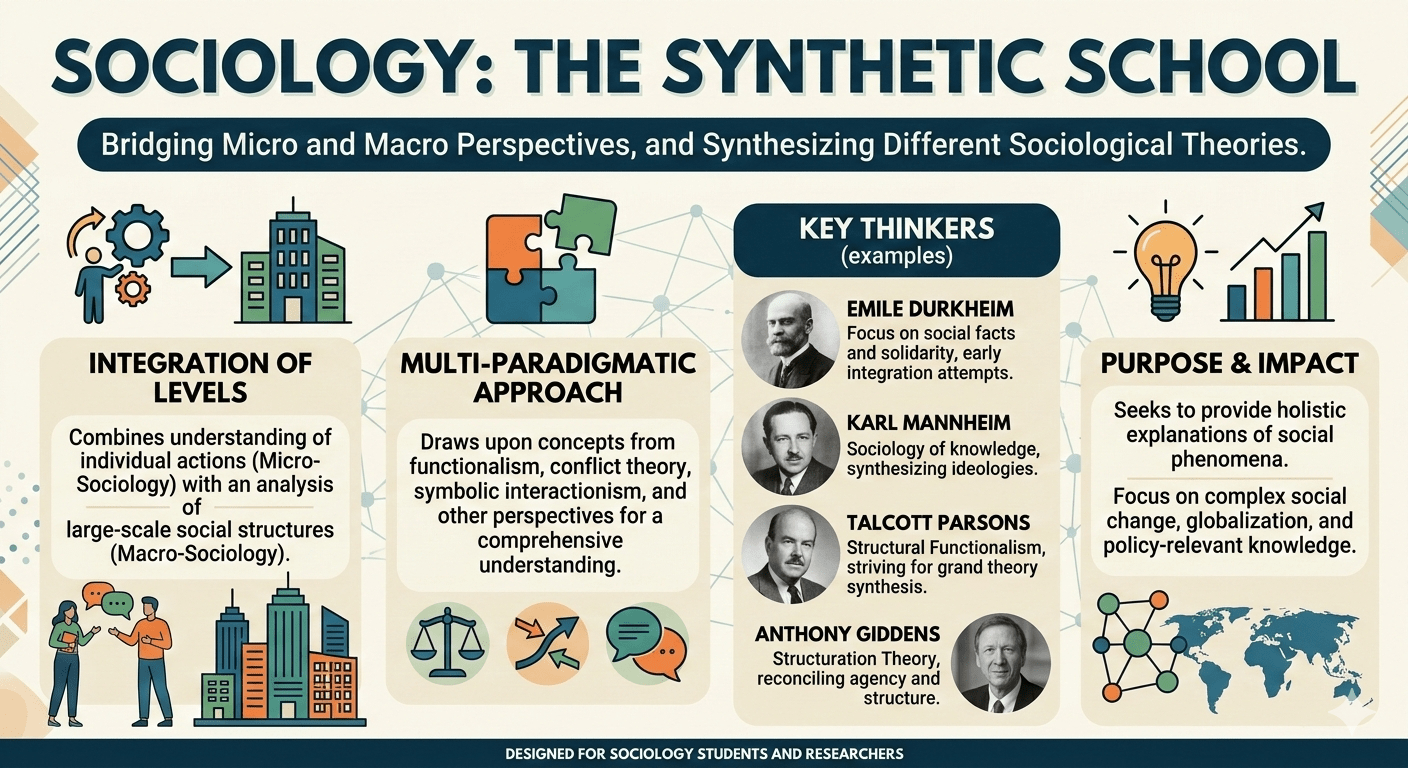
In the foundational architecture of sociological inquiry, the Synthetic School is defined as the theoretical perspective which posits that sociology is a General Science intended to synthesize the findings of specialized social sciences into a holistic understanding of the Social organism. Unlike the Formalistic School (which seeks a narrow, specialized niche), the Synthetic School argues that social phenomena are too interconnected to be studied in isolation. This definition implies an Epistemological Rupture from the idea of "purity" in social science, transitioning the discipline toward a role as the Integrative Fabric of all human knowledge. Pioneered fundamentally by Émile Durkheim, Morris Ginsberg, and Pitirim Sorokin, this school treats society as a "total social fact" that necessitates a multi-dimensional lens.
For a sociologist of this school, the definition signifies the study of the Collective Conscience through the coordination of diverse data. It involve the belief that the "Truth" of society resides in the Synthesis of economic, psychological, and historical insights. By defining sociology as a Generalizing Science, the Synthetic School investigate how social institutions interact as a diachronic whole. This successfully transitioned the study of humanity from "fragmented statistics" to a Rationalized Science of Totality, providing the Analytical Authority required to understand the National Identity as a lived, systemic aggregate rather than a collection of separate behaviors, established through a rigorous internal moral code of Interdisciplinary Integrity.
2. Concept & Background: The Quest for a Unified Science
The conceptual background of the Synthetic School is rooted in the 19th-century vision of Auguste Comte, who viewed sociology as the "Queen of Sciences." Historically, the school emerged as a reaction against the Simmelian effort to limit sociology to the "forms" of interaction. The background represents a fundamental shift in the Theory of Knowledge: the realization that a "social act" (like marriage) is simultaneously an economic transaction, a psychological bond, and a legal contract.
Intellectual history shows that the Synthetic School was catalyzed by the Modernization process, which increased the complexity and Moral Density of the social world. This background moved the focus of social science toward the study of Functional Integration. Understanding this concept requires recognizing that sociology acts as the Theoretical Foundation for other sciences. This perspective established the foundation for General Systems Theory, proving that the stability of the Social organism depends on the Value Consensus mediated across all its subsystems, established through a rigorous internal moral code of Holism, providing the Analytical Authority required to bridge the gap between Knowledge, Power, and the Body.
3. Émile Durkheim: The Three-Fold Synthesis
Émile Durkheim provided the definitive methodological anchor for the Synthetic School. He argued that sociology is not a "super-science" but a Synthesis of specialized social sciences. In his journal Année Sociologique, he classified sociological inquiry into three essential branches that orchestrate the Social Fabric:
- Social Morphology: The study of the "Material Substrate"—population size, density, and spatial distribution (Urbanization).
- Social Physiology: The study of the "Organs" of society—religion, law, language, and the economy—as they function in a Mechanical system of interdependence.
- General Sociology: The "Philosophical" branch that discovers the Nomothetic Laws underlying the specific social facts identified in the first two branches.
Durkheim’s analysis proves that the "utility" of sociology is its ability to find the common thread in diverse Social Facts. This perspective highlights the Duality of Authority, proving that while we study "Economics" or "Law" separately, they are all manifestations of a single Collective Conscience.
4. Pitirim Sorokin: The 'N+1' Generalizing Science
Pitirim Sorokin radicalized the synthetic vision through his "N+1 Theory." He argued that if there are N specialized social sciences (economics, politics, ethics, etc.), sociology is the $(N+1)^{th}$ science that studies the General Characteristics common to all of them.
Sorokin utilized the formula of Social Space to prove that every social phenomenon has components that belong to multiple disciplines. From this viewpoint, Sociology is the study of the Symbolic Logic that binds the individual agency to the macroscopic social structure. His analysis confirms that the progress of the Social organism is a diachronic outcome of these interconnected variables, reconciling Knowledge, Power, and the individual within a universal systemic aggregate.
5. Morris Ginsberg: The Study of the Whole
Morris Ginsberg, a leading British sociologist, defined the scope of the Synthetic School through four primary tasks: (1) defining the social relations between individuals, (2) classifying different types of social groups, (3) identifying the laws of social change, and (4) discovering the general principles that govern the social life as a whole.
Ginsberg’s analysis focused on the Value Consensus required for social stability. He argued that sociology must act as a Reflexive critique of other sciences, ensuring that they do not lose sight of the Human Dignity inherent in the Social Fabric. This successfully moved the focus of the discipline toward the study of Social Integration, providing the Analytical Authority required to navigate the Anomie of modern industrial society.
Comparative Analysis: Synthetic vs. Formalistic
| Feature | Formalistic School | Synthetic School |
|---|---|---|
| Main Thinkers | George Simmel, Max Weber, Vierkandt | Durkheim, Ginsberg, Hobhouse, Sorokin |
| Scope | Narrow, Specific, Specialized | Broad, General, Holistic |
| Focus | 'Forms' of social interaction | 'Contents' and interconnections |
| Philosophy | Pure science of abstract relations | Applied synthesis of social reality |
6. Indian Contextualization: The Lucknow School (Paper II)
In Indian Society, the Synthetic School found its most vibrant expression in the Lucknow School of Sociology. Radhakamal Mukerjee radicalized the discipline by synthesizing Sociology, Economics, and Ecology. He argued that Indian social life is a "Regional Synthesis" of physical environment and spiritual values.
Furthermore, D.P. Mukerji advocated for a Marxian-Synthetic approach, arguing that Indian sociologists must study Tradition and Modernity as an integrated dialectic. Contemporary India illustrates the Politicization of Synthesis, where the "Digital India" plan is analyzed as a synthetic project of Technology and Governance. This proves that in the Indian Context, the Synthetic School is a Democratic Mobilization of knowledge, used for Substantive Progress and the reclamation of Subaltern Agency against the Structural Violence of traditional hierarchies, established through Constitutional Morality.
7. Case Study: Durkheim’s Study on Religion
Émile Durkheim’s 1912 study, The Elementary Forms of Religious Life, serves as the definitive case study for the Synthetic approach. Durkheim did not simply study theology; he synthesized Anthropological data on Australian tribes with Psychological theories of collective behavior.
Sociologically, this case study reveals that religion is a Synthetic fact—it is the Institutionalization of the Collective Conscience. By dividing the world into the Sacred and the Profane, religion orchestrates the Authoritative Allocation of meaning to the entire social organism. This study confirms that Social Solidarity is a diachronic outcome of this synthesis. For sociologists, Durkheim’s work remains the blueprint for identifying how Structural Shifts in Meaning lead to a total reconfiguration of the Social Contract, reconciling Knowledge, Power, and the Body.
Mains Mastery Dashboard
The Synthetic School represents the epistemological and structural core of social inquiry, acting as the primary mechanism for transforming Macroscopic Social Facts into a unified science of the Social organism. As articulated by Émile Durkheim, sociology achieves its scientific status not by isolating its object of study, but by coordinating the findings of Social Morphology and Social Physiology. This shift successfully moved the focus of the discipline from "mechanical fragments" to a profound inquiry into the Social Fabric as a whole. In this view, sociology is the Authoritative Allocation of general meaning to the specific behaviors analyzed by economics, law, and psychology, providing the Analytical Authority required for Rational Social Planning.
In the Indian context, this synthetic lens is essential for deconstructing the Caste System. While a formalist might study Caste merely as a "form" of hierarchy, the Synthetic School—as seen in the work of Radhakamal Mukerjee—treats it as a Pathological Social Construct that integrates ritual status, economic exploitation, and ecological adaptation. This transition proves that Caste is a "Total Social Fact" that cannot be understood through a single lens. By prioritizing a Synthetic process of inquiry, contemporary Indian sociology achieves a state of Reflexive Modernity, where the "Sacred" tradition of Jati is re-evaluated using the "Secular" tools of Democratic Mobilization and Constitutional Morality to achieve Substantive Progress for the Subaltern.
In CONCLUSION, the Synthetic School is a Total Social Fact that remains the prerequisite for a Humanistic social science. The sustainability of a modern social order depends on achieving a Dynamic Equilibrium between specialized efficiency and holistic understanding. Reconciling Knowledge, Power, and Agency in the 21st century requires moving beyond "Mechanical Specialization" toward a Reflexive Humanism. Sociology ensures that the study of collective life serves the ends of Human Liberation, proving that the progress of a nation is measured by its capacity to achieve Cognitive Justice—honoring the interconnected dignity of all social relations in a globalized world.
Revision Strategy: Keywords
- General Science: Sociology as the science that synthesizes all social knowledge.
- Social Morphology: The study of the population and spatial structure (Durkheim).
- N+1 Theory: Sorokin's idea that sociology is the generalizing science above all others.
- Collective Conscience: The shared beliefs and values that bind a society (Durkheim).
- Regional Synthesis: Radhakamal Mukerjee's term for the ecology-society link.
- Nomothetic Laws: The general universal rules discovered through social synthesis.